
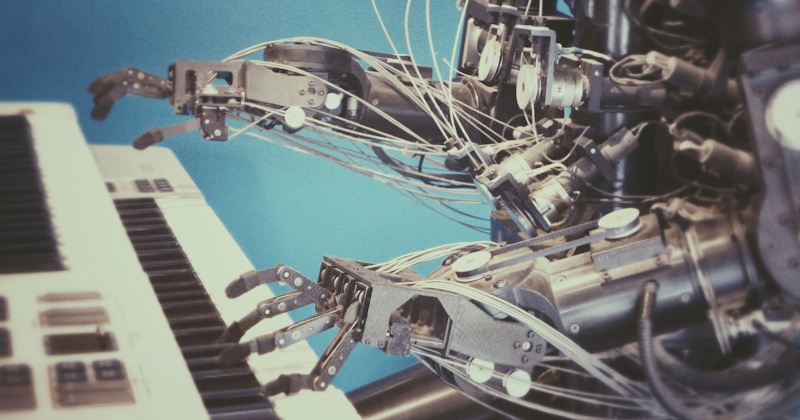
Could AI actually be good for musicians?
Image credit: Possessed Photography
The rise of AI in music has ignited a fierce debate: Creative partner or existential threat? Let’s explore how AI can empower musicians.
The rise of Artificial Intelligence has raised all sorts of questions. Governments scramble to catch up with legislation as AI gets more powerful whilst models use copyrighted material to to train on and produce digital music.
This has reached new heights with the recent success of The Velvet Sundown, an AI-generated band that generated over 400,000 monthly Spotify listeners. At the same time, the first U.S. court decision about AI models training from copyrighted art has closed in favour of the AI company.
However, as the narrative has so quickly (and understandably) become about the threat that AI poses to creatives, we must ask if there are any potentially positive relationships between artists and AI. Without downplaying the concerns or threat of AI, we can certainly explore the ways in which artificial intelligence actually empowers artists rather than threatens them.
How AI can improve and streamline the musicmaking process
Mixing and Mastering
Advances in technology and equipment have meant that most people can now record and produce music from the comfort of their homes. This means that creating music has never been more widely possible. Plus, thanks to services like RouteNote it is easier than ever for artists to both create and release music worldwide.
However, that doesn’t mean that suddenly every musician has the skills to produce and polish their music to the standard they’d like. That’s where AI can come in, with some tools able to analyse audio and apply mixing and mastering techniques automatically. Tools like Dolby Track Mastering and LANDR offer automatic track mastering tools.
AI mastering isn’t always perfect, but it can significantly improve your mix if you don’t know how to do it yourself. As AI advances, so too should AI mixing tools to bring better results and more customisability to give artists some power over how they want the mix to sound.
Stem Separation
A number of AI tools are now capable of detecting the different elements within a song. That allows the AI to then extract those elements, for example it can isolate vocals or certain instruments so that you have just that part of the track.
This can be a major benefit for sampling, extracting just the parts you want or remixing certain elements. It can even be a great tool to help break down a track and how its different parts work to learn from it.
This isn’t as ideal as having the original stem files, as the AI is extracting the audio elements. This means that noise from other sections can leak in or frequencies from the extracted track can get lost. However, it’s already very good and most of its inadequacies are lost once placed into a mix with other elements around it.
Popular tools include LALAL.AI and Moises.ai.
Sample Management
File management can help your workflow so much, but it’s uninspiring. While file management can significantly improve your workflow, the process of manually sorting and navigating samples can be uninspiring and even kill your artistic flow.
AI is being used more and more to detect sample types and automatically filter them into easily browsed folders, categories, and tags. Look at Ableton, who integrated automatic sample-tagging into their acclaimed DAW late last year.
There are a number of AI apps and software for helping sort samples, meaning it’s easier to simply browse and create in the moment.
How AI could help to spark human creativity
Finding Inspiration
Finding inspiration as a creative can be difficult. Oftentimes, it is simply starting that presents the biggest blocker to creation. There are lots of exercises to help you to find inspiration when it seems there is none – you can check them out in our songwriting guide.
AI presents a really easy sounding board, a bit like brainstorming and seeing what sticks. Ask it to give you prompts, or even to write its own lyrics or present song ideas. It may feel untruthful, but what matters is what you then do with those ideas.
The AI isn’t there to create your song in this scenario, it is there to spark the idea in you that you jump off from to build into music. Use it as inspiration to simply kickstart a new idea that is then developed from your own creativity and talent.
For lyrics you can simply speak to chatbots like Google Gemini and ChatGPT to see what they say and if anything lights a fire in you. For some melodic inspiration, tools like AIVA and Soundraw can provide musical ideas with tweakable parameters.
Building the Band
It can sadly feel like a big blocker when you’re a musician who can’t find people to play with. Virtual players can help musicians build upon their songs in the areas they aren’t so confident in.
For example, say you’re a guitarist and vocalist. You’re home recording your songs and you’ve laid down some really nice guitar tracks, the vocals are there, and your transferrable guitar skills mean you’ve got a bassline – but you really need some drums. A virtual player gives that musician the chance to complete their sound if they don’t have access to a drummer or drum recording possibilities.
Most virtual players allow control over their dynamics so that musicians can still input their own creative force upon the final sound. You can get great results from programs like EZ Drummer or Apple’s session players. Many of the latest AI session tools can analyse your recordings to play in a fitting style.
While recording with AI ‘players’ may raise eyebrows, for musicians who need to complete their mix but lack the personnel or resources, it can help break limitations for smaller artists.
Conclusion on concerns
None of this potential is meant to downplay the legitimate concerns, simply to show that AI can also empower musicians when in the right hands and used correctly. Even before AI, we have come to an interesting place in which independent musicians have more opportunities than ever.
The proliferation of music potential thanks to accessible music recording tools, distribution, and digital music platforms has opened up music careers for artists over the world. That has opened up more opportunities than ever, but also introduced new difficulties like increased competition and an attention economy.
Artificial Intelligence presents the latest major development to musicians’ lives, offering similar potential for huge benefits and extra difficulties. As the development of AI tech is inevitable, it’s important to place emphasis on the positive effects of it so that efforts for advancement are placed in the right direction.
There is an argument for a “human-in-the-loop” philosophy, in which AI acts as an empowering assistant rather than any form of human replacement. But fully AI content is a different kettle of fish, and as of yet we don’t have systems that function with that in mind.
For example, simply tagging AI-produced content online would both allow creative exploration with AI music whilst ensuring that listeners know what they’re listening to. Their also must be protections for artists’ content, allowing artists to consent or not to having their creative works used in training and compensation when their rights are violated.
AI producers should not be able to illegally use copyrighted content, to replicate artists’ sound without their consent, or to take away revenue from hard-working, human artists. But deeper questions remain regarding the extent to which we should integrate AI into the music we create.
The music industry isn’t remaining quiet about the spread of AI into the music industry. However, as governments scramble to keep up with fast-evolving technology, it is clear that politicians often don’t understand what musician’s are demanding in protection or why.
What do you think? Leave us a comment below explaining how you feel about AI tools and where you think the line should be drawn.