
How are artists using AI to shape music?
A new study from Stability AI shows artists are embracing AI as a creative partner, not a replacement.
For artists, AI is increasingly becoming a tool that can’t be ignored. Now, Stability AI has researched how exactly artists are using it. The paper analyzed 337 AI-related music works, and left out casual creators who use AI to wholly produce entire tracks from AI music generators like Suno and Udio. Instead, it focuses on how professional artists are really using AI in the music industry.
So, what did the study find?
Most are using AI as an assistant in their creative process, rather than entirely relying on AI. Think lyric brainstorming, sound design, or quick co-composition ideas. That way, artists are still keeping creative control of their music, but let AI help in the background.
Of course, this isn’t the same for all artists. Some are going a step further by training AI models on their voice to expand the creative possibilities of their music, such as “Holly Herndon, Grimes, and Sevdaliza”.
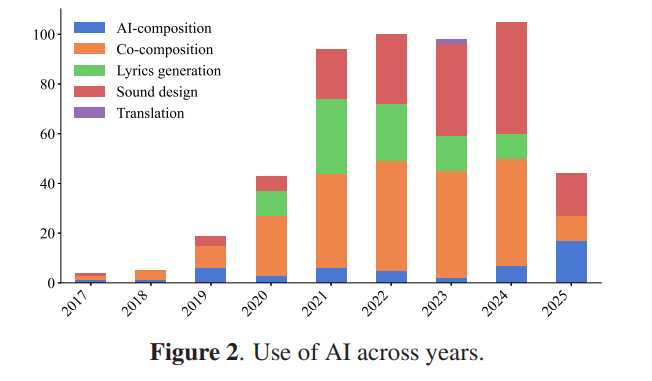
The study also highlighted several interesting ways that AI is pushing the boundaries of innovation within music:
- Multilingual releases: AI is opening up global audiences by making it easier to translate vocals into different languages. Just last year, we saw Universal Music translate Brenda Lee’s “Rockin’ Around The Christmas Tree” into Spanish thanks to AI.
- Restoring voices: AI is also helping to bring old recordings back to life, or help those artists who had previously lost their voice. For example, Paul McCartney used AI to restore John Lennon vocals from an old demo for The Beatles “Now and Then” track which ended up winning a Grammy for Best Rock Performance.
- Genre experimentation: AI is helping artists push genre boundaries. Thanks to AI, artists can blend styles and create new sounds in ways that were previously time-consuming for artists to learn.
“Before, musicians had to dedicate years to learn a specific genre. Now, AI can blend and produce music in multiple (and potentially new) genres.”
What’s clear is that professional artists are the ones steering the technology, using it to enhance their creative output. They’re not solely relying on it to create music.
Pushback and parallels
Not everyone is on board with AI. Legal and ethical debates continue to swirl around AI in music, while some are concerned with the flood of AI-generated music on streaming platforms. Just think of the uproar surrounding AI-band The Velvet Sundown who were racking up millions of streams on Spotify recently.
But this kind of pushback isn’t new. Stability AI compares today’s AI pushback to previous technological innovations that eventually became industry staples and helped to shape genres. It references auto-tune, and sampling, as well as more basic advancements such as the introduction of iron frames in pianos, and amplifiers. All of which faced resistance when they were first introduced.
“These cases underscore the evolving nature of artistic evaluation, where initial skepticism can transform into historical validation and cultural significance… parallels with past narratives showcase that current trends and cultural pushback are not new.”
So what does this all mean?
Well, it’s clear that AI is here, and it likely isn’t going anywhere fast. Right now, artists are using it to boost creativity, not replace it- at least when it comes to professional artists.
While it has the potential to redefine genres, impact pop music, and shape culture, the scale at which it may happen still remains uncertain.
If you’re an artist looking to use AI in your creative process, here are some blogs you may find useful: