

80% of listeners want AI music labeled, new Deezer study reveals
A new global survey from Deezer and Ipsos shows growing demand for AI transparency, falling belief in AI’s future popularity, and a clear message for independent artists.
AI has dominated music industry conversations over the past couple of years, with streaming platforms receiving tens of thousands of artificial uploads every single day. Now, Deezer has released its second annual global survey on AI music, carried out by Ipsos across 9,000 listeners in eight countries.
The findings offer a revealing snapshot of how streaming habits are shifting in 2026, and they carry plenty of good news for human creators.
Key findings from the 2026 Deezer and Ipsos AI survey
If you’ve been wondering how music fans actually feel about the flood of AI tracks hitting streaming services, the numbers speak for themselves:
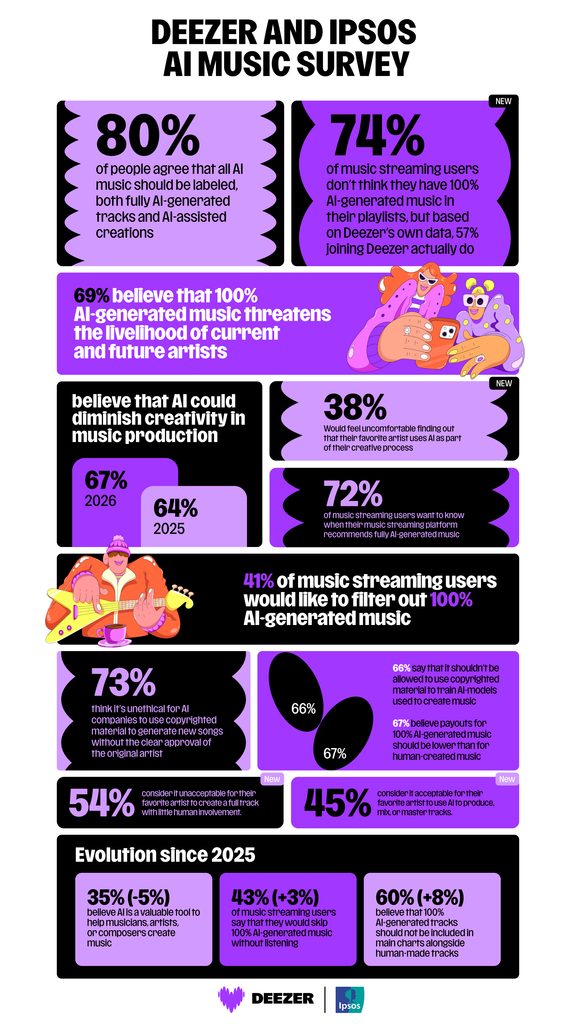
- 80% want clear labels: Four in five respondents agree that all AI music, both 100% AI-generated tracks and AI-assisted creations, should be clearly labeled for listeners.
- A massive playlist blind spot: Nearly three-quarters (74%) of streaming users assumed their playlists were completely free of 100% AI-generated music. However, Deezer’s internal data shows that nearly 57% of over 53,000 users switching from other platforms in October already had at least one fully AI-generated track sitting in their library.
- Hype around AI popularity is cooling: Belief that 100% AI-generated music will become popular in the future dropped across every single surveyed country compared to 2025. In the US, optimism fell sharply from 60% down to 41%, while the UK dropped from 49% to 37%.
- Listeners want AI out of the charts: Six in ten (60%) respondents say 100% AI-generated songs shouldn’t appear in main charts alongside human-made music—up 8 percentage points from last year.
- Fair pay and ethics matter: 69% of listeners believe fully AI-generated music threatens artists’ livelihoods, 67% feel AI tracks should earn lower royalty payouts than human music, and 73% think training AI on copyrighted music without clear artist approval is unethical.
Interestingly, listeners draw a clear line between machine-made songs and human-led production. While 54% say it’s unacceptable for their favourite artist to release a full track with little human involvement, 45% are totally fine with artists using AI tools to help produce, mix, or master their tracks.
The wider picture: Streaming fraud and industry pushback
Deezer’s survey lands amid a broader industry reckoning over how generative AI is treated on streaming platforms.
Since rolling out its patented AI detection tech in 2025, Deezer has reported receiving roughly 90,000 fully AI-generated tracks every single day, accounting for over half of daily uploads on peak days. Even more tellingly, Deezer found that up to 85% of streams on fully AI-generated tracks in 2025 were fraudulent. Rather than building real fanbases, bad actors are largely using synthetic tracks to game algorithms and dilute the royalty pool.
To combat this, Deezer already strips detected AI tracks from algorithmic recommendations and editorial playlists, and plans to launch a user toggle before the end of 2026 allowing fans to filter out AI music completely. Meanwhile, major industry bodies like the IFPI and RIAA have also been pushing for stricter chart rules and clearer standards distinguishing between “AI-generated” and “AI-assisted” recordings.
What this means for independent artists and labels
For independent musicians, producers, and labels, the takeaway from Deezer’s study is encouraging: audiences still crave authentic, human-made music. The novelty of purely AI-generated tracks is wearing off, and listeners actively want tools to avoid them.
Here is how you can put these insights into practice:
- Keep human creativity front and centre: Using AI-powered mastering, stem separation, or mixing tools to speed up your workflow won’t alienate your audience, but just make sure you remain in the creative driving seat.
- Be transparent and check your metadata: As platforms tighten rules around AI disclosure and licensing, always ensure your release metadata is accurate and that any assistive tools you use are properly licensed for commercial release.
- Focus on real fan connection: Algorithms can be gamed, but genuine community can’t. Lean into storytelling, behind-the-scenes content, and consistent releases to stand out in a crowded market.
Getting your authentic, human-made music in front of real listeners starts with distribution. With RouteNote, you can distribute unlimited tracks to Deezer and all major streaming platforms worldwide for free.
Sign up to RouteNote today to start sharing your music with the world.