
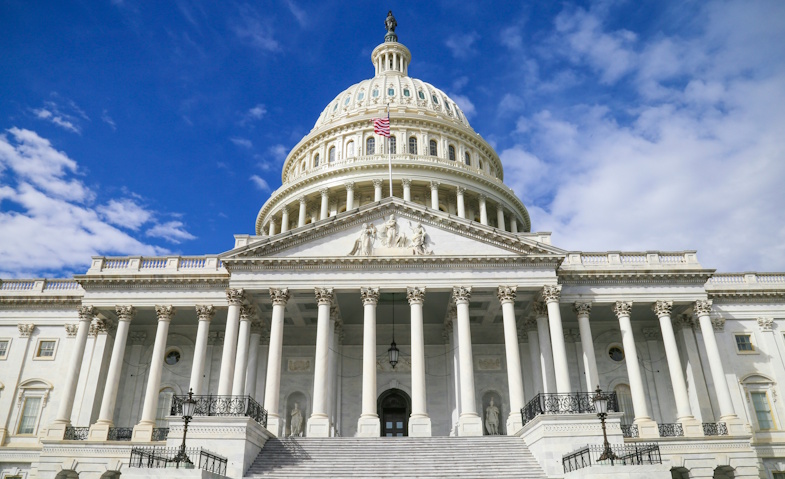
A musician’s guide to America’s AI Action Plan
Image credit: Louis Velazquez
The White House have unveiled a 30-page document on AI development in the U.S., here’s what creators and musician’s need to know.
The landscape of artificial intelligence is moving at lightning speed, and governments are racing to keep up. This month, the White House released a new document, “Winning the Race: America’s AI Action Plan,” outlining a bold and aggressive strategy for the United States.
It comes at a poignant time after President Trump announced support for investment in energy infrastructure that will directly power advancing AI and tech companies in the U.S.. It also comes the same week that two U.S. senators put forward a bill to fast-track legal protections for artists against AI training.
The plan’s core message is clear: achieve global dominance in AI by accelerating innovation, building massive infrastructure, and getting out of the private sector’s way. It marks a significant shift from previous policies, prioritizing deregulation to “win this race.”
But what does a high-level geopolitical strategy mean for the independent musician, producer, or creator? We’ve read through the plan to pull out the key details that will directly impact your work.
The Big Picture: An “innovation first” approach
The central theme of the AI Action Plan is removing barriers to innovation. The document argues that “bureaucratic red tape” and “onerous regulation” hinder America’s ability to compete on a global scale. In its first days, the new administration rescinded the previous one’s Executive Order on AI, signaling a clear shift away from regulatory guardrails and towards unencumbered development.
For creators, this philosophy is a double-edged sword. On one hand, it could lead to an explosion of new, powerful, and accessible AI tools. On the other, it places the responsibility for ethical development and risk management squarely on the shoulders of the tech companies building the AI.
Key Takeaways for Musicians and Creators
While much of the plan focuses on semiconductors, energy grids, and international diplomacy, several sections have direct relevance for the creative community.
1. The Fight Against Deepfakes Gets Official Support
One of the biggest fears for artists is having their voice or likeness stolen by malicious deepfakes. The Action Plan acknowledges this threat and outlines concrete steps to combat it in the legal system.
- Building on the TAKE IT DOWN Act: The plan references President Trump signing the TAKE IT DOWN Act to protect against sexually explicit deepfakes and notes that more action is needed.
- Developing Forensic Tools: It directs the National Institute of Standards and Technology (NIST) to develop its “Guardians of Forensic Evidence” program. This aims to create reliable tools to detect AI-generated media, which could be crucial for proving fraud or defamation in court.
This is a clear signal that the government is taking the threat of synthetic media seriously, which is a major positive for artists seeking to protect their identity.
2. A Push for Open-Source and Open-Weight AI
The plan strongly encourages the development of open-source AI models, which are made freely available for anyone to download and modify.
For the independent music community, this is fantastic news. Open-source models level the playing field, allowing smaller developers and even individual artists to build custom tools without being dependent on large, closed-off systems from major tech companies. This could lead to more innovative, niche, and affordable AI music applications, from unique vocal synthesizers to personalised mixing assistants.
3. A New Stance on AI Content and “Bias”
The plan takes a strong ideological position on the content of AI models. It calls for AI systems to be “free from ideological bias” and to pursue “objective truth rather than social engineering agendas.”
To achieve this, the plan recommends revising the NIST AI Risk Management Framework to eliminate references to misinformation, Diversity, Equity, and Inclusion (DEI), and climate change. This represents a significant policy change, aiming to ensure that AI tools procured by the government are neutral and do not reflect specific social viewpoints.
4. Help with Upskilling: Tax-Free AI Training
The plan recognises that AI will change the nature of work. One practical benefit for creators is a recommended policy action for the Department of the Treasury to clarify that AI skill development programs may qualify as tax-free educational assistance for employees.
In simple terms, this could mean that a record label or employer who pays for you to attend a workshop on AI-powered music production could be reimbursed without it being taxed as income. This is designed to encourage private-sector investment in retraining the workforce.
What the plan doesn’t cover
It’s important to note that such a comprehensive document leaves some major holes in the conversation, particularly as to what concerns creators. There are still major questions over:
- Copyright for AI-generated music
- Defining fair use in AI training or whether artists should be allowed to opt-in or out
- Compensation for artists whose work is used to train AI models
Whilst dicsussions are being had here, like Senators Blumenthal and Hawley’s proposed AI Accountability and Personal Data Protection Act, AI technology is moving fast and governments need to act fast to truly protect artists who feel their livelihoods are in question.
Particularly as the U.S. government show clear intentions to rapidly invest in AI, creators need clarity. We will stay tuned to the latest news across AI legislation and keep you updated on the RouteNote Blog as and when any news is made.