

Michael Jackson tops Forbes’ 2025 list of highest-earning dead musicians
Image credits: Michael Gambriel / Forbes
Ever wondered who are the highest paid dead musicians? Forbes has the answer in its 25th annual list.
Forbes has dropped its 25th annual ‘Highest-Paid Dead Celebrities’ list. This year, the top spot once again belongs to Michael Jackson. It’s the 13th time in the 16 years since his death that MJ has claimed the No.1 spot, proving that even in death, the King of Pop continues to reign supreme.
The music industry dominates the afterlife
Musicians dominate the list this year. In fact, 10 of the top 13 highest-earning dead celebrities are musicians, collectively pulling in a massive $541 million before taxes and fees. Forbes credits this dominance to the “global appeal of pop music” and the likely higher profits that artists receive from their catalog in comparison to actors, for example.
From streaming royalties to publishing rights, the estates of legends like Prince, John Lennon, and Bob Marley continue to cash in. Meanwhile, popular branded physical products like Kobe Bryant’s Nike trainers pull in huge revenues too.
You can make sure your music earns more too. With RouteNote Publishing, you can collect your Performance Royalties, Mechanical Royalties, and Neighbouring Rights from around the world. That way, you can ensure you never miss out on the money your music deserves.
MJ’s everlasting empire
Michael Jackson’s estate pulled in $105 million in 2025 alone, but that’s just one part of a much bigger story. Since his death in 2009, Jackson’s estate has earned an estimated $3.5 billion, making him the highest-earning deceased celebrity since Forbes began tracking posthumous earnings in 2001.
“When it comes to estate earnings… It’s MJ, then an enormous canyon, then everybody else.”
A high-profile estate lawyer told Forbes
For comparison, Elvis Presley’s estate ranks second with $1.2 billion, despite having a 32-year head start. Rather impressively, Elvis has been on the list every year since Forbes began recording the list.
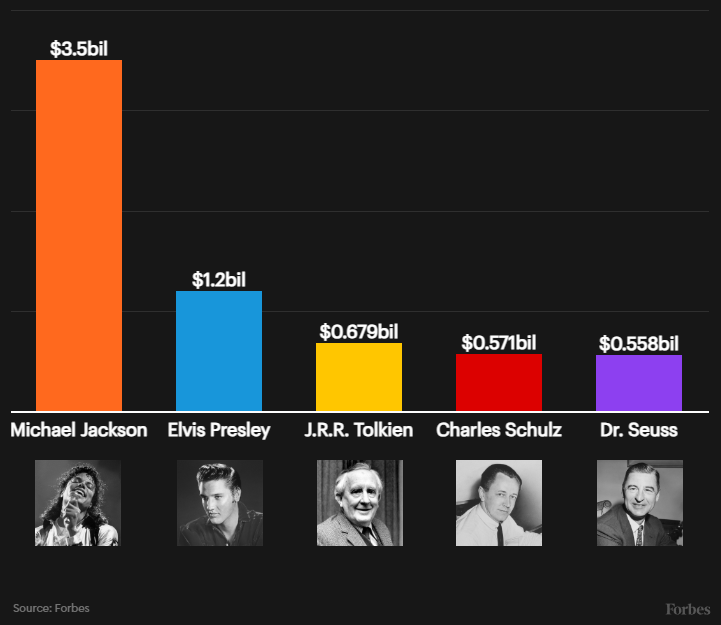
Image credits: Forbes
MJ’s assets haven’t been easy to calculate. However, Forbes breaks it down nicely:
- He owned his own publishing rights and master recordings, with a 50% stake being sold by his estate to Sony last year for $600 million.
- His 1985 purchase of the ATV catalog (which included almost every hit written by John Lennon and Paul McCartney) was later sold to Sony in 2016 for $750 million (worth around $1 billion today).
Since his death, MJ’s music and brand has only grown more, seemingly unaffected by the highly publicized sexual abuse allegations against him. His posthumous accolades include:
- His 2009 concert film, This Is It, grossed $267 million at the box office.
- A 2012 MJ-themed Cirque du Soleil show earned $160 million, becoming that year’s most successful concert and earning MJ’s estate more than any living musician.
- MJ: The Musical has raked in around $300 million in ticket sales across different productions around the world, since its Broadway show debut in 2022.
Who else makes the list?
While Jackson leads by a considerable margin, several other musical icons also made this year’s list, including a few newcomers. Here’s the top 10 earning posthumous musicians of 2025:
- Michael Jackson – $105 million
- Richard Wright (Pink Floyd) – $81 million
- Syd Barrett (Pink Floyd) – $81 million
- The Notorious B.I.G. – $80 million
- Miles Davis – $21 million
- Elvis Presley – $17 million
- Jimmy Buffett – $14 million
- Bob Marley – $13 million
- John Lennon – $12 million
- Prince – $11 million
You can find the whole list on the Forbes website here, alongside more info about how each deceased celebrity is still earning their fortune.
Lessons for today’s artists
If there’s one takeaway from this list, it’s the long-term power of music ownership. The artists dominating the list built empires from owning their master recordings, publishing rights and licensing deals. Even if they’re now being sold for multi-millions, those decisions are still paying off decades later.
Whether you’re an emerging artist or an established act, protecting your rights and managing your catalog can be the key to sustaining income long after the spotlight fades.