
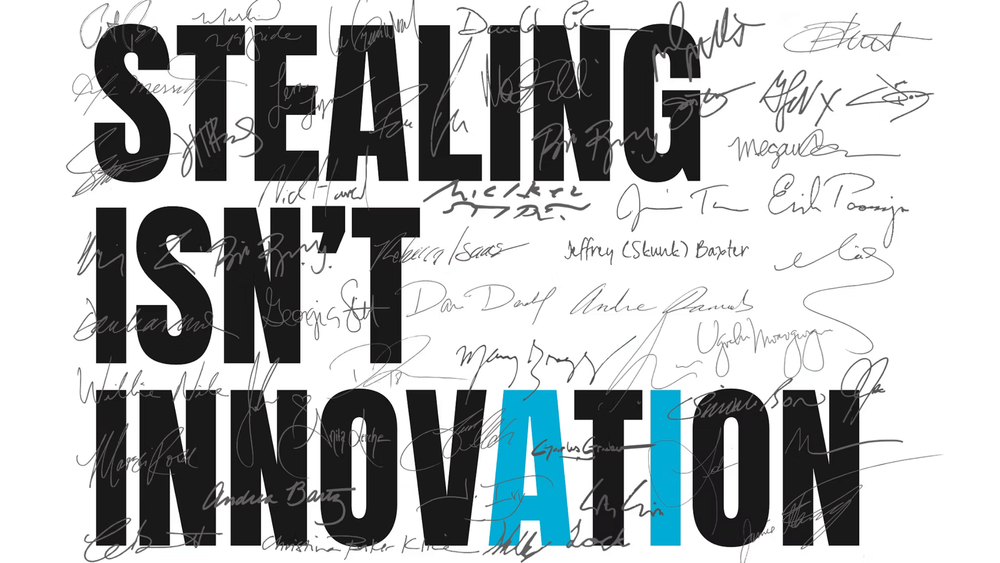
Hundreds of US creators back “Stealing Isn’t Innovation” campaign against AI firms
The campaign calls on the entire AI sector to follow others and secure licenses to train their AI models.
What is the “Stealing Isn’t Innovation” campaign?
The debate around AI copyright just got louder thanks to a new initiative titled “Streaming Isn’t Innovation”. Launched last Thursday by the Human Artist Campaign, the initiative is backed by the Writers Guild of America, the Recording Industry Association of America, alongside around 800 creatives spanning artists, actors, and authors.
Their concern? Despite some AI companies now having licensing agreements with creators and copyright owners, many AI firms still continue to use copyrighted work “without authorization or regard for copyright law” to train their AI models. All while arguing the practice falls under “fair use” in US copyright law.
The campaign’s message is clear though:
“Artists, writers, and creators of all kinds are banding together with a simple message: Stealing our work is not innovation. It’s not progress. It’s theft – plain and simple.”
Support for the campaign spans from well-known actors and musicians to authors, and includes the likes of Scarlett Johansson, Cyndi Lauper, Cate Blanchett, MGMT, and REM. One notable supporter is Breaking Bad creator Vince Gilligan, who described AI as the “world’s most expensive and energy-intensive plagiarism machine” last year.
What the campaign is actually calling for
At the heart of it, the campaign is a reminder. Creatives still want AI tech firms to seek their permission before using their material, and they want compensation for doing so. As some AI companies now have licensing agreements in place, the campaign is now arguing all AI companies to do the same.
The campaign points out that licenses are the “responsible, ethical route to obtaining the content and materials they wish to use.” By obtaining them, everyone can benefit: “it is possible to have it all – we can have advanced rapidly developing AI and ensure creators’ rights are respected”.
The bigger picture
This conversation is clearly relevant for the music industry, where we’ve seen a shift in recent times. At first, AI music generators were embroiled in legal battles, but we’ve now started seeing them sign licensing agreements with record labels. Take Udio who has signed licensing deals with Universal, Warner, and Merlin. Meanwhile, Suno has also signed a deal with Warner that allows artists to opt-in to their work being used and compensating them for it.
That’s where the “Stealing Isn’t Innovation” campaign’s message comes in. The argument isn’t that AI development should stop. It’s that there’s a responsible route. One where music can be used to train systems legally with rights holders in mind, while also helping AI to advance.
A familiar story
The campaign also echoes other high-profile protests we’ve seen around AI and copyright. Last year, artists from the UK raised concerns about proposed changes to copyright law which would require artists to opt out of AI training, rather than protecting them by default. The result? A silent protest album, Is This What We Want?, which later gained a bonus track from Paul McCartney to reinforce its message.
The bottom line
“Stealing Isn’t Innovation” isn’t about rejecting AI entirely, it’s about setting boundaries. AI can still advance, but creators want their rights to be respected and their work to be compensated if they give permission for its use.
So, while some licensing agreements are now in place between AI companies and the creative industries, the campaign’s message is that there’s still more to be done.
Distribute your music to streaming platforms everywhere for free with RouteNote today!