
Suno brings Voices to its mobile app for iOS and Android
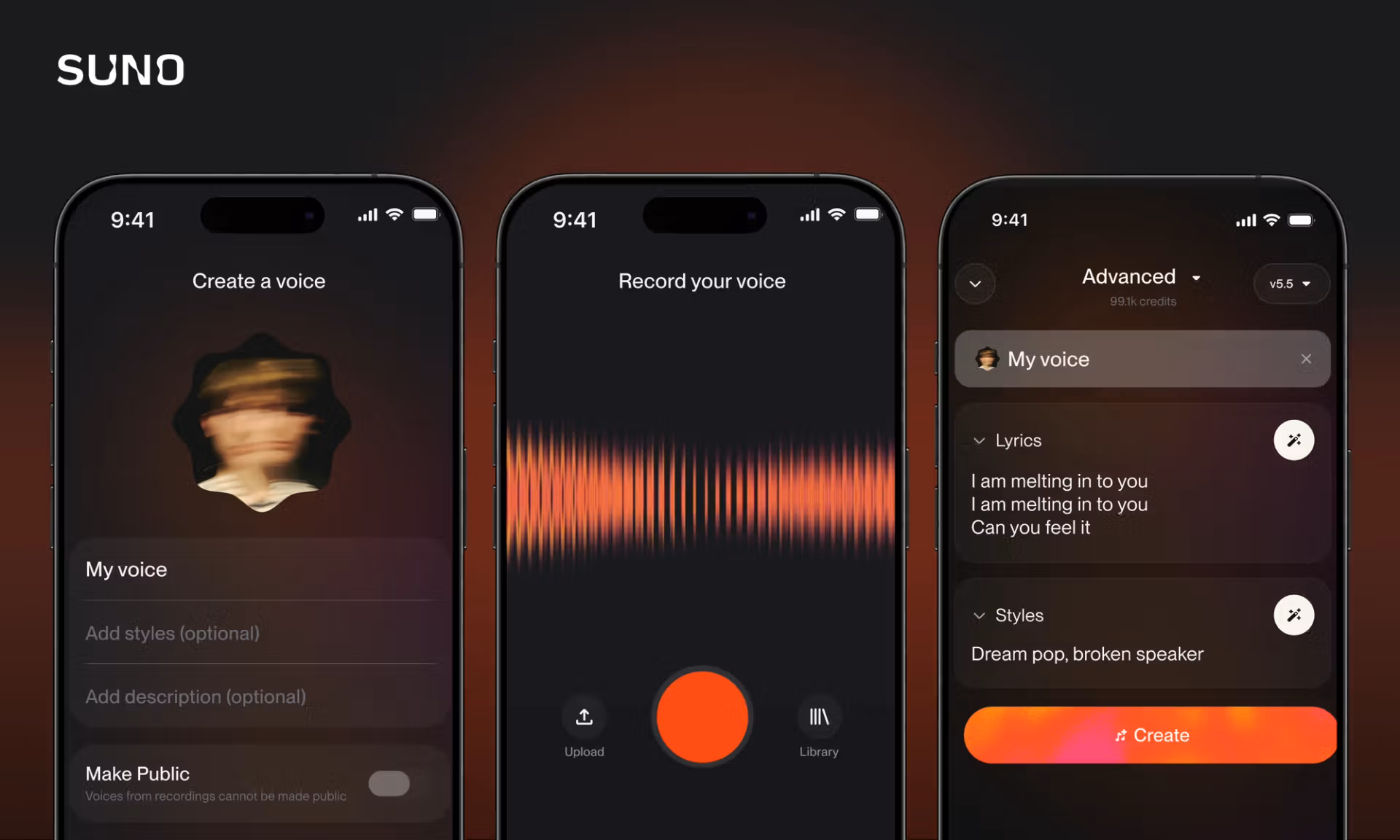
Suno has brought its Voices feature to mobile, letting users record their own voice and use it in AI-generated songs wherever they are.
Suno is making its AI music creation tools a little more personal, and a lot more portable. The AI music platform has brought Voices to its mobile app for both iOS and Android, allowing users to record their own voice directly from their phone and use it across songs they create in Suno.
The feature was previously available on Suno’s web platform, where it launched alongside the company’s v5.5 model in March. Now, users can create with their own voice without needing to sit down at a computer.
How does Suno Voices work?
Suno Voices lets you create a voice profile from your own vocal recording, which can then be used in new AI-generated songs.
Users can access the feature from the Create screen by tapping the ‘+ Voice’ button. You’ll need to record your voice for at least a minute before Suno can use it across your tracks. The feature is now available on both iOS and Android.
There’s also a verification step. When Voices launched with Suno v5.5, the company introduced a process that compares the singing voice provided with a spoken phrase to check that they belong to the same person. Suno says Voices are private, meaning only the creator can use their voice to make new songs.
That is particularly important for a technology capable of reproducing recognisable voices. As Music Ally notes, the verification process is intended to help prevent the feature being used to create deepfake tracks using established musicians’ voices.
For free users, there is a limited version of Voices to try, while Pro and Premier subscribers get unlimited access.
What does Suno Voices mean for independent artists?
The biggest change here isn’t necessarily the technology itself. It’s how easily it can fit into an artist’s existing workflow.
With Voices coming to mobile, Suno is moving further towards something resembling a fuller mobile music studio, where creators can capture ideas such as hummed hooks or voice notes on the go before turning them into music.
Suno Voices could be used to quickly test ideas, experiment with songwriting, build demos or explore arrangements around a recognisable vocal identity.
For independent artists, that’s potentially useful as a songwriting and demo tool. You could capture a vocal idea while you’re away from your studio, experiment with arrangements around it, or use Suno to quickly explore a direction before developing the idea further yourself.
For artists who already use AI as part of their process, moving that capability onto a phone removes another barrier between having an idea and actually trying it.
But the same old advice still applies: the tool is only as useful as the creativity behind it. AI can help you explore an idea quickly, but your songwriting, taste, performance and artistic identity are still what give a release its character.
And if you do turn those experiments into finished tracks, you’ll need a way to get them in front of listeners. Once your music is ready, you can distribute it to major streaming platforms with RouteNote and start building your audience beyond the AI creation platform.
Distribute your music to streaming platforms worldwide for free with RouteNote today.