

Spotify’s biggest hits are getting cleaner: Is this the future of music?
New data shows explicit songs now make up just 13% of Spotify’s Global Top 50. Here’s what’s driving the trend and what independent artists can learn from it.
Just a few years ago, explicit tracks dominated Spotify’s biggest charts. Now, they’re becoming surprisingly rare.
According to reporting from Digital Music News, just 13% of Spotify’s current Global Top 50 tracks carry an explicit label, a dramatic fall from 74% in 2018. That doesn’t necessarily mean artists are censoring themselves.
Instead, it reflects a much bigger shift in the kinds of music listeners are choosing, the genres driving streaming growth, and how Spotify’s audience is evolving.
For independent artists, it’s another reminder that understanding listening behaviour can be just as valuable as following musical trends.
From explicit dominance to just 13%
The data comes from journalist Daniel Parris, whose analysis tracks the percentage of explicit songs appearing in Spotify’s Global Top 50 over several years.
The trend is striking too. After climbing as high as 74% during 2018, explicit songs consistently made up the majority of Spotify’s biggest hits for several years before gradually declining. Today, only 13% of the chart is marked explicit.
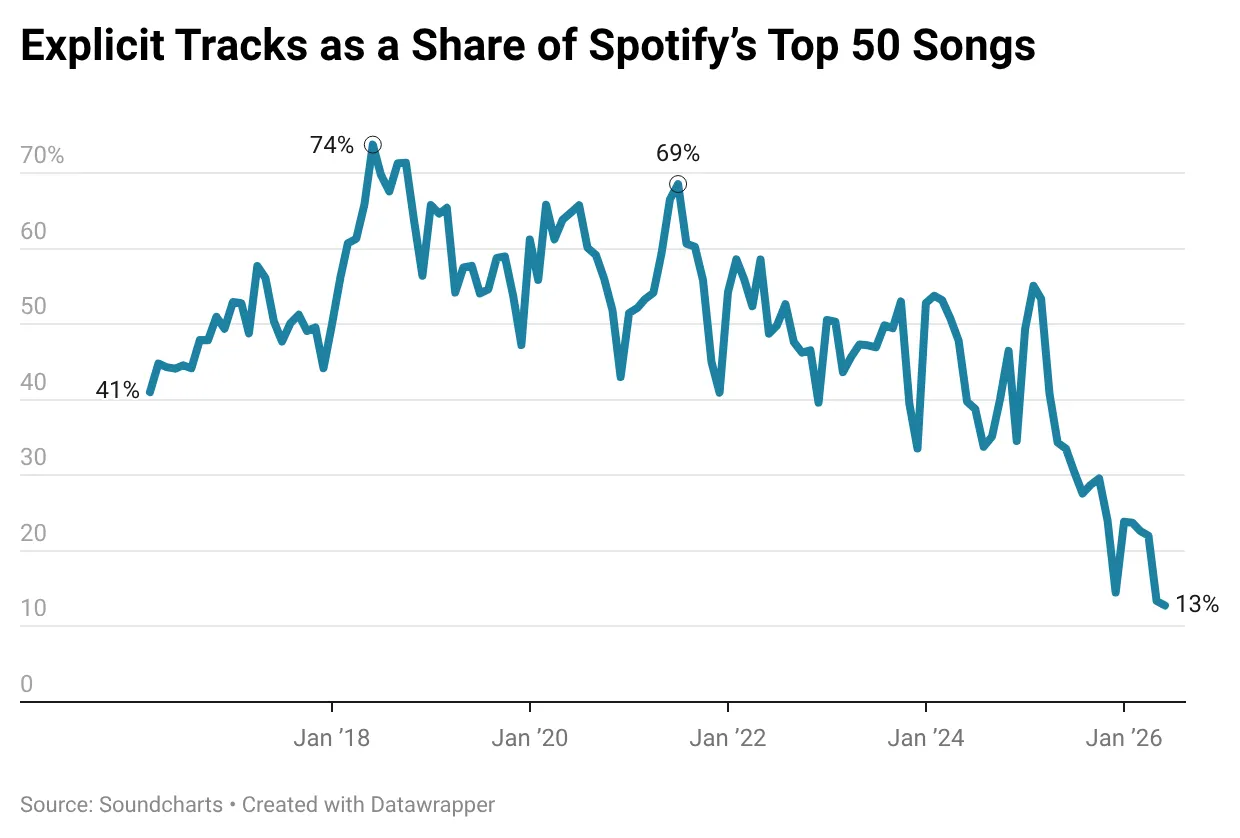
Interestingly, these numbers differ across platforms. Around 36% of Apple Music’s equivalent global chart contains explicit tracks, while Deezer sits much closer to Spotify at around 14%. That suggests this isn’t simply about music becoming “cleaner.” Different streaming platforms are attracting different listening habits.
Why are Spotify’s charts changing?
There isn’t one single explanation, but several wider industry trends appear to be pulling Spotify in this direction.
Catalogue music continues to thrive
Older songs continue finding new audiences through streaming. Whether it’s viral social media moments, film soundtracks, TV shows or major biopics, classic hits are spending more time on modern streaming charts than they once did.
For example, the success of recent Michael Jackson and Bruce Springsteen biopics have seen their tracks gain momentum years after release. Many of these songs were originally written with radio in mind, making them far less likely to contain explicit lyrics.
We’ve also seen nostalgia become one of streaming’s biggest drivers over the past few years. Older hits are no longer confined to “classic” playlists, they’re regularly competing with brand new releases for streams.
Hip-hop isn’t dominating like it once did
For much of the last decade, hip-hop was the defining force behind streaming culture. Because many of the genre’s biggest releases carried explicit labels, Spotify’s charts naturally reflected that. Today, the picture looks different.
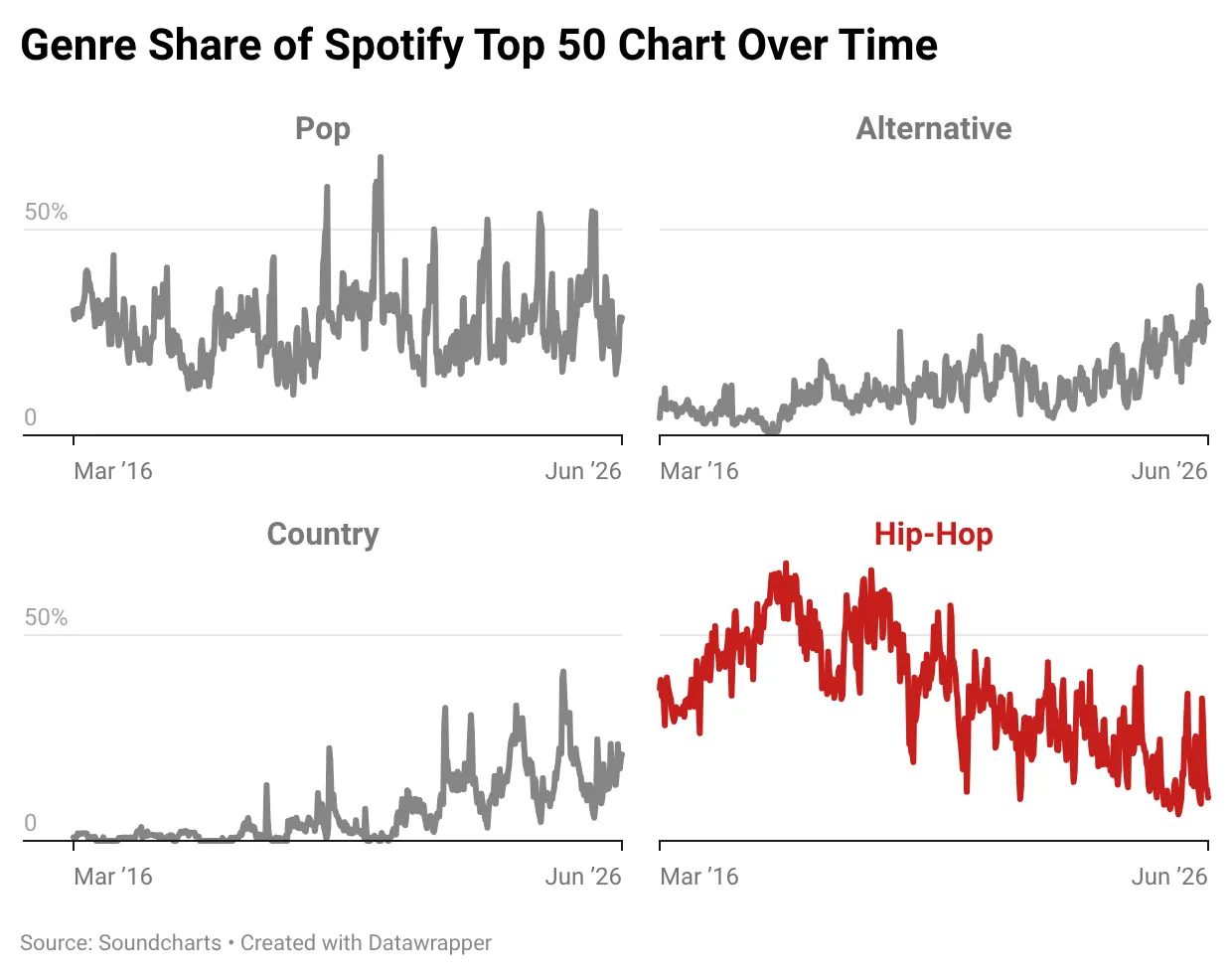
The data shows that hip-hop’s relative share of Spotify’s biggest hits has declined compared with its peak years, leaving more room for genres that traditionally feature fewer explicit releases.
Global genres are expanding
Another major factor is Spotify’s increasingly international audience. K-pop continues attracting enormous global audiences, while country music has experienced significant streaming growth over the past few years. Neither genre relies on explicit lyrics to the same extent as mainstream rap, helping shift the overall balance of Spotify’s biggest charts. The takeaway isn’t that one genre is replacing another. Instead, Spotify’s charts are becoming more diverse than they were several years ago.
Listener behaviour is changing
It’s tempting to assume artists are deliberately avoiding explicit language to maximise streams. But in reality, the bottom line simply points towards changing listener behaviour.
Spotify hasn’t announced any policy changes favouring clean songs, and explicit music continues to perform extremely well across countless playlists and genres. Instead, the charts are reflecting what people are choosing to listen to.
More people are revisiting catalogue music. Streaming audiences are becoming increasingly global. Different genres are sharing the spotlight rather than one dominating everything.
Rather than signalling the end of explicit music, the data suggests Spotify’s audience is simply becoming more diverse. As listening habits evolve, the platform’s biggest charts are increasingly reflecting a broader mix of genres, cultures and generations of music.
What independent artists can learn
There’s no reason to rewrite your lyrics simply because Spotify’s Top 50 looks different.
Authenticity still matters far more than chasing trends.That said, the data does highlight a few useful lessons for artists planning their releases.
First, don’t underestimate the value of accessibility. Songs that can comfortably sit across multiple editorial playlists, radio stations and family listening environments naturally have a broader range of opportunities.
Second, remember that streaming audiences are increasingly international. Music no longer needs to fit one platform’s or one country’s trends to find success. Distribution platforms like RouteNote make it easier than ever to release music worldwide, giving independent artists access to the same global platforms as major labels.
Finally, think long-term. One of the biggest stories in streaming isn’t just new releases, it’s catalogue longevity. Songs released today could still be finding audiences years from now through playlists, recommendations, viral videos and algorithmic discovery.
That’s another reason why getting your music onto every major streaming service from day one is so valuable.
The bigger picture
The decline in explicit songs isn’t really the story. The real story is that streaming is maturing. Spotify’s charts increasingly reflect a mix of new releases, evergreen classics and global genres, rather than being driven by a single style of music.
For independent artists, that’s encouraging news.
Success on streaming platforms has never depended on sounding exactly like what’s already topping the charts. As listening habits become more diverse, there’s arguably more room than ever for different genres, languages and styles to build loyal audiences.
Whether your next release is explicit or completely clean, the most important thing is making sure it’s available wherever listeners are discovering music, and giving it every opportunity to find its audience.