

Gen Z and Millennials are powering classical concert attendance, study finds
A new global survey of 8,000 people across 10 countries suggests younger audiences are the ones showing up to classical music concerts.
In a surprising twist for a genre often associated with older audiences, new data suggests the audience of classical music may be far younger than you’d expect.
The global Classical Pulse 2026 study conducted by Candlelight by fever, has shed a light on classical music consumption habits. The research gathered insights from over 8,000 adults across ten countries (Australia, Brazil, Canada, France, Germany, Italy, Mexico, Spain, the United Kingdom, and the United States), offering a look at how audiences engage with the genre today from all across the globe.
So, what did it reveal?
Gen Z and Millennials lead classical concert attendance
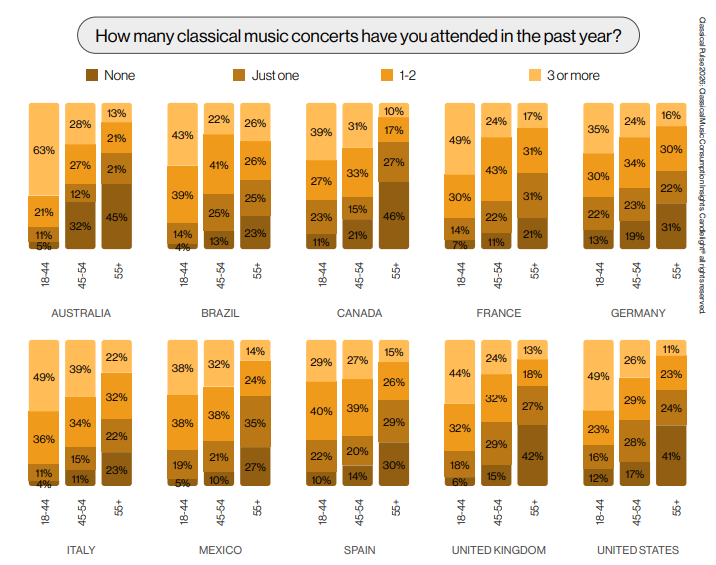
Most surprisingly, the study revealed a generational divide in concert attendance. Gen Z and Millennials are significantly more likely to have attended a classical concert in the past year, when compared to Gen X and Baby Boomers. In fact, these older audiences were often the least likely to attend classical concerts over the last 12 months.
When breaking it down by country, more than half of older adults in Australia, Canada, and the United States reported that they had not attended a single classical concert during the past year. Australia was the highest with 77% of older adults having not attended a classical concert in the past year.
Compare that to countries like Brazil, Italy, and Mexico where younger listeners are embracing the genre fully. Across these regions, nearly all Gen Z and Millennial classical concertgoers had done so within the past year, and sometimes more than once.
Classical music interest is deeper among younger audiences
The shift from younger audiences is not limited to live attendance either. Younger listeners are also showing stronger engagement with classical music overall.
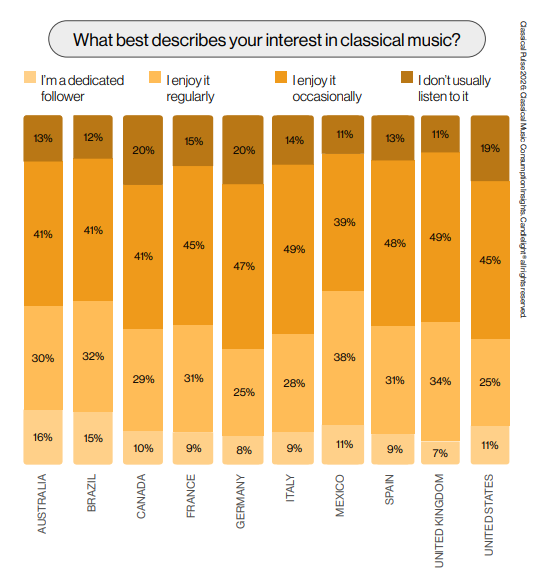
Globally, nearly three quarters of respondents say they listen to classical music either occasionally or regularly. Yet, when it comes to dedicated fans, younger generations stand out yet again.
Around 15% of Gen Z and Millennials described themselves as “dedicated followers” of classical music who actively track performances and artists. Compare that to globally, where 10% of all respondents call themselves dedicated followers, and is higher than both Gen X (8%) and Boomers (5%).
Looking at it by country again, Australia and Brazil had the highest number of dedicated followers, 16% and 15% respectively. Meanwhile, more casual enjoyment was exercised by those in Italy, Spain, France, and the UK.
What this means for the industry
Taken together, the findings paint an interesting picture in how classical music audiences are evolving. For a genre that is typically associated with older listeners, this new data suggests the reality may be changing. Younger audiences are not only listening to classical music, they’re also the ones showing up to concerts too.
For the music industry, that shift could be significant. Rather than being just for older generations, the genre appears to be resonating with a new wave of listeners who may play a key role in shaping the future of classical music.
Distribute your music to streaming platforms everywhere for free with RouteNote today!