

Why AI music creation may not be bad news after all
New MIDiA data reveals a surprising thing about AI music makers: they’re usually the music industry’s most valuable audience, superfans.
Generative AI is all the talk in the music industry, and usually not for good reasons either. Concerns typically center around copyright issues over the music used to train AI models, to the rise of fraudulent streams on AI tracks which might actually be taking royalties away from real artists. But now, data from an upcoming MIDiA report reveals an interesting twist to the story.
Titled, AI and Consumer Creation: The Superfan Factor, the upcoming report shows that the people creating AI-generated music are typically part of the industry’s most valuable audience. They’re superfans.
What are superfans?
In short, superfans are the ones who are more likely to support and invest in their favorite artists fully. They’ll buy merch, go to gigs, spend both time and money, and follow artists through thick and thin. Essentially, superfans serve as the backbone to an artist’s career and are the heartbeat of the music ecosystem.
The negative narrative around AI music
The skepticism toward AI music hasn’t come out of nowhere. Over the past year, the industry has had to deal with a growing list of challenges. AI music tools like Suno have made music creation so simple that anyone can produce full tracks with just a few prompts. This has contributed to a huge surge in AI-made content. Deezer now says that more than 34% of the tracks it receives each day are fully AI-generated (around 50,000 tracks every day), up significantly from the 10% that Deezer were receiving at the start of the year.
The problem isn’t just the volume of AI tracks reaching streaming services either though. It’s the intent behind them. Deezer highlights that around 70% of streams on AI-generated tracks are fraudulent, designed to siphon royalties or clean dirty money.
While Deezer adds that these fraudulent streams only represent 0.5% of total streams on the platform, the potential downside to this is clear. Just take CISAC’s study from last year, which warned that nearly a quarter of music creators’ revenues could be at risk by 2028 due to generative AI, potentially resulting in €4 billion in lost revenues.
So, of course the concern is well justified and needs addressing, but the story doesn’t end there.
The upside: AI music creators are actually superfans
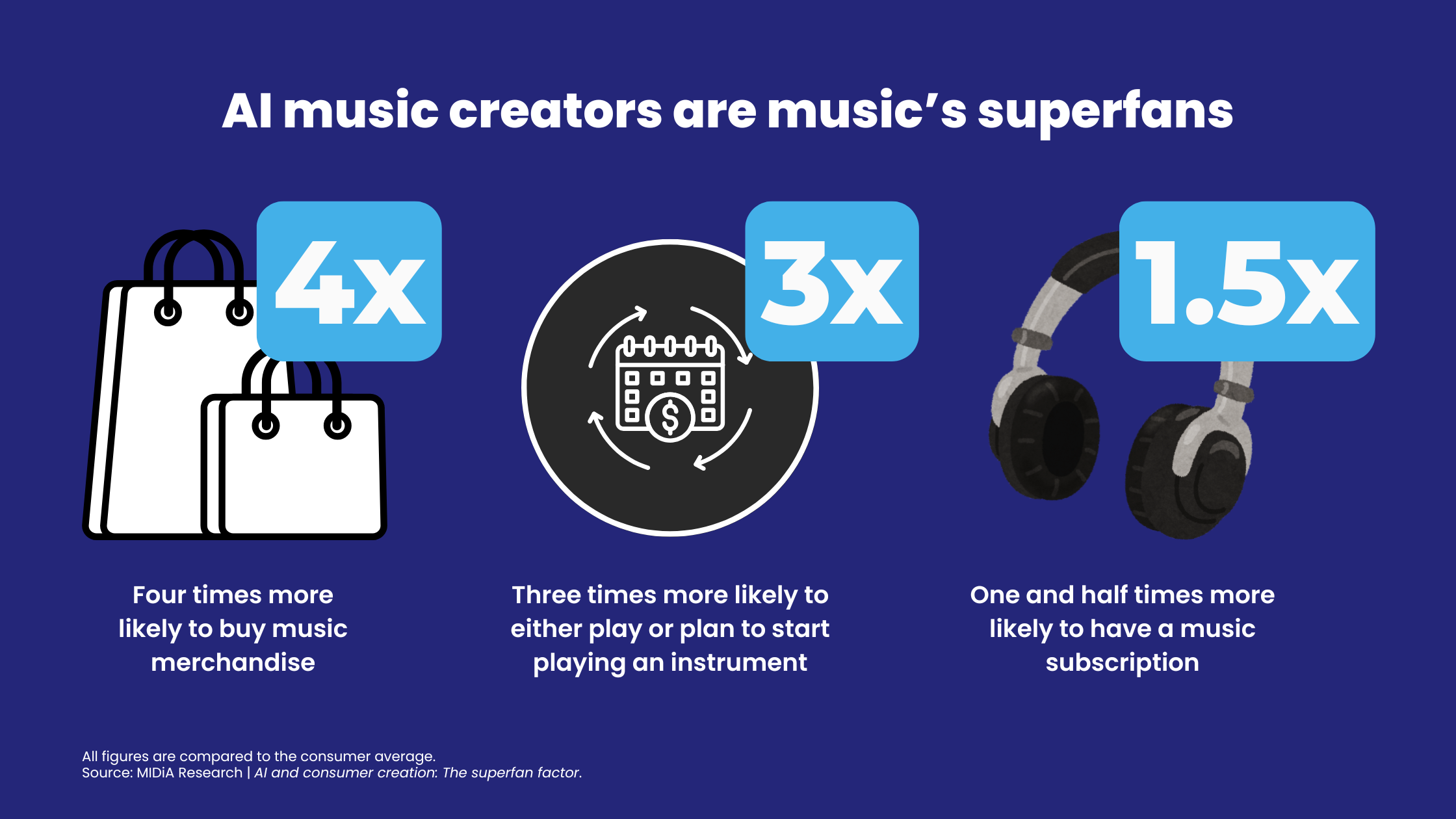
Now’s time for the good news around AI music generation. Despite the worries, MIDiA’s data shows that AI music creators are typically music superfans. In fact, these AI creators stand out significantly across every major fan metric. They’re:
- Four times more likely than overall consumers to buy merch.
- Three times more likely to either play or plan to start playing an instrument.
- One and half times more likely to have a music subscription.
In some ways, this isn’t surprising. AI music creators simply align with a long-standing pattern: making and playing music has always been a core superfan behavior. MIDiA likens it to someone “learning to play the riff for ‘Smells Like Teen Spirit’ in the 90s or a kid making music in her bedroom with BandLab today”. The act of creating music is often tied to deeper music fandom, and generative AI is simply their latest tool that enables that more easily.
What this means for the music industry
The key takeaway from this is that these AI creators are bringing more value into the industry than the average listener, and that matters. If fans making AI music are also the ones spending the most within the industry, then AI music may not only represent a challenge, but also an opportunity to tap into.
Labels, platforms, and rights holders could utilize this information. They could build tools, experiences, and campaigns geared towards these highly engaged consumers, encouraging them to channel their creativity in ways that support artists rather than undermine them.
We can perhaps even see this happening already, with Spotify already rolling out a customizable transition feature and a recent patent rumor indicates that fans may soon be able to create seamless mashups thanks to AI.
Final thoughts
AI music isn’t going anywhere. The risks around streaming fraud, royalties, and artist protection are real and need careful regulation. As for the people diving into AI music creation, they’re not the threat that many assume. They’re actually the superfans, the same people who buy tickets, show up for artists, and pump more money into the industry.