
Is the slowdown in pop hits continuing in 2026?
Chart analysts warn that the slowdown in breakout hits and chart-topping singles seen in 2025 could be continuing into 2026.
Last year, we spoke about whether 2025 was the “year that chart music and hit singles died”. At the time, it had come after a slow year music-wise. There were fewer breakout hits, less culturally dominant songs, and no real “song of the summer”. Compare that to the year before where we were living in a Brat summer, and Sabrina Carpenter’s Espresso was being played everywhere.
Fast forward to 2026, and that conversation hasn’t gone anywhere. New data from Chartmetric suggests the so-called ‘pop slump’ may have carried over into 2026.
Chartmetric’s data tells a familiar story
Starting with the numbers, 2026 looks to be on a similar decline to 2025.
In the first half of 2025, just 23 songs reached the top charts. The year before? 49. That’s a steep drop-off that has only continued. And so far, 2026 is painting a similar picture.
In January, current-year releases made up just 3.5% of Spotify’s Global Top 50. That figure is significantly down compared to previous years, sitting below 8.4% in January 2023 and 9.4% in January 2024. January 2025 was unusually high with 26% thanks to a Bad Bunny-driven spike.
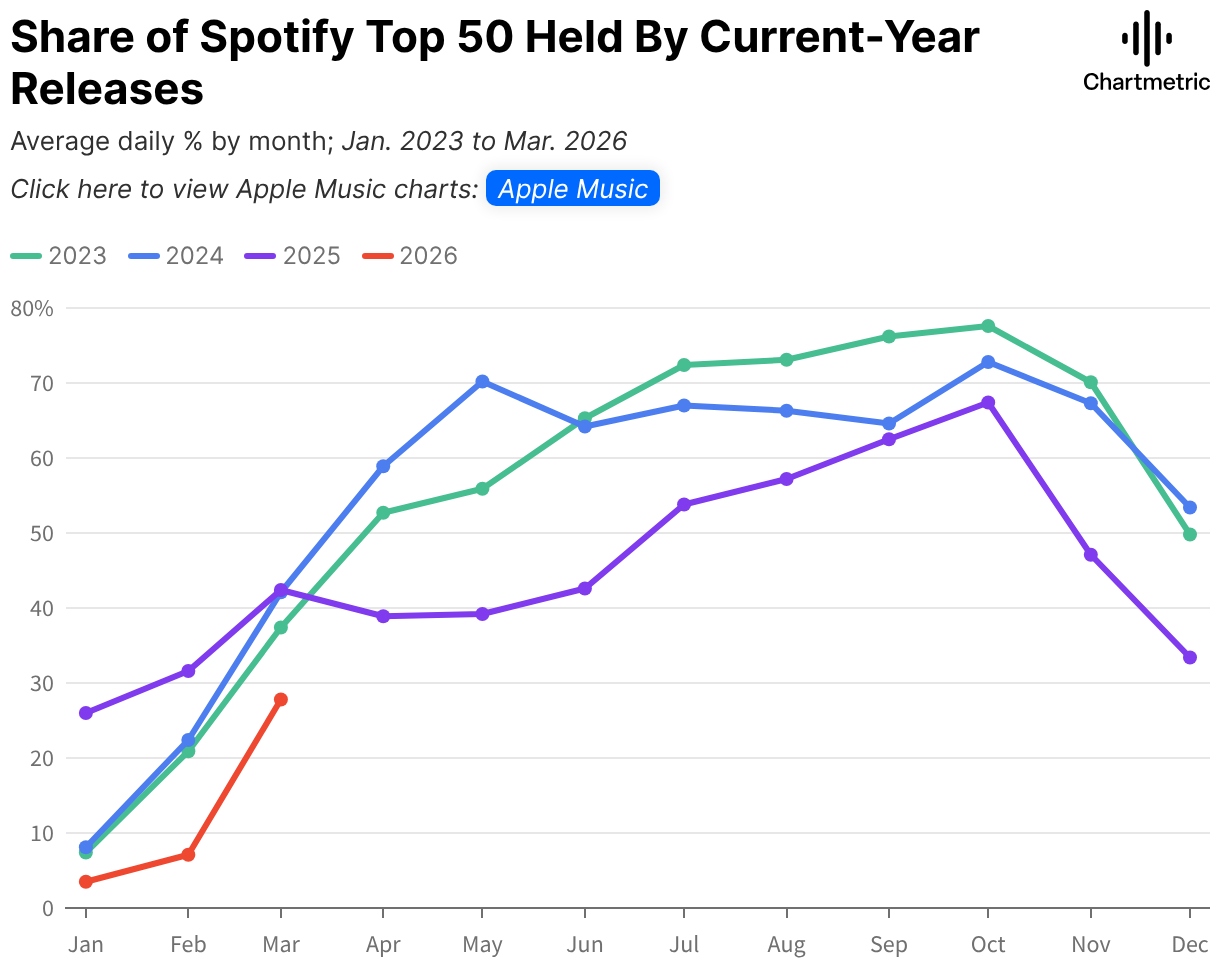
Across Q1 2026, 197 tracks have appeared in Spotify’s Global Top 50. Of those, 116 were holdeovers, while 81 were new releases. Compare that to Q1 2024 and 2025, where the split was far more balanced.
With that being said, things do look slightly healthier on Apple Music, where 155 new releases have gone in and out of its Global Top 100. So perhaps, platform dynamics such as editorial playlists and user behavior are shaping what breaks through.
So, what’s actually causing the slowdown?
We touched on a few theories last year, including that the slowdown may be nostalgia-driven in light of the ongoing global conflicts, issues and political turmoil. While this still may be relevant, Chartmetric’s latest report points to some specific reasons.
Music is more fragmented than ever
Music consumption isn’t centralized anymore. Audiences are spread across TikTok, Instagram, YouTube, and streaming platforms, each with its own micro-trends and breakout moments. That means we’re no longer all listening to the same songs at the same time, making it harder for any one track to dominate globally.
Volume of music published
Music is being pumped out at an astonishing rate these days. Chartmetric recorded there were nearly 30,000 new releases every day last year. That’s a lot of music competing for attention with each other, which unfortunately makes it harder to break through.
Charts aren’t moving like they used to
In the past, radio rotation gave tracks a natural expiry date. Now, songs can essentially live forever, resurfacing through playlists, algorithms, and social media trends. That means older songs are sticking around longer than they used to, creating few openings for new releases to cut through.
Nostalgia-driven listening
Viral moments and nostalgia-driven listening are increasingly driving more streams, with Zara Larsson’s “Lush Life” (2015), Dominic Fike’s “Babydoll” (2018), and even The Police’s “Every Breath You Take” (1983) seeing a resurgence on Spotify’s charts this year. So, new releases aren’t just competing with each other, they’re up against decades of music history too.
Superstars are on top
When songs do break through, they tend to come from the biggest names. These releases are treated like events that dominate attention, rack up huge numbers, and usually stick around at least for a little bit. But, even this is getting harder for established artists with new projects from A$AP Rocky, Don Toliver, and even Bruno Mars failing to stick for longer than a couple weeks.
If established artists are struggling, how are new artists supposed to pop up with new hits?
Recorded music is still growing
It’s worth noting that this doesn’t mean music is in decline. Revenue is still growing around the globe, with the UK, the US, Germany, France, and Spain all experiencing recorded music growth in 2025.
It’s more that the shape of breakout tracks appears to be changing. Instead, the idea of a culturally-recognized hit that resonates with audiences worldwide is becoming less common.
What happens next?
There could be some early signs of movement. March 2026 saw a spike in new releases hitting Spotify’s Top 10 tracks thanks to projects from Harry Styles and BTS. Whether these tracks bring about long-lasting hits remains to be seen. But for now, the broader trend is still pointing towards fragmentation, slower chart movement, and more streams for catalog tracks.
For the industry, that raises some important questions: How do you build a hit in an era where attention is so divided? How can you break through when charts are moving slower than ever? How can new artists compete when people continue to favor familiarity?
One thing’s for sure, the goal posts are changing when it comes to hit-making.
Distribute your music to streaming platforms everywhere with RouteNote. Start for free today!