
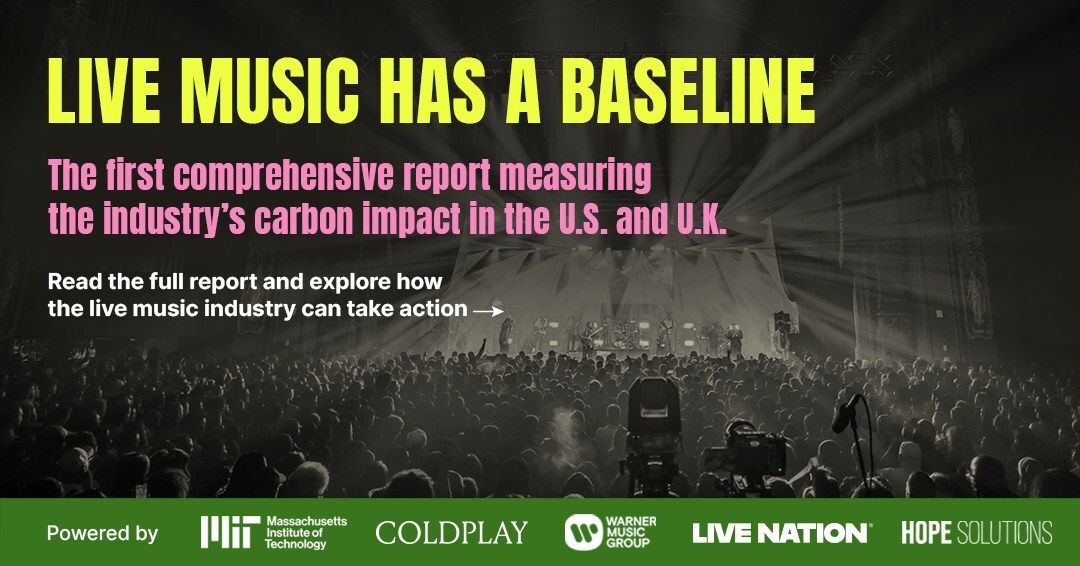
Report sets a baseline for reducing live music’s environmental impact
A new study on the environmental impact of the live music industry pin points key opportunities for change.
If you’re a musician or music lover, many of your core memories will likely revolve around live music. The first gig you ever attended, or your favourite music festival that keeps you going for the rest of the year. Live music plays an enormous role in culture, community, and creativity. But, like most major industries, it has its environmental impact. A new study from the Massachusetts Institute of Technology (MIT) finally puts clear numbers on that impact and explains where meaningful change can happen.
MIT has published what it calls, “The first comprehensive assessment of live music emissions in the US and UK.” The research comes from MIT’s own Climate Machine team, and is backed by donors including Coldplay, Live Nation, and Warner Music Group. The aim of the research is simple; understand the problem clearly so the industry can reduce its emissions more effectively.
What the study found
The research looks at live music emissions during 2023, which MIT say are a result of decisions, actions, and places. These emissions are measured in metric tonnes of carbon dioxide equivalent (MtCO2e). The results show that live music generated:
- 4.0 million MtCO₂e in the UK
- 14.3 million MtCO2e in the US
To give these figures perspective, the study explains, “UK live music accounts for the equivalent of 1% of the nation’s total emissions, while US live music represents the equivalent of 0.2% of national emissions”.
While those percentages seem small, the study emphasises that implementing its recommendations can still make a significant difference in reducing emissions. The sector is incredibly broad, meaning the potential for millions of people to change their habits, methods, and wider behaviours in order to bring about meaningful change.
The biggest sources of emissions
Perhaps unsurprisingly to some, the biggest contributor to live music emissions, according to the 2023 study, was fan travel.
Fan travel made up 77% of total emissions in the UK, and 62% in the US. This includes travel by car, train, bus, and plane. Because audiences travel from all over the world, this is understandably one of the hardest areas to tackle.
After travel, food and drink is the next biggest contributor. It accounts for 7.6% of emissions in the UK and 16.9% in the US. Much of this comes from animal-based products. Complete Music Update points out that the study notes that “a shift toward plant-based menus could reduce these emissions by 40% or more”.
When fan travel is removed from the data, touring logistics become more visible. Air freight accounts for nearly 35% of remaining emissions in the UK, while trucking makes up around 14% in the US.
Recommendations for change
The MIT Climate Machine team has outlined 33 recommendations to help reduce emissions across the live music industry. These are grouped into seven areas, which are as follows:
- Power solutions
- Venue improvements
- Transportation & logistics
- Food systems
- Fan travel
- Artist & crew travel
- General industry actions
The recommendations are backed by detailed AI-based computational and mathematical modelling, including analysis of touring routes, energy use in venues, and different transport options. With each area modelled and examined, a clearer picture is painted of the decisions that have the biggest environmental impact, and where changes can deliver the greatest results.
Industry reaction
The study has been warmly received by key players within the industry, with supportive statements being shared.
Live Nation welcomed the report, with Head of Sustainability Lucy August-Perna saying, “Real progress starts with shared understanding. For the first time, the live music industry has a clear picture of where our collective impact lies. For Live Nation, this data empowers us to continue taking smarter, more coordinated action in partnership with artists, venues and fans to preserve a strong future for live music and the communities that support it”.
Madeleine Smith, Senior Director, ESG at Warner Music Group said, “”Live music doesn’t just entertain; it shapes culture and connects communities. As we advance our sustainability efforts, we’re committed to turning insights into measurable action–aligning purpose with performance, building resilience across the ecosystem, and ensuring that music continues to create shared value for artists, fans, and the planet alike.”
Wrapping up
This MIT study makes one thing clear. Live music now has a solid data-driven foundation for reducing its environmental impact. With fan travel at the centre of the challenge, progress will depend on collaboration across the whole ecosystem.
While commitment and participation must come from the higher level of the system (i.e. organisers, venues) in order for meaningful change to come about, individuals can take inspiration from the study. Opting for lower carbon transport to venues where possible, or choosing more plant-based meals at festivals and events, are positive actions that feed into the behaviour change that will support a greener live music industry.