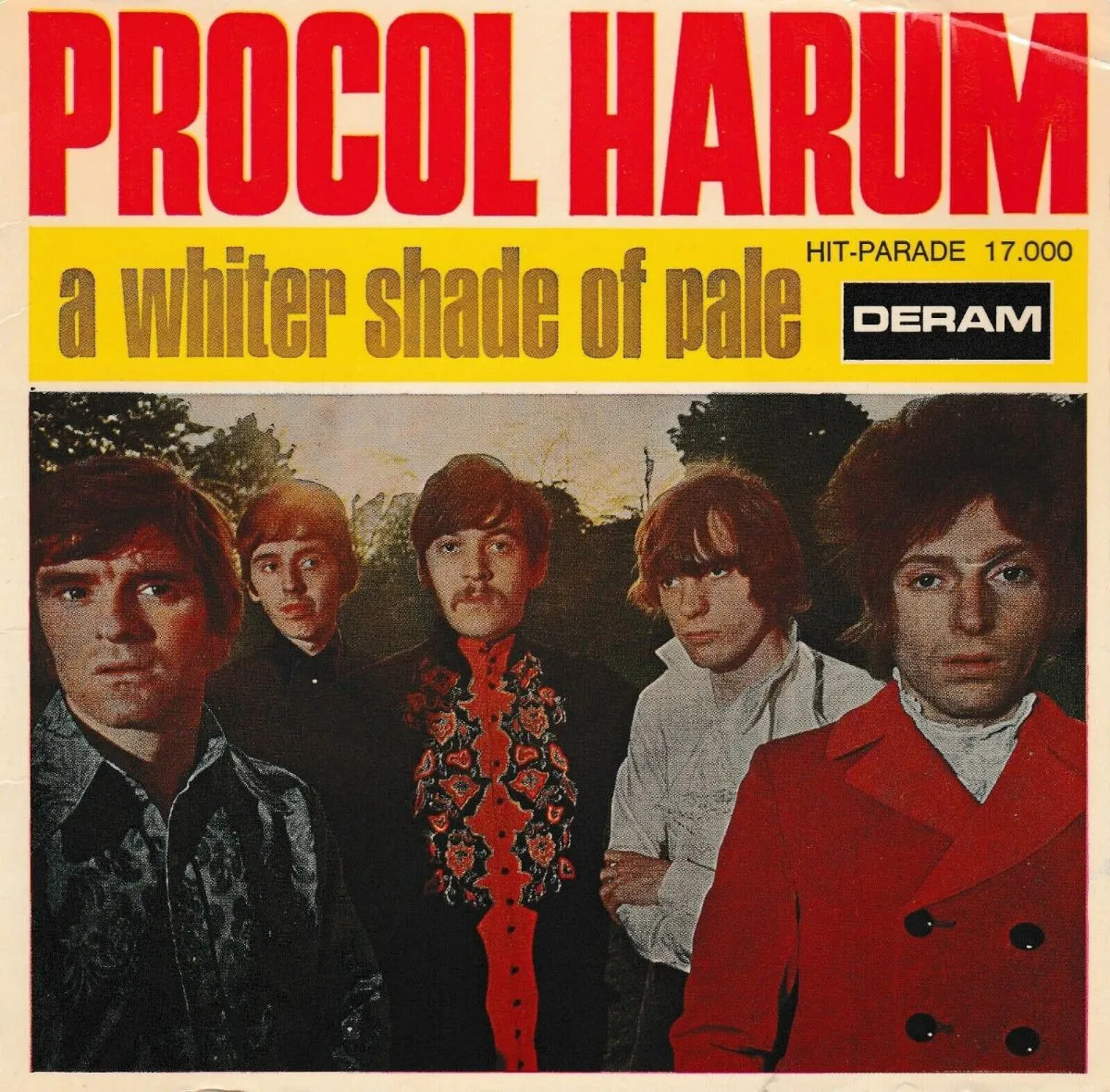
What Does “A Whiter Shade of Pale” Mean?
There is no single universally accepted literal explanation.
The song is deliberately surreal.
But the strongest reading is that it describes a mysterious encounter involving attraction, intoxication and emotional disorientation.
Its writer, Keith Reid, developed the title after overhearing a phrase at a party.
Someone had described a woman as becoming a whiter shade of pale.
Reid liked the strange expression.
He built a song around it.
Then Procol Harum transformed his words into one of the most recognisable recordings of 1967.
Is “A Whiter Shade of Pale” about drugs?
Not necessarily.
The record became strongly associated with the psychedelic era.
That naturally encouraged interpretations involving hallucinogens or altered consciousness.
But describing it as a straightforward drug song is too simplistic.
The lyrics create a dreamlike atmosphere using unusual images and disconnected events.
Those images can suggest intoxication.
They can also suggest:
romance
confusion
embarrassment
sexual attraction
or memory.
The ambiguity is part of the composition.
Where did the title come from?
A party.
Keith Reid overheard somebody using a peculiar expression about another person’s appearance.
He found it memorable.
The phrase effectively exaggerates an ordinary description.
Someone becomes pale.
Then even paler.
The repetition creates something slightly unreal.
That quality appealed to Reid.
He was interested in poetic language that could suggest an emotional atmosphere without explaining every detail.
Why are the lyrics so confusing?
Because they do not follow the normal structure of a pop story.
Most songs tell you:
who is speaking
what happened
how they feel
what changed.
“A Whiter Shade of Pale” offers fragments.
People dancing.
Unusual conversations.
Disorientation.
Maritime imagery.
Classical and literary references.
The listener is expected to create connections.
That gives the song a quality closer to surreal poetry than conventional pop storytelling.
Is the song about a romantic encounter?
That is one reasonable interpretation.
Several writers have suggested that the images describe a flirtatious encounter that becomes increasingly uncomfortable or emotionally complicated.
The narrator’s perspective is not completely reliable.
That allows different interpretations.
But it is important not to turn one critic’s reading into the definitive intention of the songwriter.
The available explanations do not support that level of certainty.
Why does the organ sound so familiar?
Because it draws from classical music.
Gary Brooker’s musical ideas were influenced by Johann Sebastian Bach, particularly the atmosphere of pieces such as “Air on the G String”.
But the final Procol Harum recording is not simply a direct adaptation of one Bach composition.
It uses classical influence as part of a new rock arrangement.
That combination gave the recording its extraordinary atmosphere.
Who actually played the organ?
Matthew Fisher.
Fisher’s distinctive organ part became central to the song’s identity.
In fact, his contribution eventually became the subject of a major legal dispute.
He argued that the part he created was substantial enough to count as songwriting rather than merely instrumental performance.
The dispute reached Britain’s highest court at the time.
In 2009, Fisher’s contribution was recognised through a ruling concerning his share of the composition’s authorship.
That history shows just how important the organ line was.
Is “A Whiter Shade of Pale” classical music?
No.
It is a rock recording incorporating classical influences.
That distinction matters.
During the late 1960s, musicians were increasingly experimenting with arrangements that moved beyond conventional guitar-based pop.
Classical harmony.
Orchestration.
Extended compositions.
Unusual song structures.
Procol Harum became an important part of that movement.
When was the song released?
It reached No. 1 in the UK and became strongly associated with the Summer of Love.
Its atmospheric production made it stand out even during a period full of musical experimentation.
The song also helped establish a path towards progressive rock.
Its success demonstrated that a single could be commercially enormous without following straightforward pop conventions.
Why does the recording sound so sad?
Partly the harmony.
Partly the organ.
Partly Gary Brooker’s vocal.
The melody has a solemn quality that makes even the more surreal lyrics feel emotionally significant.
It creates a strange effect.
You may not understand exactly what is happening.
But you understand that something important appears to be happening.
That is one of music’s great advantages over ordinary language.
Were there originally more verses?
Yes.
Reid wrote additional material beyond the verses included in the famous single.
Procol Harum occasionally performed more of the song live.
The full lyrical idea was larger than the best-known recording.
That does not necessarily make the meaning clearer.
It simply expands the strange world Reid created.
Why has the song been used in so many films?
Atmosphere.
The organ immediately communicates:
nostalgia
romance
mystery
the 1960s
or a dreamlike emotional state.
Directors can use the opening to establish an entire mood before a character says anything.
That is why the recording continues appearing across film and television decades after release.
What genre is “A Whiter Shade of Pale”?
Baroque pop.
Psychedelic rock.
Proto-progressive rock.
Classic rock.
There are also strong classical influences.
The genre overlap is part of the song’s historical importance.
It belongs to a moment when rock musicians were discovering they could borrow from almost any musical tradition.
Songs like “A Whiter Shade of Pale”
The Moody Blues – Nights in White Satin
The Beatles – A Day in the Life
The Zombies – A Rose for Emily
The Doors – The Crystal Ship
King Crimson – Epitaph
Roxy Music – More Than This
The Kinks – Waterloo Sunset
The Beach Boys – Surf’s Up
What does the title really mean?
Its power comes from sounding meaningful without offering one obvious explanation.
Someone becomes impossibly pale.
A strange encounter unfolds.
The music creates a solemn atmosphere.
The listener fills in the gaps.
Sometimes songs remain famous because everybody understands them.
“A Whiter Shade of Pale” may have lasted partly because nobody can completely pin it down.