Who Originally Sang “Monster Mash”?
Bobby “Boris” Pickett.
The American singer and comedian recorded “Monster Mash” in 1962 with a group credited as the Crypt-Kickers.
The famous voice is not Boris Karloff.
Pickett is impersonating him.
And the entire song began because that impression went down well during a completely different musical performance.
More than six decades later, “Monster Mash” remains one of the most recognisable Halloween recordings ever made.
Who was Bobby “Boris” Pickett?
Bobby Pickett was an aspiring actor and singer with a talent for impersonating famous horror performers.
He particularly enjoyed imitating Boris Karloff.
Karloff was strongly associated with the Frankenstein monster in classic horror cinema.
His voice and appearance had become cultural shorthand for old-fashioned movie monsters.
Pickett discovered that audiences enjoyed hearing his impression.
Eventually he realised the voice might work inside a novelty song.
That decision would effectively define his career.
How was “Monster Mash” written?
Pickett was performing with a group called the Cordials.
During a performance of “Little Darlin’” by The Diamonds, he introduced a Boris Karloff impression.
The audience loved it.
Pickett subsequently worked with Leonard Capizzi on a song built around the idea of monsters attending a dance party.
The composition reportedly came together extremely quickly.
They had found a simple concept that combined:
horror-film references
popular dance crazes
comedy
and rock and roll.
The result was “Monster Mash”.
What does “Monster Mash” actually mean?
It is the name of a fictional dance.
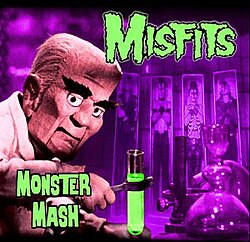
The narrator is a mad scientist working late in his laboratory.
A monster begins dancing.
Other monsters become interested.
Eventually a party develops.
The dance becomes a sensation.
That is basically the entire story.
There is no hidden tragedy.
No elaborate metaphor.
No complicated romantic relationship.
Sometimes a monster simply wants to dance.
Why is it called a “mash”?
Because dance crazes were enormously popular in the early 1960s.
One of the most important was the Mashed Potato.
“The Twist” was another giant dance phenomenon.
Pickett and Capizzi effectively imagined what would happen if the horror-movie world developed its own dance craze.
The Monster Mash.
The name made immediate cultural sense in 1962.
Modern listeners may not recognise the original dance references.
But they certainly understand the monsters.
Was Boris Karloff involved?
Not in the original vocal performance.
Pickett supplied the impression himself.
That distinction matters because the delivery is so convincing that some listeners assume the famous horror actor actually appeared on the recording.
He did not.
The “Boris” nickname refers to Pickett’s impersonation.
He also drew on other classic horror personalities while performing.
The entire recording is a playful tribute to old monster movies.
Who were the Crypt-Kickers?
A studio group assembled for the recording.
The name was deliberately ridiculous.
It sounded like the sort of band that might perform in a graveyard.
The record’s production involved musicians working around producer Gary S. Paxton.
Like plenty of novelty records, its fictional presentation became more famous than the actual session personnel.
Listeners remembered:
Bobby Boris Pickett and the Crypt-Kickers.
Exactly as intended.
Did “Monster Mash” reach No. 1?
Yes.
It topped the Billboard Hot 100 in October 1962.
The timing could hardly have been better.
The song reached the top of the chart immediately before Halloween.
Then, unlike most novelty records, it kept returning.
It charted again in later decades and found additional life through films, television and seasonal radio.
Why did the BBC ban “Monster Mash”?
Because it was considered too morbid.
Yes.
Really.
The original BBC response to the song reflected a more conservative broadcasting environment.
Even though the recording is essentially a comedy dance number, its references to graves, laboratories and monsters were apparently enough to cause concern.
The song subsequently became an enormous family-friendly Halloween favourite.
Standards change.
Monsters apparently become less threatening when accompanied by a catchy chorus.
Was “Monster Mash” a one-hit wonder?
Commercially, Pickett is overwhelmingly associated with this one recording.
He released other material, including seasonal follow-ups.
But nothing approached the original song’s popularity.
That does not necessarily make the career unsuccessful.
Plenty of artists never record anything that people remember for sixty years.
Pickett recorded a song that essentially gets a guaranteed invitation to Halloween every October.
Why does it sound so old-fashioned?
Because it belongs to early-1960s novelty rock and roll.
The rhythm is simple.
The vocal is theatrical.
The arrangement leaves plenty of room for sound effects and character performances.
It is closer to a comedy record with a dance beat than modern horror-themed pop.
That is part of the charm.
Is “Monster Mash” suitable for children?
Generally, yes.
The song is playful rather than genuinely frightening.
It references familiar monsters without creating graphic horror imagery.
That makes it useful for mixed-age Halloween parties.
Radar’s existing guide to Halloween songs for children includes “Monster Mash”, so this deeper history would make a natural internal link.
Songs like “Monster Mash”
Try:
Sheb Wooley – The Purple People Eater
Ray Parker Jr. – Ghostbusters
Andrew Gold – Spooky, Scary Skeletons
The Addams Family Theme – Vic Mizzy
Oingo Boingo – Dead Man’s Party
Rockwell – Somebody’s Watching Me
Warren Zevon – Werewolves of London
Michael Jackson – Thriller
Why does it return every October?
Because it serves a very specific purpose.
People want music that immediately communicates Halloween without becoming genuinely upsetting.
“Monster Mash” does that almost perfectly.
The moment the narrator begins performing his horror-movie voice, listeners understand the occasion.
The record has become seasonal shorthand.
Who originally sang “Monster Mash”?
Bobby “Boris” Pickett.
He co-wrote it with Leonard Capizzi.
The famous voice is his Boris Karloff impression.
The Crypt-Kickers provided the fictional monster-band identity.
And a joke inspired by early-1960s dance crazes became one of the most durable seasonal songs in pop history.