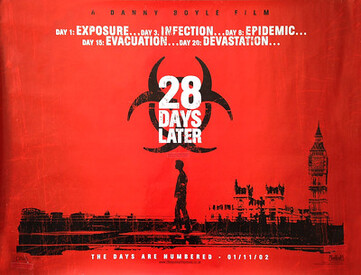
What Is the 28 Days Later Theme Song? Two Famous Tracks Explained
The famous dramatic theme from 28 Days Later is “In the House – In a Heartbeat” by John Murphy.
But there’s another recording many viewers remember just as strongly.
“East Hastings” by Godspeed You! Black Emperor.
The two pieces are frequently confused because they both appear in the film and share a slow-building, unsettling atmosphere.
One accompanies the film’s terrifying climax.
The other helps establish the abandoned world experienced by Jim after he wakes up to discover that London appears empty.
Both became hugely influential examples of how music can transform horror cinema.
Who wrote “In the House – In a Heartbeat”?
John Murphy.
The British composer created the recording for Danny Boyle’s 2002 film.
Murphy’s score combines electronic textures with rock instrumentation and atmospheric arrangements.
“In the House – In a Heartbeat” became its most recognisable piece.
The composition begins relatively quietly.
Then gradually introduces more musical weight.
By the climax, it feels enormous.
That progression is what makes it so effective.
When does the music play in 28 Days Later?
During the film’s climactic confrontation at the military compound.
The scene becomes increasingly violent and chaotic.
Murphy’s music begins building underneath the action.
Instead of relying on a conventional horror score full of sudden orchestral shocks, the recording creates a sense of approaching inevitability.
The music keeps growing.
The danger keeps increasing.
Eventually the two become almost inseparable.
Why is the song so frightening?
Because it delays the payoff.
The recording doesn’t begin with maximum intensity.
It builds gradually.
A simple musical idea repeats.
Additional instruments appear.
The arrangement grows heavier.
The listener knows something is coming.
But the music refuses to deliver the climax immediately.
That creates tension.
It’s particularly effective in a film where danger can emerge suddenly and without warning.
What genre is “In the House – In a Heartbeat”?
Instrumental rock.
Post-rock.
Electronic film score.
There are also strong alternative-rock influences.
The track sounds closer to an atmospheric rock composition than a conventional orchestral horror theme.
That distinction helped make it influential.
It demonstrated that distorted guitar and repetitive arrangements could create cinematic tension as effectively as traditional film-scoring techniques.
What is the song during the empty London scenes?
“East Hastings” by Godspeed You! Black Emperor is used during the sequence showing the deserted city.
The Canadian post-rock group’s recording originally appeared on F♯ A♯ ∞.
Its slow-building atmosphere is perfect for the scene.
Jim walks through a familiar urban environment.
The buildings remain.
The streets remain.
But the people have disappeared.
The music makes the ordinary surroundings feel deeply wrong.
Are the two songs related?
Not musically in the sense of sharing the same composition.
They were created by different artists.
But they occupy a similar emotional space.
Both use repetition and gradual development.
Both create tension through atmosphere.
Both avoid conventional pop-song structures.
That makes them easy to confuse in memory.
If you’re trying to identify the 28 Days Later music, start by asking which scene you remember.
Empty London?
Godspeed You! Black Emperor.
The dramatic final confrontation?
John Murphy.
Who are Godspeed You! Black Emperor?
A Canadian experimental rock collective from Montreal.
Their music is usually associated with post-rock.
The group create long instrumental compositions that build gradually.
They frequently use:
guitars
strings
field recordings
spoken-word samples
and enormous changes in intensity.
Their music can sound cinematic even without a film attached.
That’s why “East Hastings” worked so naturally in 28 Days Later.
What is post-rock?
A style of music that uses traditional rock instruments in less conventional ways.
Rather than focusing on verses and choruses, post-rock often emphasises:
atmosphere
repetition
instrumental development
and gradual changes in intensity.
Godspeed You! Black Emperor are one of the genre’s defining groups.
John Murphy’s “In the House – In a Heartbeat” isn’t a conventional post-rock recording, but it draws from similar musical ideas.
Is the theme also in 28 Weeks Later?
Yes.
Musical material based on Murphy’s original theme appears in the 2007 sequel.
The music became strongly associated with the franchise.
Its combination of tension and emotional intensity made it especially useful for later interpretations.
For many viewers, the opening sequence of 28 Weeks Later is another particularly memorable example of the theme’s power.
Where else have you heard “In the House – In a Heartbeat”?
The recording has appeared in other media, including film trailers, television and advertising.
It is also associated with the film Kick-Ass.
Its dramatic buildup makes it especially useful for scenes involving:
danger
large-scale conflict
high stakes
or impending disaster.
That explains why people sometimes recognise the music without remembering 28 Days Later.
The recording developed a life outside its original film.
Why is 28 Days Later so important to modern horror?
Because it changed the atmosphere of zombie-related cinema.
The film’s infected characters moved quickly.
The digital photography created a gritty visual style.
The abandoned city felt realistic and unsettling.
And the soundtrack avoided many conventional horror clichés.
The music was central to that identity.
Instead of constantly telling the audience when to be frightened, it allowed tension to develop.
Did Danny Boyle choose all the music?
Boyle worked with the film’s music team to create a soundtrack combining Murphy’s original score with existing recordings.
The finished film also includes music from Brian Eno, Grandaddy and Blue States.
That mixture gives the soundtrack an unusually broad character.
The score isn’t simply one continuous musical style.
Different recordings create different emotional environments.
Songs like the 28 Days Later theme
Try:
Godspeed You! Black Emperor – East Hastings
John Murphy – In the House – In a Heartbeat
Mogwai – Auto Rock
Explosions in the Sky – Your Hand in Mine
Nine Inch Nails – The Mark Has Been Made
Hans Zimmer – Time
Clint Mansell – Lux Aeterna
Max Richter – On the Nature of Daylight
These recordings share different aspects of the same slow-building cinematic atmosphere.
What is the main theme from 28 Days Later?
“In the House – In a Heartbeat” by John Murphy.
If you remember the abandoned London sequence, you’re probably looking for “East Hastings” by Godspeed You! Black Emperor.
Both are worth hearing independently.
Together, they demonstrate why 28 Days Later remains one of the most memorable examples of music shaping a horror film’s entire identity.