Ableton Live 13 Announced: New Step Sequencer, Drum Synth, Looplet and More
Ableton has officially announced Live 13, the next major version of its popular digital audio workstation (DAW), introducing new instruments, creative sequencing tools, improved mixing capabilities and deeper audio editing features.
Announced on 10 November 2026, Ableton Live 13 is scheduled for release in early 2027, with a public beta already available for producers who want to explore the new features ahead of launch.
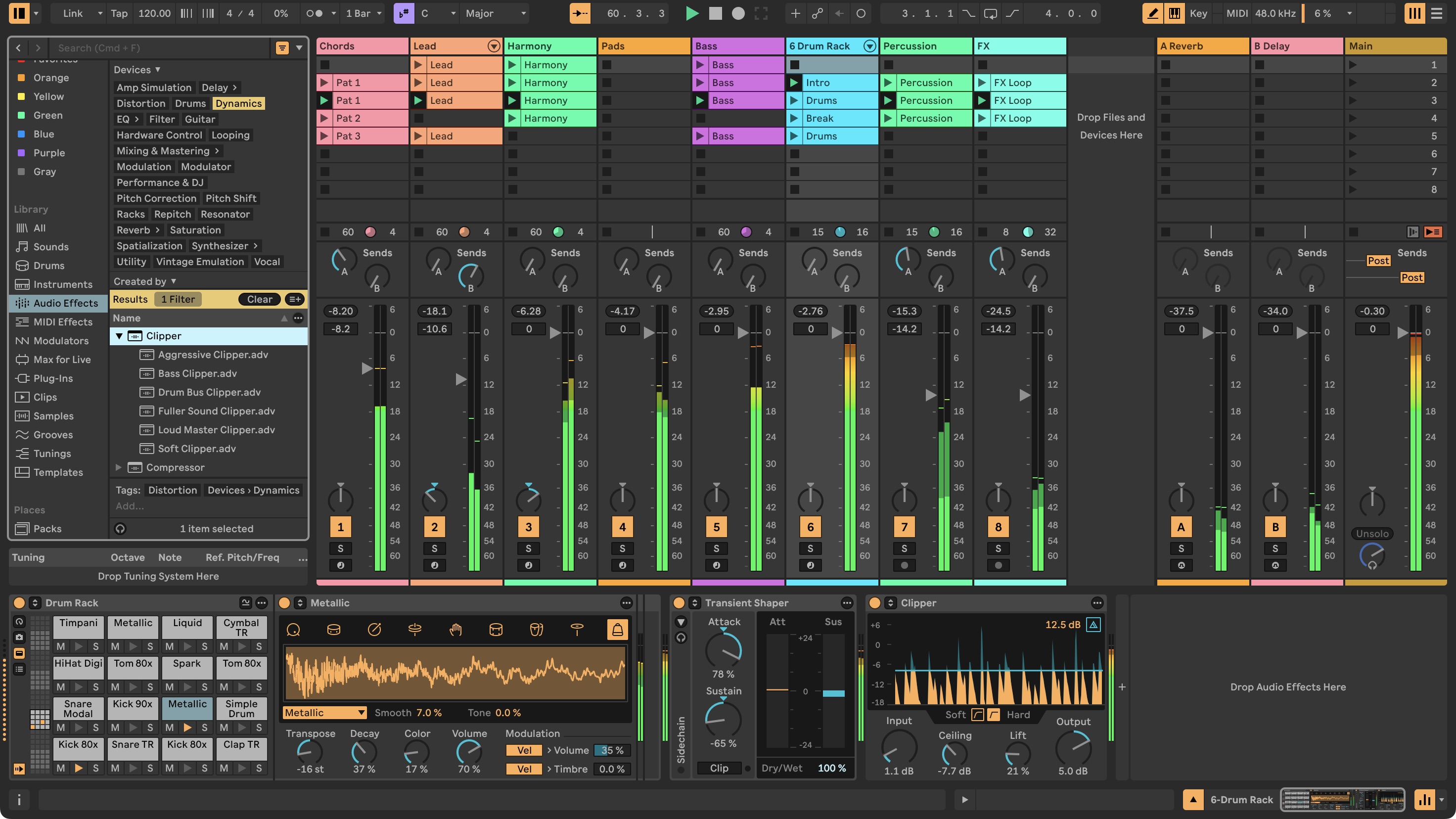
Among the biggest additions are a powerful new Step Sequencer, an experimental looping instrument called Looplet, a dedicated Drum Synth and long-awaited support for ARA 2 plugins.
The update also introduces improvements to Ableton Push 3, expanded Audio and MIDI Racks, new mixing effects and a redesigned workflow designed to make music production faster and more creative.
Here’s everything you need to know about Ableton Live 13.
What’s New in Ableton Live 13?
Ableton Live 13 introduces a wide range of new tools covering music creation, sound design, recording, editing and mixing.
Some of the biggest additions include:
- Step Sequencer: Create evolving drum patterns, melodies and polyrhythms using a dedicated step-based interface.
- Looplet: An experimental sample-looping instrument featuring four independent playheads.
- Drum Synth: Design electronic percussion using multiple synthesis engines.
- ARA 2 Support: Edit vocals and audio directly with compatible plugins such as Melodyne.
- Capture Automation: Automatically capture parameter movements and turn them into editable automation.
- Expanded Racks: Access up to 32 Macro controls with additional mapping options.
- Multiband and Mid-Side Racks: Process different frequency ranges or stereo components independently.
- New Mixing Effects: Shape transients, control peaks and add analogue-style character.
- Improved Mixer: View and manage devices directly from the mixer.
- Push 3 Improvements: Create custom performance layouts and access new sequencing controls.
Together, these additions represent one of the most significant upgrades to Ableton’s production workflow in recent years.
Ableton Live 13 Introduces a Powerful New Step Sequencer
One of the biggest additions to Ableton Live 13 is a dedicated Step Sequencer.
Step sequencing has long been a popular way to create drum patterns, basslines and melodies, particularly in electronic music production.
While Ableton already offered MIDI editing through its piano roll and sequencing capabilities on Push, Live 13 introduces a more comprehensive step-based workflow directly into the desktop software.
The new Step Sequencer allows producers to control individual steps within a pattern, including:
- Velocity: Adjust how hard or softly individual notes are played.
- Timing: Change when notes trigger within a sequence.
- Probability: Introduce variation by controlling the likelihood of individual notes playing.
- Note Length: Adjust the duration of each step.
- Repeats: Create repeated notes, rolls and rhythmic variations.
- Pitch Bend: Add expressive changes to individual notes.
One particularly interesting feature is the ability to give individual sequence rows different lengths, playback speeds and directions.
This allows producers to create evolving rhythms and polyrhythmic patterns that change over time.
For example, a producer could combine a four-step kick pattern with a seven-step percussion sequence, creating rhythmic variations without manually programming every bar.
For electronic music producers, especially those working in house, techno, hip-hop and experimental genres, this could become one of Live 13’s most useful new tools.
What Is Looplet in Ableton Live 13?
Looplet is a new experimental sampling instrument included with Ableton Live 13 Suite.
Rather than working like a conventional sampler, Looplet allows producers to manipulate different sections of a single audio recording simultaneously.
The instrument features four independent playheads that can loop different parts of an audio sample.
Users can manipulate these loops through pitch adjustments, playback speed changes, filtering and granular processing.
Looplet also supports creative techniques such as reverse playback and tape-stop-style effects.
This opens up several interesting possibilities for producers.
A simple recording of a piano chord could be transformed into an evolving ambient texture.
A short vocal sample could become a complex rhythmic soundscape.
Field recordings, guitar recordings or percussion loops could also be manipulated into entirely new sounds.
Looplet is particularly well suited to experimental electronic music, ambient production, cinematic sound design and producers who enjoy transforming existing audio into something unexpected.
As a Max for Live device, it also demonstrates Ableton’s continued investment in experimental music production tools.
Ableton Live 13 Adds a New Drum Synth
Another major addition is Drum Synth, a dedicated instrument designed for creating percussion sounds from scratch.
Instead of relying entirely on recorded drum samples, Drum Synth allows producers to generate and shape electronic percussion using synthesis.
The instrument includes more than 20 drum models across nine categories, covering traditional drum machine sounds and more experimental percussion.
Producers can use it to create:
- Electronic kick drums.
- Snares and claps.
- Hi-hats and cymbals.
- Toms and other percussion.
- Experimental rhythmic sounds.
- Custom electronic drum textures.
The advantage of using synthesis is that producers can adjust the underlying characteristics of a sound rather than simply processing a prerecorded sample.
For example, a kick drum can be designed around its pitch, attack, decay and tonal characteristics.
This gives producers more control over the individual elements of their drum sounds.
For musicians who want to develop a distinctive production style, Drum Synth could offer a useful alternative to relying on the same drum sample libraries as everyone else.
ARA 2 Support Makes Vocal Editing Easier
One of the most requested additions to Ableton Live has finally arrived.
Live 13 introduces support for Audio Random Access 2, commonly known as ARA 2.
ARA allows compatible audio editing plugins to communicate more directly with a DAW.
Previously, producers using certain vocal editing plugins often needed to transfer audio between the plugin and Ableton before applying their changes.
With ARA 2 integration, compatible plugins can work directly with audio clips inside Live’s Arrangement View.
One of the biggest beneficiaries is Melodyne, the popular pitch correction and audio editing software.
Producers can use Melodyne to adjust vocal tuning, timing and individual notes while working within their Ableton project.
Live 13 Suite will also include Melodyne Essential.
This should make vocal production significantly more convenient for singers, songwriters and music producers who regularly record and edit vocal performances.
ARA support could also improve workflows involving audio restoration, timing correction and other specialised editing tasks.
However, Ableton’s initial beta documentation notes that ARA support is currently limited to Arrangement View and that some third-party plugins have compatibility issues.
Producers should therefore check compatibility with their preferred plugins before relying on the beta for important projects.
Capture Automation Records Your Creative Ideas
Ableton has also expanded its Capture functionality with the introduction of Capture Automation.
Previously, Capture MIDI allowed producers to recover musical ideas they had played without actively recording.
Live 13 extends this concept to parameter movements.
For example, imagine experimenting with a synthesiser while adjusting filter cutoff, resonance or other parameters.
Even if you haven’t started recording automation, Capture Automation can recover those movements and convert them into editable automation data.
This could prove useful when experimenting with sound design, particularly during spontaneous creative sessions.
Instead of losing an interesting filter sweep or effect adjustment, producers can preserve it and incorporate it into their arrangement.
Ableton Live 13 Expands Racks to 32 Macros
Ableton’s Instrument Racks and Audio Effect Racks have become essential tools for producers who want to create customised instruments and effects chains.
Live 13 makes them significantly more flexible.
Racks can now feature up to 32 Macro controls, allowing producers to manage more parameters from a single interface.
Ableton has also improved Macro mapping, introducing greater control over how parameters respond to changes.
This means producers can build more advanced instruments, performance effects and sound design systems without constantly switching between individual devices.
For live performers, the extra controls could be particularly useful when creating custom instruments for Ableton Push or external MIDI controllers.
New Mixing Tools in Ableton Live 13
Beyond music creation, Ableton has introduced several features designed to make mixing and mastering workflows more flexible.
Multiband and Mid-Side Racks
Multiband Racks allow producers to process different frequency ranges independently.
For example, a producer could apply distortion to a bass sound’s midrange frequencies while keeping the low frequencies clean.
Mid-Side Racks provide greater control over the centre and sides of a stereo signal.
This could be particularly useful when shaping stereo width, processing vocals or creating more detailed mixes.
Clipper and Transient Shaper
Ableton Live 13 also introduces two new audio effects.
Clipper allows producers to control signal peaks through clipping, potentially helping increase perceived loudness or introduce saturation.
Transient Shaper provides additional control over the attack and sustain characteristics of audio.
For example, producers can use transient shaping to make drums sound punchier or soften overly aggressive percussion.
Softube Effects
Ableton is also introducing a collection of audio effects developed with Softube.
These effects are designed to recreate characteristics associated with traditional analogue studio equipment, including compressors, equalisation and saturation.
The additions could appeal to producers who want to combine modern digital workflows with the sound of classic recording hardware.
Improved Mixer Controls
Live 13 introduces Device Slots, allowing users to see and manage track devices directly within the mixer.
Rather than opening each track individually, producers can view effects chains, toggle devices and reorganise processing from the mixer interface.
This should make larger recording and mixing sessions easier to navigate.
Ableton Push 3 Is Getting Major Improvements
Ableton Live 13 isn’t just introducing changes to the desktop software.
Push 3 is also receiving new features designed to make the hardware more flexible for music production and live performance.
One of the biggest additions is Custom Layouts.
These allow producers to configure the Push pad surface around their preferred workflow.
For example, users can combine:
- Instrument playing areas.
- Clip launching controls.
- Step sequencing.
- Mixer controls.
- Expressive XYZ control elements.
Custom layouts can be saved for individual Ableton projects.
Push 3 will also receive Expressive Step Editing, an improved Performance Mixer and expanded device controls.
For musicians who use Push as their primary production or performance controller, these changes could make it easier to create music without constantly returning to a computer.
Ableton Live 13 Release Date: When Is It Coming Out?
Ableton has confirmed that Live 13 will officially launch in early 2027.
An exact release date has not yet been announced.
However, producers interested in trying the software early can access the public beta, which opened on 10 November 2026.
The beta allows users to explore the new features before the full commercial release.
As with any beta software, producers should expect the possibility of bugs, incomplete features and compatibility issues.
It is worth keeping a backup of important projects before experimenting with a new version.
You can find more information through Ableton’s official Live 13 announcement.
How Much Will Ableton Live 13 Cost?
Ableton Live 13 will continue to be offered in three main editions: Intro, Standard and Suite.
The company has listed the following US prices for the upcoming release:
| Edition | Listed US Price |
|---|---|
| Ableton Live 13 Intro | $99 |
| Ableton Live 13 Standard | $349 |
| Ableton Live 13 Suite | $749 |
Prices may vary depending on your country, taxes and available upgrade offers.
The editions also differ in their included instruments, effects, sound libraries and advanced functionality.
Not every new feature will necessarily be available in every edition. For example, Looplet is included with Live 13 Suite.
Producers should check Ableton’s official edition comparison before purchasing.
Can You Upgrade From Ableton Live 12 to Live 13 for Free?
Ableton has announced a special offer for customers purchasing Live 12 before Live 13 launches.
All Live 12 editions and upgrades are available at a 20% discount until Live 13 is released.
Customers purchasing Live 12 during this promotion will receive a free upgrade to the corresponding Live 13 edition when the new version becomes available.
Ableton has also announced a 20% discount on Push 3, Move and the Push Upgrade Kit until 30 November 2026.
Existing customers should log into their Ableton accounts to view their individual upgrade pricing.
Is Ableton Live 13 Worth Upgrading To?
Whether Live 13 is worth upgrading to will depend on your existing production workflow.
For electronic music producers, the new Step Sequencer and Drum Synth could make the software significantly more appealing.
Musicians working with experimental samples and sound design may find Looplet particularly interesting.
Meanwhile, producers who regularly record vocals could benefit substantially from the introduction of ARA 2 support and improved Melodyne integration.
The expanded mixing tools and Rack functionality may also appeal to more advanced users.
However, musicians who are happy with their existing Live 12 setup may not need to upgrade immediately.
Live 12 remains a powerful music production environment, and many existing workflows will continue to function without the newest features.
For producers interested in Live 13, the public beta provides an opportunity to explore the software before making a purchasing decision.
What Does Ableton Live 13 Mean for Independent Music Producers?
The latest update reflects an interesting direction in music production software.
Rather than focusing exclusively on artificial intelligence or automated music creation, Ableton is introducing tools that give producers more ways to experiment, customise and develop their own sounds.
Features such as Looplet and Drum Synth encourage producers to create something distinctive rather than relying entirely on presets and samples.
Meanwhile, the Step Sequencer and Capture Automation aim to reduce the friction between having a musical idea and turning it into a finished recording.
For independent artists, improvements to music production software can make it easier to produce professional-quality recordings without needing access to an expensive recording studio.
However, creating a great track is only one part of releasing music successfully.
Once a recording is complete, artists also need to consider mastering, distribution and promotion.
For producers looking to prepare their music for release, RouteNote offers Dolby Track Mastering, allowing artists to prepare tracks for digital distribution.
Artists can also distribute their music for free through RouteNote, reaching major streaming services such as Spotify, Apple Music, Amazon Music and YouTube Music.
Frequently Asked Questions About Ableton Live 13
When Will Ableton Live 13 Be Released?
Ableton Live 13 is scheduled for release in early 2027. An exact release date has not yet been announced.
Is Ableton Live 13 Available Now?
The public beta is available as of 10 November 2026. The full commercial version is expected in early 2027.
Does Ableton Live 13 Have a Step Sequencer?
Yes. Live 13 introduces a dedicated Step Sequencer with per-step controls and independent sequence lengths, playback speeds and directions.
What Is Looplet in Ableton Live 13?
Looplet is an experimental looping instrument included with Live 13 Suite. It uses four playheads to manipulate different sections of an audio sample and create evolving musical textures.
Does Ableton Live 13 Support Melodyne?
Yes. Live 13 introduces ARA 2 support for compatible audio editing plugins, including Melodyne. Live 13 Suite will also include Melodyne Essential.
How Much Does Ableton Live 13 Cost?
Ableton lists US prices of $99 for Intro, $349 for Standard and $749 for Suite. Regional pricing and upgrade discounts may vary.
Is Ableton Live 13 a Free Upgrade?
Customers purchasing Live 12 during Ableton’s announced promotional period will receive the corresponding Live 13 edition at no additional upgrade cost. Other existing users should check their individual upgrade options.
Will Ableton Push 3 Work With Live 13?
Yes. Live 13 introduces several new features for Push 3, including Custom Layouts, Expressive Step Editing and additional performance controls.
Ableton Live 13 Looks Like a Major Upgrade for Music Producers
Ableton Live 13 introduces a substantial collection of new tools designed to improve creative experimentation, audio editing and music production workflows.
The new Step Sequencer and Drum Synth could become particularly popular among electronic music producers, while ARA 2 support addresses a long-standing request from vocal producers.
Looplet adds another experimental dimension to Ableton’s sound design capabilities, and the improvements to Racks, mixing tools and Push 3 should make the software more flexible for advanced users.
With the public beta already available and the full release expected in early 2027, producers have plenty of new features to explore.
For independent artists, the update is another reminder of how accessible professional music production has become.
And once you’ve finished your next track in Ableton Live 13, RouteNote can help you release your music to streaming services worldwide for free.