What Does Pink Floyd’s “Time” Mean? Roger Waters’ Real Story
Pink Floyd’s “Time” is about suddenly realising that life is passing while you’ve been waiting for it to begin.
Roger Waters wrote the lyrics after recognising, at around the age of 29, that adulthood wasn’t something waiting for him in the future.
He was already living it.
The song appeared on Pink Floyd’s 1973 album The Dark Side of the Moon and became one of the band’s most recognisable recordings.
Its message is unusually direct.
People imagine they’ll have time to accomplish their ambitions later.
Then the years begin disappearing.
And suddenly the future they were preparing for has become the past.
What inspired Roger Waters to write Time?
Waters has explained that he grew up believing life was a process of preparing for something that would happen later.
Childhood led towards school.
School led towards adulthood.
Adulthood was supposed to lead towards a meaningful future.
But he eventually realised there was no separate moment when life officially began.
Everything happening along the way was already part of it.
That realisation became the foundation of “Time”.
It’s particularly powerful because Waters wasn’t an elderly musician reflecting on decades of missed opportunities.
He was still in his twenties.
The fear of wasting life arrived before he had even reached thirty.
Is Time about getting older?
Yes, but ageing is only part of its message.
The song is concerned with how people experience the passage of time.
Young people often imagine they have an almost unlimited future.
That can encourage postponement.
Important decisions can wait.
Ambitions can wait.
Experiences can wait.
But the years continue passing whether those decisions happen or not.
Waters explores the moment when somebody notices that process.
The anxiety doesn’t come simply from becoming older.
It comes from wondering whether you’ve actually been living the life you intended.
Why does the song begin with clocks?
Because the passage of time is its central subject.
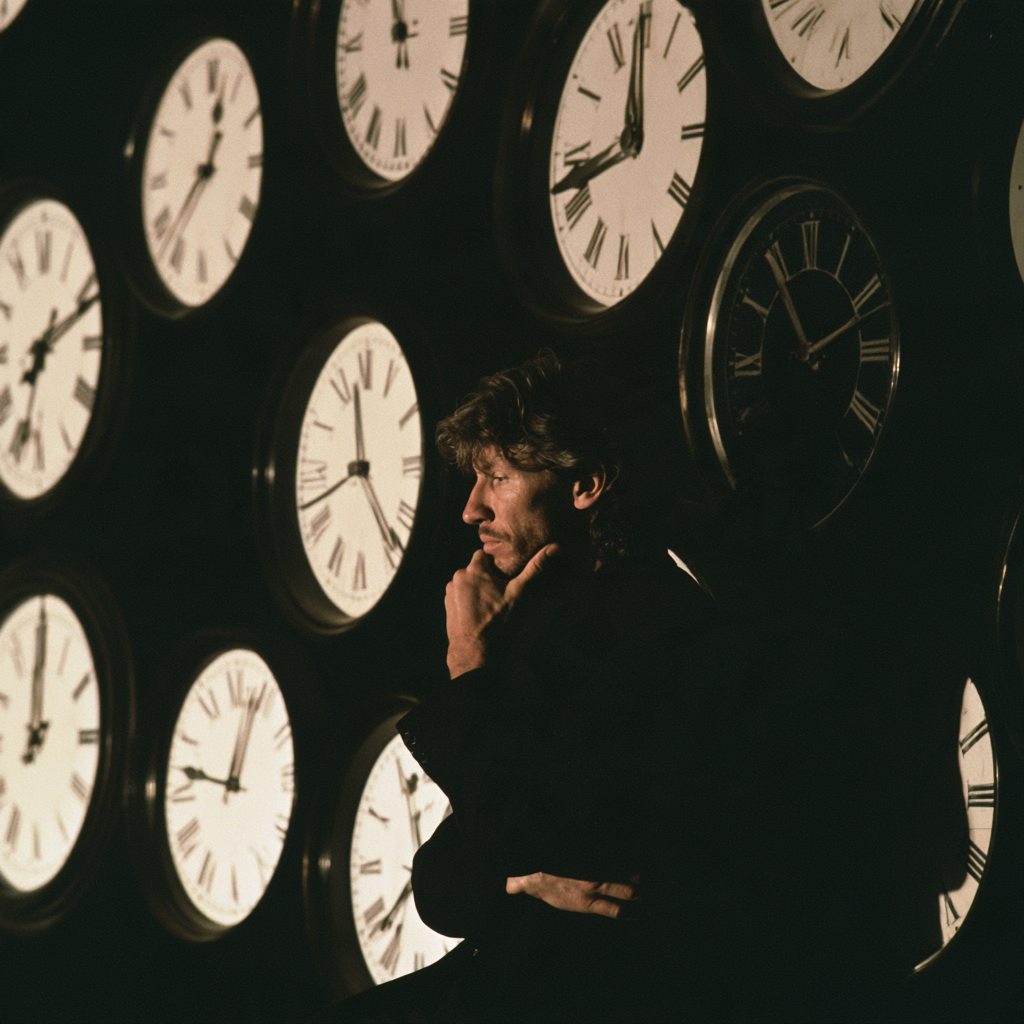
The famous introduction features multiple clocks and alarms ringing.
The effect is deliberately startling.
It interrupts the listener before the conventional musical arrangement begins.
Sound engineer Alan Parsons had previously recorded clocks at an antiques shop using equipment intended for quadraphonic sound experiments.
Those recordings became part of the track.
The introduction therefore transforms ordinary mechanical sounds into a dramatic musical statement.
Before anybody sings about time, you can hear it passing.
What happens after the clock introduction?
Nick Mason’s distinctive percussion becomes central.
He uses rototoms to create an unusual rhythmic introduction.
The arrangement gradually develops.
Then David Gilmour’s vocal enters.
The music combines rock instrumentation with atmospheric production.
Richard Wright’s keyboard work becomes particularly important during the contrasting vocal sections.
That creates a sense of movement across the recording.
The instrumental introduction feels almost mechanical.
The later vocals make the subject deeply human.
Who actually sings Time?
David Gilmour sings the principal verses.
Richard Wright sings the contrasting bridge sections.
Gilmour also provides backing vocals.
The different voices are important because they create changes in emotional perspective.
Gilmour’s delivery is powerful and direct.
Wright’s sections sound more reflective.
The combination gives the recording a wider emotional range than a single uninterrupted vocal performance.
Is Time about wasting your life?
Partly.
But that interpretation can become unnecessarily harsh.
Waters wasn’t arguing that every moment needs to be productive.
He has discussed enjoying activities such as attending football matches without regarding them as wasted time.
The distinction is between consciously choosing how to live and simply allowing other people’s expectations to determine your future.
The song isn’t saying that relaxation is bad.
It’s questioning what happens when somebody never makes deliberate choices about their own life.
That gives the lyrics a more interesting meaning than a simple instruction to work harder.
What does the guitar solo represent?
There isn’t one officially established narrative interpretation of the solo.
But musically, it creates an enormous sense of emotional release.
David Gilmour’s playing becomes increasingly expressive.
The guitar stretches over the rhythm, creating a sense of urgency.
Listeners can reasonably hear that development as reflecting the anxiety within the lyrics.
The solo doesn’t need words to communicate something important.
Its emotional character complements the song’s central concern with time disappearing.
What album is Time on?
The Dark Side of the Moon.
Released in March 1973, the album explores several pressures associated with human experience.
Money.
Conflict.
Mental health.
Mortality.
And the passage of time.
The individual tracks connect thematically.
That makes “Time” more powerful when heard as part of the complete album.
Its ending returns to musical material from “Breathe”, another song on the record.
The reprise creates a sense of continuity.
The listener is reminded that the album’s themes aren’t completely separate.
Why is Time becoming popular with younger listeners?
The track appeared in UK TikTok trending data on 10 November 2026, but individual social-media trends don’t necessarily reveal why everybody is listening.
One plausible reason for its wider enduring appeal is that the subject translates naturally across generations.
A teenager may hear it as a warning about the future.
Somebody in their thirties may recognise the feeling of time accelerating.
An older listener may connect it with experiences that can no longer be repeated.
That allows the same recording to acquire new meanings as people age.
Its musical introduction also makes it particularly recognisable in short video clips.
What genre is Time?
Progressive rock.
Psychedelic rock.
Classic rock.
The recording incorporates elaborate instrumental arrangements and studio experimentation.
Its structure is also less conventional than a standard radio-oriented rock single.
The extended instrumental introduction and guitar solo give it a cinematic character.
That helped establish Pink Floyd’s reputation for creating complete musical experiences rather than simply collections of unrelated songs.
Songs like Pink Floyd’s Time
If you enjoy the philosophical writing, try:
- Pink Floyd – Wish You Were Here
- Pink Floyd – Breathe (In the Air)
- Pink Floyd – Comfortably Numb
- Supertramp – The Logical Song
- Kansas – Dust in the Wind
- The Alan Parsons Project – Time
- David Bowie – Changes
- Fleetwood Mac – Landslide
- Genesis – Ripples
- Aerosmith – Dream On
For another classic rock recording exploring ageing and the determination to keep pursuing something meaningful, read Radar’s explanation of Aerosmith’s “Dream On”.
Why does Time remain so powerful?
Because it describes an experience that doesn’t disappear.
People continue making plans.
They continue imagining future versions of themselves.
And eventually they notice how much of life has already happened.
Pink Floyd communicate that realisation through both lyrics and music.
The clocks create urgency.
The guitar creates emotional intensity.
And Waters’ words turn the listener’s attention towards their own life.
What does Pink Floyd’s Time really mean?
Life isn’t something that begins later.
It’s happening now.
Roger Waters developed the song after recognising that he had spent years preparing for a future he was already living.
That realisation became one of Pink Floyd’s most enduring messages.
The recording isn’t simply about getting older.
It’s about noticing that time matters while you still have some of it.