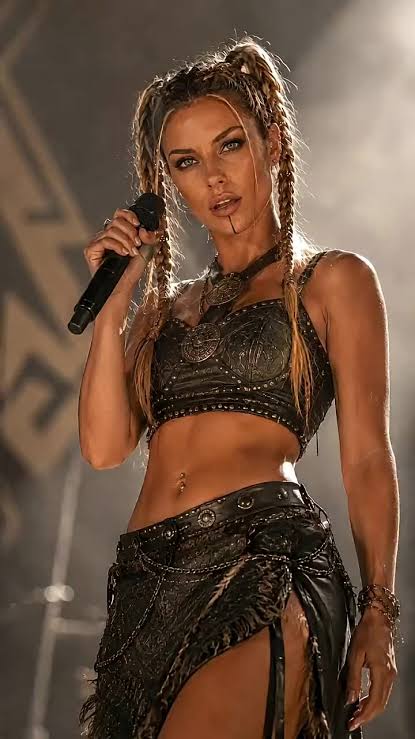
Who Is RAVNIR? Is the Mysterious Viking Music Singer Real or AI?
If you’ve been watching Viking-inspired music videos on YouTube, Facebook, Instagram or TikTok, there’s a chance you’ve come across RAVNIR.
The Nordic music project combines powerful vocals, dramatic imagery, Viking mythology and cinematic production.
But as RAVNIR has attracted attention, an increasingly familiar question has emerged.
Who is actually behind the music?
And is RAVNIR a real singer, or another AI-generated artist?
The answer is more complicated than it might initially appear.
Who is RAVNIR?
RAVNIR is a Nordic and Viking-inspired music project based in Switzerland.
According to RAVNIR’s official website, the project was created by two people named Emma and Oskar, who describe their work as being inspired by their roots in Norway and Iceland.
Emma is presented as the project’s main vocalist and visual identity.
Oskar is described as handling much of the music production and cinematic sound.
Together, they create music influenced by Nordic folk, Viking mythology, dramatic percussion and modern electronic production.
The project says it began on 23 January 2026.
Since then, RAVNIR has released numerous recordings and developed a substantial social media presence.
However, questions remain about the role of AI in the project’s visuals and performances.
Is RAVNIR an AI-generated singer?
There is clear evidence that artificial intelligence is involved in some of RAVNIR’s visual content.
That does not automatically mean the music or vocals are AI-generated.
RAVNIR has described its visual presentation as involving modern AI-enhanced artwork and has referred to digital tools in its social media presence.
Several of its YouTube music videos have also carried YouTube’s “Made with AI” disclosure.
These notices are important, but they require some context.
YouTube’s disclosure can apply when sounds or visuals have been meaningfully altered or generated.
It does not necessarily mean that every element of a recording was created by AI.
A video could contain AI-generated scenery while featuring a real singer.
Alternatively, a virtual artist could combine synthetic vocals, generated imagery and human-written songs.
The available public information does not establish exactly how RAVNIR produces every part of its music.
So while the use of AI in the project’s visual presentation is documented, the status of its vocal performances remains unverified.
Who is the woman in RAVNIR’s music videos?
RAVNIR identifies a woman named Emma as the voice and face of the project.
Its website presents Emma as the central performer, while Oskar works on the production.
However, the public biography provides limited independent information about Emma.
There is no widely established full name, detailed traditional musician biography or independently verified live-performance history that conclusively establishes the identity of the woman depicted across its videos.
This does not prove that Emma is fictional.
It simply means the available public material does not independently verify the relationship between the project’s visual character and the recorded voice.
That distinction has become increasingly important as AI-enhanced music videos grow more convincing.
A singer appearing on screen is no longer necessarily evidence that the recording features that person’s voice.
Where is RAVNIR from?
Despite the strong Norwegian and Icelandic influences, RAVNIR describes itself as a Swiss-based music project.
Its creators say they have roots in Norway and Iceland.
That explains why the music frequently draws on Nordic languages, mythology and historical imagery.
RAVNIR’s songs move between English and Nordic-inspired lyrics, combining traditional-sounding vocal arrangements with modern cinematic production.
The result is music that can appeal to fans of Viking mythology, fantasy soundtracks, Nordic folk and dramatic battle music.
It’s worth remembering that modern Viking-inspired music is not necessarily an accurate recreation of music performed during the Viking Age.
Much of the genre is a contemporary interpretation of ancient stories and imagery.
Is RAVNIR connected to VYRMA?
Yes.
RAVNIR and VYRMA collaborated on the six-track EP HRAFNAKALL, released on 14 September 2026.
The project brought together two artists operating in a similar musical space.
Both use Nordic mythology, ravens, warriors and cinematic imagery as central parts of their musical identity.
HRAFNAKALL includes “Ísblóð”, “Odins Ravner”, “Sigrblót”, “Where Ravens Fly”, “Einherjar” and “Two Vikings”.
The collaboration is especially interesting because VYRMA has also generated considerable curiosity surrounding the artist’s identity and use of artificial intelligence.
VYRMA’s public music credits identify Marios Demetriou as a songwriter and composer on several previous releases, although the identity of the voice behind the project has been a separate question.
We’ve previously explored those questions in Who Is the Singer Behind VYRMA?.
The two projects share a musical aesthetic, but RAVNIR and VYRMA are presented as separate artist identities.
Their collaboration does not establish that they have the same creators or production methods.
What songs and albums has RAVNIR released?
RAVNIR has built an extensive catalogue during 2026.
Releases listed on its official website include Vølven, Gudlaus, GODS, Nordlys, Modpoler and No Pain No Gain.
The catalogue contains tracks such as “Mørk Pels”, “Odins Ravner”, “Freya”, “Í Valhöll” and “Iron Heart Queen”.
These recordings explore different elements of the project’s Nordic sound, including mythology, atmospheric folk and cinematic arrangements.
RAVNIR has also announced another album, Cold Nights, scheduled for release on 7 December 2026.
For listeners discovering the project through VYRMA, the HRAFNAKALL collaboration provides an obvious starting point.
Are RAVNIR’s concert videos real?
This is another important question.
Some social media clips associated with RAVNIR use concert-style imagery, showing a singer performing in front of audiences.
But a convincing concert video is no longer sufficient evidence that a live performance actually took place.
AI video tools can now generate stages, crowds, lighting effects and realistic-looking singers.
When a concert-style video is labelled as AI-generated, viewers should avoid assuming that the depicted performance happened at an actual venue.
That doesn’t mean RAVNIR has never performed live.
It means a specific video should not be treated as documentation of a real concert without supporting evidence such as a venue announcement, official ticket listing or independently documented performance.
Why are artists like RAVNIR and VYRMA becoming so popular?
Part of the attraction is undoubtedly the music.
Nordic folk and Viking-inspired recordings have a recognisable combination of dramatic vocals, percussion, mythology and atmospheric production.
These sounds can work especially well alongside fantasy imagery, gaming content and cinematic social media videos.
But another element is the mystery.
Listeners aren’t simply searching for new songs.
They’re asking questions about the artists themselves.
Who is singing?
Are the performances real?
Is the artist an AI character?
Who produces the music?
These questions create a second reason for people to discover the project, separate from simply enjoying the recordings.
For traditional musicians, attention generally centres on the artist’s performances, career and personal story.
For some newer digital music projects, the uncertainty surrounding the identity can become part of the appeal.
So, is RAVNIR real or AI?
The most accurate conclusion is that RAVNIR is a real music project which publicly identifies Emma and Oskar as its creators.
The project acknowledges using digital and AI-enhanced visual techniques, and some of its music videos carry AI disclosures.
However, those disclosures do not conclusively establish whether the singing is performed by a human vocalist or generated using AI.
Until more detailed production information or independent confirmation becomes available, that question remains unresolved.
What is clear is that RAVNIR is part of a growing category of music projects where the boundary between traditional performers, digital characters and artificial intelligence is becoming increasingly difficult for listeners to distinguish.
And with projects like VYRMA attracting attention in the same musical space, those questions are unlikely to disappear anytime soon.