What Does OutKast’s “Hey Ya!” Mean? The Sad Story Behind the Happy Song
OutKast’s “Hey Ya!” is about relationships that continue even when the people involved are no longer happy.
Yes.
That song.
The one everybody dances to at weddings.
André 3000 wrote it as a playful but surprisingly cynical examination of modern relationships.
He was interested in the idea that people sometimes remain together because society expects them to.
They get married.
Build a life.
Stay together.
But the relationship itself may no longer make either person happy.
Instead of writing a slow, depressing ballad about that situation, André created one of the most joyful-sounding pop records of the 2000s.
The contradiction is deliberate.
Is “Hey Ya!” actually a sad song?
Emotionally, yes.
Musically, absolutely not.
The drums are energetic.
The guitars are bright.
The vocals sound playful.
The chorus is enormous.
Nothing about the production initially suggests romantic disappointment.
But the lyrics repeatedly question whether love actually lasts.
André is interested in the gap between what people say about relationships and how those relationships function in reality.
That gap is the real subject.
What did André 3000 say the song was about?
He described it as an examination of relationships in the 2000s.
He was interested in people remaining together because of tradition rather than happiness.
The idea wasn’t necessarily autobiographical.
André has explained that he often builds fictional situations from observations and fragments of his own experience.
“Hey Ya!” is closer to a humorous social observation than a literal diary entry.
That helps explain the exaggerated performance.
The song is partly serious.
And partly making fun of how seriously people take romantic conventions.
Why is the chorus so happy?
Because contrast makes the song more powerful.
Imagine the same subject performed with a slow piano.
It would be obvious.
Relationships are difficult.
People are unhappy.
Love may not last.
Instead, André hides those ideas inside an irresistible dance record.
That creates two completely different listening experiences.
At a party, the music feels celebratory.
When you’re alone with headphones, the writing becomes considerably more uncomfortable.
The same recording performs both jobs.
Is the song criticising marriage?
Not exactly.
It’s more interested in questioning assumptions.
People are frequently told that finding a partner and remaining together is the natural route towards happiness.
André asks whether that expectation always matches reality.
Some relationships continue because both people are happy.
Others continue because separation feels difficult or socially unacceptable.
The song doesn’t provide a simple answer.
It simply suggests that conventional romantic stories are often less honest than they appear.
What does “Hey Ya!” mean as a title?
The title functions mainly as a vocal expression.
It’s energetic.
Memorable.
Easy to shout.
And completely disconnected from the emotional complexity underneath the recording.
That is part of the joke.
The title sounds like pure celebration.
The song itself is more cynical.
Why does the song mention Polaroid pictures?
Because André wanted a memorable image that people could immediately understand.
The reference became one of the recording’s most famous moments.
Listeners began physically shaking imaginary Polaroid photographs while dancing.
Interestingly, Polaroid later pointed out that shaking its pictures wasn’t actually necessary and could potentially interfere with development.
An excellent example of pop music becoming more culturally influential than the instructions supplied by the manufacturer.
Who wrote “Hey Ya!”?
André 3000.
He wrote and produced the recording.
It appeared on OutKast’s 2003 double album Speakerboxxx/The Love Below.
The album was unusual because the two members effectively created separate musical worlds.
Big Boi’s Speakerboxxx remained more closely connected with hip-hop.
André’s The Love Below explored:
funk
pop
soul
rock
jazz
and experimental songwriting.
“Hey Ya!” became the most commercially successful example of André’s approach.
Is Big Boi on “Hey Ya!”?
Not as a featured lead performer in the way listeners might expect from a conventional OutKast collaboration.
The song primarily belongs to André’s half of the album.
That reflects the project’s structure.
Although released under the OutKast name, Speakerboxxx/The Love Below gave both members considerable room to develop their individual musical identities.
What genre is “Hey Ya!”?
Pop.
Funk.
Alternative hip-hop.
Dance-rock.
There are also strong influences from:
soul
new wave
and classic pop songwriting.
The song is difficult to categorise because André deliberately ignores conventional musical boundaries.
That genre mixture helped it reach audiences far beyond hip-hop.
Why does the rhythm feel unusual?
The composition uses a repeating chord pattern with an unusual rhythmic structure.
Most listeners don’t consciously notice it.
They simply feel the groove.
But the song doesn’t behave exactly like a conventional four-beat pop record throughout.
The slight irregularity gives the arrangement additional personality.
It’s another example of André experimenting while making something that still sounds immediately accessible.
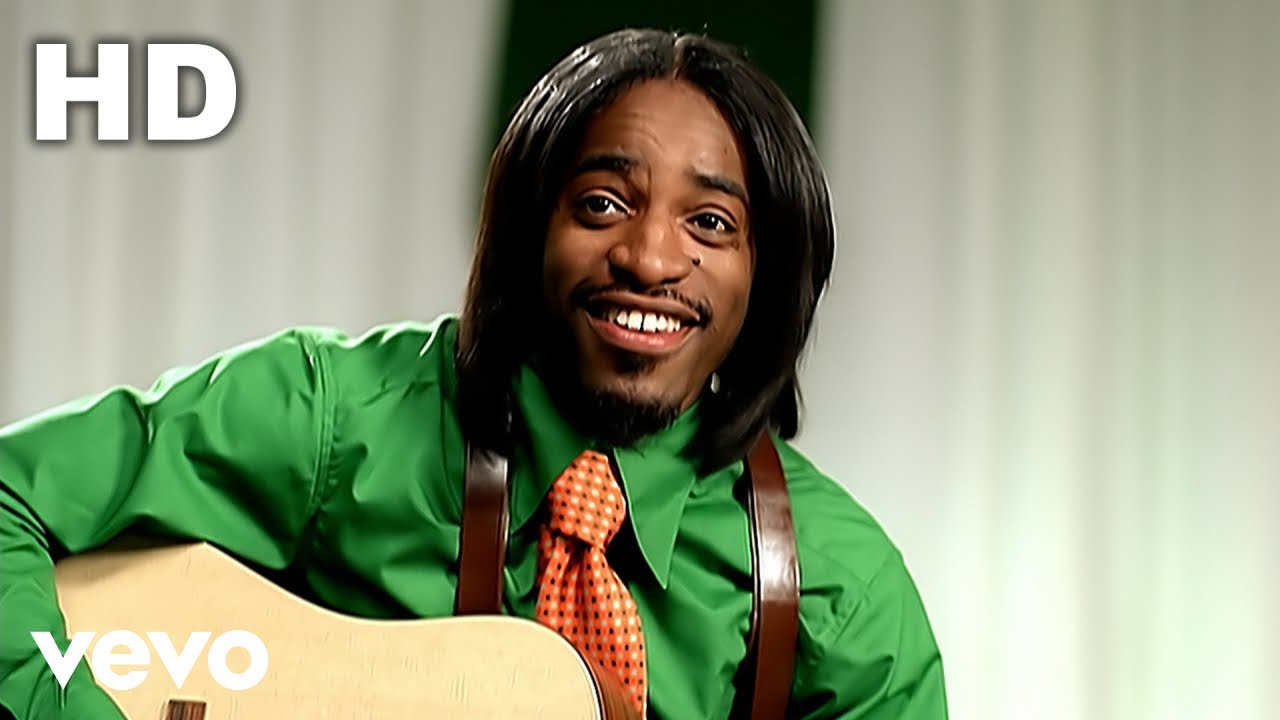
Why is the music video so memorable?
Because it transforms André into an entire fictional band.
He plays multiple characters inspired by classic television performances and 1960s pop groups.
The video contains a deliberate sense of theatrical comedy.
Different band members.
Different personalities.
Different costumes.
The result looks like a historical performance that has somehow become slightly ridiculous.
That visual identity fits the song’s mixture of sincerity and satire.
Why do people still play “Hey Ya!” at weddings?
Because the music works.
Most people attending a wedding aren’t carefully analysing relationship philosophy.
They hear:
an enormous chorus
an energetic rhythm
a familiar song.
That is enough.
The irony is that the original recording questions whether conventional relationships actually make people happy.
And it has become one of the most familiar soundtracks to celebrating marriage.
André probably appreciates the joke.
Songs like “Hey Ya!”
Try:
OutKast – Roses
OutKast – The Way You Move
Gnarls Barkley – Crazy
Prince – Kiss
N.E.R.D. – She Wants to Move
Janelle Monáe – Tightrope
The Black Eyed Peas – Let’s Get It Started
MGMT – Electric Feel
These songs combine different elements of funk, alternative pop and unusual songwriting.
Why has “Hey Ya!” lasted?
Because the musical surface is almost impossible to resist.
You don’t need to understand the lyrics.
You don’t need to enjoy conventional hip-hop.
You don’t even need to know who OutKast are.
The recording works immediately.
But the writing gives it another layer that listeners can discover years later.
That combination creates unusual longevity.
What does “Hey Ya!” really mean?
Love is complicated.
Social expectations don’t guarantee happiness.
And people sometimes remain in relationships for reasons that have very little to do with actually enjoying being together.
André 3000 turned that uncomfortable observation into a party anthem.
Millions of people have spent two decades dancing to it.
Many are only now discovering the joke.