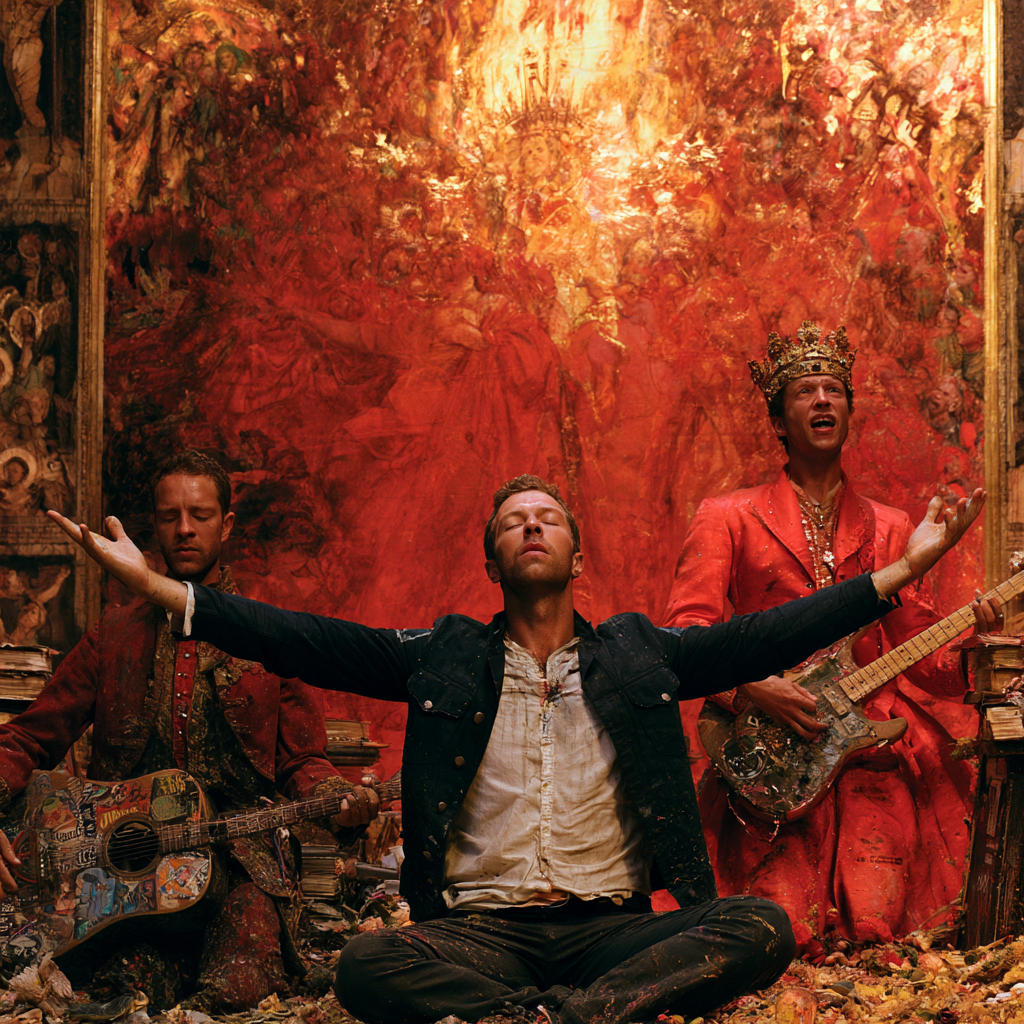
What Does Coldplay’s “Viva la Vida” Mean? The Fallen King’s Story Explained
Coldplay’s “Viva la Vida” is about a powerful ruler who loses everything.
The narrator remembers being a king.
He once controlled an enormous kingdom.
But now his authority has disappeared.
Revolutionaries have turned against him.
And he is forced to confront the consequences of his former power.
The song uses imagery associated with revolution, religion and historical monarchy.
But it isn’t a straightforward retelling of one real king’s life.
It’s a fictional story about power, pride and loss.
And its title comes from a painting by Mexican artist Frida Kahlo.
What does “Viva la Vida” mean in English?
“Long live life”.
The phrase is Spanish.
Chris Martin has explained that he encountered it through Frida Kahlo’s artwork.
Kahlo experienced considerable physical pain and personal difficulty during her life.
Nevertheless, the phrase expresses a celebration of living.
Martin admired that contrast.
The title became part of Coldplay’s fourth album.
Who is the king in Viva la Vida?
The song doesn’t identify one specific historical ruler.
The narrator is fictional.
But his situation resembles that of monarchs who lost power during periods of revolution.
Some listeners connect the song with King Louis XVI of France.
That interpretation makes sense because the lyrics contain images associated with revolution and execution.
However, Coldplay haven’t established that the composition is exclusively about Louis XVI.
It’s better understood as a broader story about the fall of an arrogant ruler.
Is the song about the French Revolution?
It contains imagery that strongly resembles revolutionary history.
The narrator describes a reversal of power.
People who once obeyed him now threaten him.
His former authority offers no protection.
That creates a natural connection with the French Revolution.
But the song also incorporates biblical imagery and other historical references.
It isn’t structured as a precise account of events in France.
The historical details are used to create a larger emotional story.
What does the king regret?
The loss of his former identity.
He once believed his power was permanent.
But circumstances changed.
The narrator now recognises how quickly authority can disappear.
That creates a sense of regret and disbelief.
The song can therefore be interpreted beyond politics.
People experience similar feelings when losing status, relationships or control over their lives.
The king becomes a metaphor for anybody confronting the collapse of something they once considered secure.
Why are there religious references?
The song uses biblical imagery to create an atmosphere of judgement.
References to spiritual authority and religious symbolism suggest that the narrator is questioning his own moral position.
That makes the story more complicated.
The king hasn’t simply lost political power.
He appears to be confronting the possibility that his former behaviour was wrong.
The religious imagery gives the loss a sense of moral consequence.
Is the king supposed to be sympathetic?
Partly.
The song is written from his perspective.
The listener experiences his fall through his own words.
That creates emotional intimacy.
But the narrator isn’t necessarily innocent.
He once held enormous power.
And the story suggests that his downfall may be connected with how he used it.
That ambiguity makes the song particularly interesting.
The listener can feel sympathy without believing the king deserved his authority.
When was Viva la Vida released?
2008.
The song appeared on Coldplay’s album Viva la Vida or Death and All His Friends.
It became one of the band’s biggest international hits.
The recording reached No. 1 in Britain and America.
It subsequently won Song of the Year at the Grammy Awards.
That was a remarkable commercial success for a recording with such elaborate lyrical imagery.
Why does it sound so different from earlier Coldplay?
Because of the arrangement.
Earlier Coldplay hits such as “Yellow” and “The Scientist” were strongly associated with guitar and piano-driven alternative rock.
“Viva la Vida” places greater emphasis on orchestral textures and rhythmic strings.
The production is energetic and dramatic.
The recording also uses unusual percussion and layered instrumentation.
That gives the song a much larger musical personality.
Who produced the song?
The album involved producers including Brian Eno, Markus Dravs and Rik Simpson.
Eno became particularly associated with encouraging Coldplay to experiment beyond their established musical style.
The resulting album incorporates broader instrumental and structural ideas.
“Viva la Vida” is one of the clearest examples.
It retains Coldplay’s accessible melodic songwriting.
But the production is more elaborate.
Why does the music sound triumphant?
Because of the rhythm and melody.
The string arrangement creates excitement.
The percussion drives the recording forward.
The chorus has an enormous, communal quality.
But the story is actually about defeat.
That contrast is central.
The music sounds like a celebration.
The lyrics describe the collapse of power.
It’s one reason the recording remains so memorable.
What is the Frida Kahlo connection?
The album title was inspired by Kahlo’s painting containing the phrase “Viva la Vida”.
Chris Martin admired her decision to celebrate life despite extraordinary personal suffering.
That emotional contrast fits the album’s wider themes.
Life and death.
Success and failure.
Hope and disappointment.
But the painting isn’t a literal explanation of the fictional king’s story.
It’s the inspiration for the title and broader creative atmosphere.
Why does the song still connect with listeners?
Because power and status are temporary.
The narrator’s experience can be understood as a historical story.
But the emotional meaning is much broader.
People lose jobs.
Relationships end.
Circumstances change.
And identities built around those circumstances can become unstable.
“Viva la Vida” turns that experience into a dramatic musical narrative.
For another example of an album using a fictional story to explore larger human emotions, Radar’s The Black Parade material offers a useful comparison with My Chemical Romance’s theatrical approach.
Songs like “Viva la Vida”
Try:
- Coldplay – Violet Hill
- Coldplay – Lovers in Japan
- Arcade Fire – Wake Up
- Muse – Starlight
- Keane – Somewhere Only We Know
- The Killers – All These Things That I’ve Done
- Snow Patrol – Open Your Eyes
- U2 – Where the Streets Have No Name
- Florence + the Machine – Shake It Out
- Imagine Dragons – Demons
What does “Viva la Vida” really mean?
The rise and fall of power.
Coldplay created a fictional narrator who once controlled a kingdom but has lost everything.
The song draws from revolutionary history and biblical imagery.
Its title was inspired by Frida Kahlo’s celebration of life despite suffering.
The result combines an uplifting arrangement with a story about defeat.
That’s what makes it unusual.
The music sounds victorious.
But the person singing has already lost.