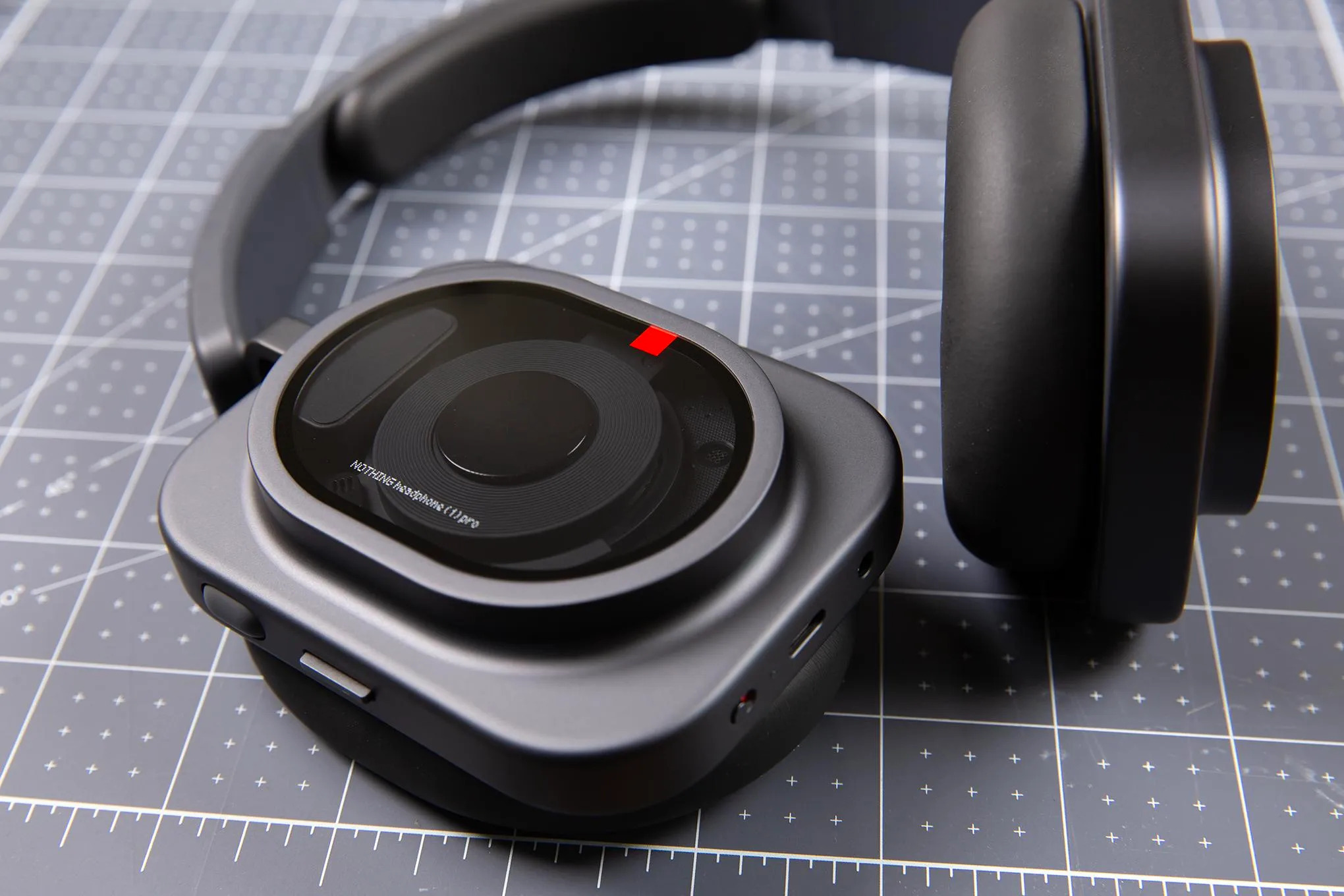
Nothing Headphone (1) Pro – New £349 Flagship Headphones Bring Studio-Grade Audio to Everyday Listening
Nothing is taking a much bigger swing at the premium headphone market.
The company has unveiled the Nothing Headphone (1) Pro, its new flagship pair of wireless over-ear headphones, with a £349 UK price tag and a long list of upgrades aimed at listeners who want more control over how their music sounds.
Rather than simply adding better noise cancellation or increasing battery life, Nothing has completely reworked the audio system.
The Headphone (1) Pro uses three separate drivers inside each earcup, supports high-resolution and lossless audio, offers spatial audio with head tracking and even includes a physical switch that lets listeners bypass much of the headphone’s sound processing.
At $399 in the US and £349 in the UK, Nothing is now competing directly with some of the biggest names in premium headphones.
So what exactly makes the Nothing Headphone (1) Pro different?
Nothing has put three drivers inside each ear
The headline feature is the new triple-driver system.
Most mainstream wireless headphones use a single large driver in each earcup to reproduce everything from deep bass to vocals and high-frequency details.
Nothing has taken a different approach.
Each side of the Headphone (1) Pro contains:
- A 40mm dynamic driver for bass
- A separate precision driver for the midrange
- An xMEMS solid-state driver for high frequencies
The idea is similar to a multi-speaker system: instead of asking one component to reproduce the entire frequency range, different drivers can concentrate on different parts of the music.
Nothing says this should deliver deeper bass, clearer vocals and better separation between instruments.
For listeners, that could make complex recordings feel less congested, particularly when several instruments, vocals and percussion are all competing for space.
It is also an unusual configuration for mainstream wireless headphones. The Sony WH-1000XM6, Bose QuietComfort Ultra Headphones and Apple’s AirPods Max traditionally rely on a single primary driver in each earcup.
There is a physical Flat EQ switch
One of the most interesting features isn’t hidden inside an app.
Nothing has put a physical Flat EQ switch on the headphones.
The feature was developed alongside London’s Metropolis Studios and is designed to remove Nothing’s normal EQ and spatial processing, giving listeners a more neutral representation of the original recording.
It’s primarily aimed at producers, engineers and musicians who may want to hear music without additional sound colouring.
But it could also be interesting for music fans.
Most consumer headphones deliberately alter the sound of music. Manufacturers may boost the bass, emphasise vocals or increase certain higher frequencies to create their preferred sound signature.
Flat EQ gives listeners another option.
You could potentially listen to an album using Nothing’s normal tuning and then switch to Flat EQ to hear a more neutral version of the same recording.
The Verge found that Nothing’s standard Balanced EQ pushes the mids and highs forward, while activating Flat EQ brings those frequencies closer in balance with the bass.
That doesn’t necessarily mean Flat EQ will sound better.
Many listeners actually prefer headphones with some additional bass and treble rather than a perfectly flat response.
But having both options available instantly is unusual.
Nothing worked with Metropolis Studios
The studio connection is another interesting part of the Headphone (1) Pro.
Nothing collaborated with Metropolis Studios in London while developing its audio tuning and Flat EQ features.
Metropolis is one of Britain’s best-known recording and mastering facilities and has worked with a huge number of major artists.
The partnership helps explain why Nothing appears to be positioning these headphones somewhere between everyday wireless headphones and more serious listening equipment.
They aren’t traditional studio headphones.
But Nothing clearly wants users to feel comfortable using them both for Spotify on a train and for analysing a recording in much more detail.
Hi-res and lossless music support
The Headphone (1) Pro also gives listeners several ways to play higher-quality audio.
Wireless playback supports LDAC alongside AAC and SBC, while the headphones are Hi-Res Audio certified.
Connect them directly using USB-C and they can play lossless audio at up to 24-bit/192kHz.
There’s also a 3.5mm connection, with Nothing listing support for high-resolution audio at up to 24-bit/96kHz through the analogue connection.
That makes the Headphone (1) Pro particularly interesting for listeners using lossless streaming services such as Apple Music, Tidal or Qobuz.
Bluetooth audio still involves limitations depending on your phone, codec and streaming setup, so using USB-C remains the most direct route to the highest supported audio quality.
Active noise cancellation gets a major upgrade
Nothing has also considerably upgraded its active noise cancellation system.
The Headphone (1) Pro uses a total of ten microphones and offers real-time adaptive ANC of up to 46dB, according to Nothing.
There’s also a transparency mode for situations where you need to hear what’s happening around you.
Early testing from The Verge found the headphones particularly effective at reducing low-frequency noise such as aircraft and air-conditioning sounds.
Its reviewer considered the ANC below the leading Sony, Bose and Apple alternatives, but described it as Nothing’s best noise cancellation system so far.
For most listeners, that’s probably more important than achieving the absolute strongest ANC available.
Good noise isolation means you don’t need to push your music as loud to hear details while travelling or working in noisy environments.
Up to 68 hours of battery life
Battery life is another strength.
Nothing claims up to 68 hours of AAC playback with ANC switched off.
With noise cancellation enabled, that figure drops to around 30 hours.
Using LDAC increases power consumption slightly:
- Up to 53 hours with ANC off
- Up to 28 hours with ANC on
Fast charging is supported too.
A five-minute charge can provide up to four hours of playback without ANC or around two hours with ANC enabled.
For most users, that means the Headphone (1) Pro should comfortably survive several days of regular listening between charges.
Spatial audio with head tracking
Nothing has also added spatial audio with head tracking.
Spatial audio attempts to create the impression that sound is coming from around you rather than directly from two speakers attached to your ears.
Head tracking then adjusts that virtual soundstage as you move your head.
It’s becoming increasingly common among flagship headphones, particularly as services including Apple Music continue expanding their catalogues of Dolby Atmos and spatial mixes.
The Headphone (1) Pro also includes Nothing’s Personal Sound technology, allowing the listening experience to be customised further.
Auracast could become increasingly useful
Another less obvious feature is Auracast.
The Headphone (1) Pro can operate with Auracast through the Nothing X app, allowing compatible devices to broadcast audio to multiple headphones simultaneously.
Auracast is part of the newer generation of Bluetooth audio technology.
Eventually, it could allow people to connect headphones directly to audio broadcasts in places such as airports, gyms, cinemas and public venues.
It could also make sharing music much easier.
Instead of passing someone one side of your headphones, multiple compatible pairs could potentially receive the same broadcast.
It’s still an emerging technology, but support on a flagship pair of headphones is useful future-proofing.
Nothing keeps its physical controls
Nothing hasn’t abandoned one of the better features of its earlier headphones either.
Physical controls remain.
The Headphone (1) Pro includes a roller for adjusting volume, a paddle for controlling tracks and calls, buttons for additional functions and the dedicated Flat EQ switch.
Touch-sensitive headphone controls can sometimes be awkward, particularly when adjusting headphones or wearing them outdoors.
Physical controls provide much clearer feedback.
The Verge was particularly positive about Nothing’s tactile buttons and volume roller.
The case could be controversial
The headphones themselves retain Nothing’s distinctive transparent-inspired industrial design, but the carrying case may divide opinion.
Instead of completely enclosing the headphones, the hard-shell case protects primarily the earcups while leaving the headband exposed.
The headband essentially becomes the carrying handle.
The Verge compared the idea to Apple’s unusual AirPods Max Smart Case, although Nothing’s version offers a harder protective shell around the earcups.
It’s certainly distinctive.
Whether you actually want your £349 headphones’ headband exposed inside your bag is another question.
Nothing Headphone (1) Pro specifications
The main specifications include:
Price: £349 UK / $399 US
Drivers: 40mm dynamic bass driver, separate precision driver and xMEMS treble driver
Frequency response: 20Hz–40kHz
Noise cancellation: Real-time adaptive ANC up to 46dB
Microphones: 10
Battery: Up to 68 hours with ANC off
Battery with ANC: Up to 30 hours
Bluetooth: Bluetooth 6.1
Codecs: SBC, AAC, LDAC and LC3 for broadcast audio
USB-C audio: Up to 24-bit/192kHz lossless
3.5mm audio: Up to 24-bit/96kHz
Spatial audio: Yes, with head tracking
Multipoint: Yes
Auracast: Yes
Weight: 327g
Water and dust resistance: IP52
Nothing is now competing with Sony, Bose and Apple
Perhaps the biggest story here isn’t any individual specification.
It’s the price.
At £349, Nothing isn’t trying to make an inexpensive alternative to premium headphones anymore.
The Headphone (1) Pro sits in broadly the same market as headphones from Sony, Bose, Sennheiser and Apple.
That means buyers will expect excellent sound, comfort, ANC and build quality rather than simply accepting compromises in exchange for Nothing’s distinctive design.
The triple-driver architecture gives Nothing something genuinely different to talk about.
The combination of physical controls, Flat EQ, USB-C lossless playback, LDAC and extensive EQ options should also appeal to people who enjoy experimenting with how their music sounds.
Are the Nothing Headphone (1) Pro worth £349?
That may depend on exactly what kind of listener you are.
If your only requirement is excellent noise cancellation, established alternatives from Sony and Bose remain formidable competition.
But Nothing is clearly approaching the premium headphone category slightly differently.
Instead of concentrating entirely on convenience, it’s giving users unusually deep control over their audio.
Three separate drivers.
High-resolution wireless playback.
Lossless USB-C audio.
A sophisticated EQ.
Spatial audio.
And a physical switch capable of stripping much of that processing away again.
That makes the Nothing Headphone (1) Pro one of the more interesting flagship headphone launches of 2026.
For serious music listeners, perhaps the most compelling part is that Nothing isn’t simply promising “better sound”.
It’s giving listeners considerably more choice over what better sound actually means.