AI Music Disclosure Checklist for Artists and Labels
Generative AI is becoming part of the music production process.
Some artists use it for small creative tasks.
Others generate substantial parts of a recording.
For distributors and streaming services, that difference matters.
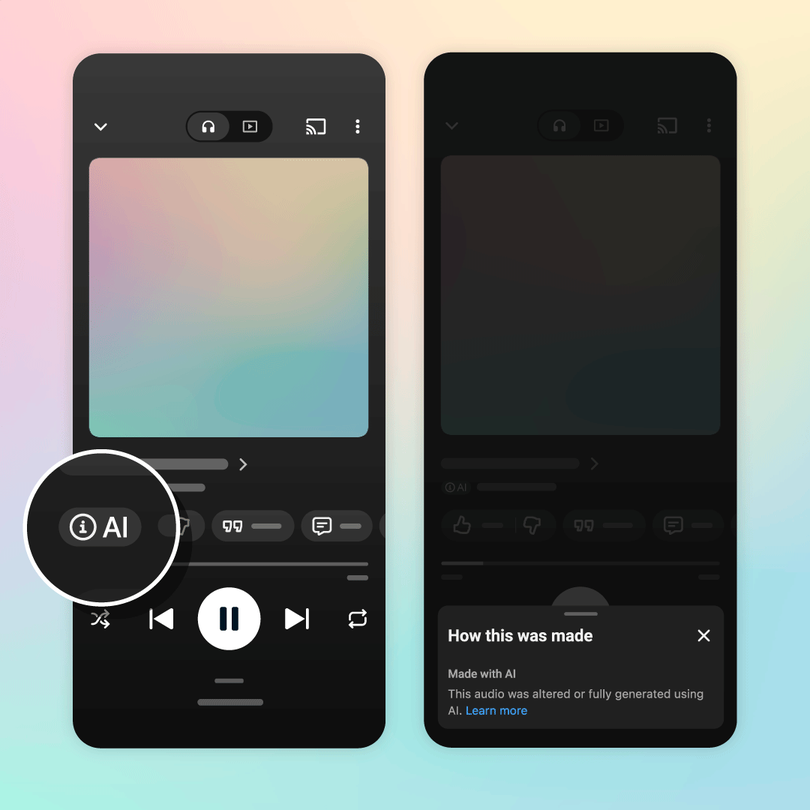
YouTube now supports music metadata distinguishing fully generated, partly generated and non-generative content.
The easiest way to handle these requirements is to document AI use while creating the music, rather than trying to reconstruct the production process months later.
Why keep an AI production log?
Imagine a song was created with five collaborators.
One person recorded vocals.
Another generated a string arrangement.
A third used AI mastering.
Six months later, the distributor asks how AI was used.
Without production notes, nobody may remember exactly which tools were involved.
A simple log avoids that problem.
Record the project details
For every commercial release, start with:
- artist;
- track title;
- project date;
- release date;
- producer;
- contributors;
- master owner.
Add the ISRC and UPC when assigned.
Record each AI tool
For every relevant tool, record:
- tool name;
- provider;
- version where known;
- subscription tier;
- date used;
- purpose;
- output created.
This creates a useful history.
Separate different kinds of AI use
Do not describe the entire recording simply as “made with AI” without further detail.
Record whether AI was used for:
Composition
Melodies, chords, lyrics or song structure.
Instrumental generation
Generated drums, bass, strings, synthesis or other musical material.
Vocals
Generated performances, voice conversion or synthetic singing.
Production assistance
Mixing recommendations, editing, noise reduction or mastering.
Artwork
Generated visual assets or altered images.
Music video
Generated scenes, characters or other visual material.
These categories can matter differently under platform policies.
Keep the original files
Save relevant:
- audio recordings;
- stems;
- sessions;
- lyrics;
- prompts;
- generated outputs;
- final mixes.
You do not need to archive every insignificant experiment.
Focus on the material incorporated into the commercial release.
Check commercial rights
For each generative tool, establish whether the applicable terms allow the intended commercial use.
Keep a record of:
- licence terms;
- subscription status;
- permissions;
- usage restrictions.
If third-party material was uploaded into the tool, document the rights to those inputs too.
Voice permissions need particular care
If a model reproduces a person’s voice, verify the relevant permission.
Do not assume that owning the finished audio automatically gives you rights to imitate another performer.
Keep any voice-licensing agreement with the release records.
Record the disclosure decision
Before distribution, summarise:
- Was generative AI used?
- Which parts were generated?
- Which parts were performed by humans?
- Was the full recording generated?
- Were synthetic voices involved?
- Were generative visuals used?
Then follow the current instructions from your distributor and target platforms.
Use a standard log
A simple production record could contain:
| Field | Example |
|---|---|
| Track | Running Home |
| AI tool | Example mastering tool |
| Purpose | Mastering |
| Generative content produced | None |
| Human recordings | Vocals, guitar, bass |
| AI-generated instruments | None |
| AI-generated lyrics | None |
| AI-generated artwork | No |
| AI-generated video | No |
| Rights checked | Yes |
| Evidence saved | Yes |
| Disclosure reviewed | Yes |
This is an illustrative record, not a substitute for the platform’s official metadata declaration.
Keep the log updated
If the release changes, update the record.
For example:
You might later create an AI-generated music video around an entirely human-recorded song.
That new video can require a different disclosure from the original sound recording.
Do not assume one declaration automatically covers every associated asset.
Final thoughts
AI disclosure is becoming part of ordinary release administration.
It does not need to be complicated.
Document the tools used, identify which creative elements were generated and keep the relevant rights evidence.
That makes distribution easier and helps avoid confusion as music platforms introduce new transparency requirements.