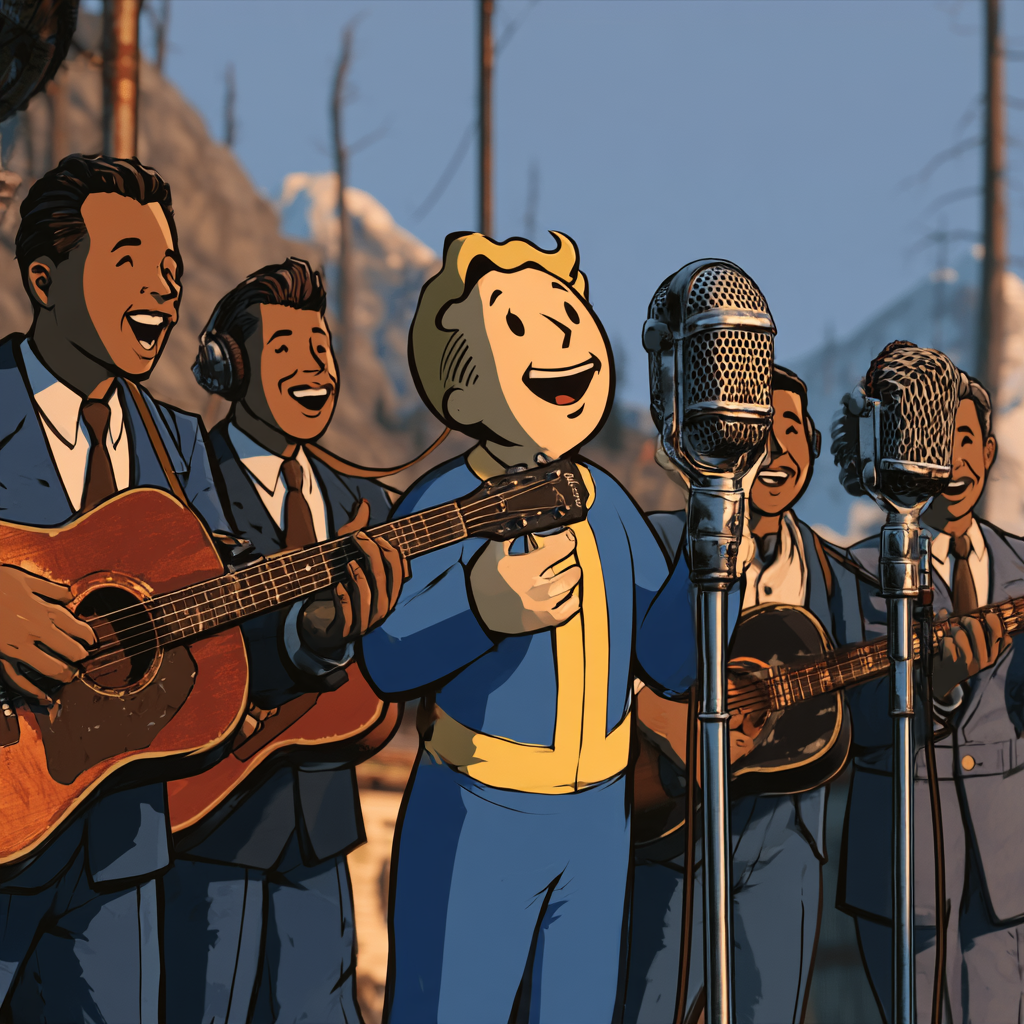
What Is the Fallout Theme Song? The Ink Spots Classic Explained
The song most closely associated with the Fallout franchise is “I Don’t Want to Set the World on Fire” by The Ink Spots.
The recording was released in 1941.
That’s decades before the first Fallout video game appeared in 1997.
Its gentle vocal harmonies and romantic message create a striking contrast with the franchise’s post-apocalyptic setting.
But Fallout doesn’t have one single theme song across every game.
Different releases use original scores and collections of older popular recordings.
The Ink Spots’ music nevertheless became central to the franchise’s identity.
Who are The Ink Spots?
An American vocal group that became enormously successful during the 1930s and 1940s.
Their recordings combined close vocal harmonies with jazz, pop and rhythm-and-blues influences.
The group’s distinctive sound frequently features a high lead vocal and a low spoken or sung passage.
That approach became particularly recognisable.
Their catalogue includes “If I Didn’t Care”, “Maybe” and “I Don’t Want to Set the World on Fire”.
These songs were already important long before they appeared in video games.
When was “I Don’t Want to Set the World on Fire” released?
1941.
The Ink Spots recorded their version in August of that year.
The single appeared the following month.
It became a major American hit.
The composition was written by Bennie Benjamin, Eddie Durham, Sol Marcus and Eddie Seiler.
Several artists recorded versions during the same period.
The Ink Spots’ interpretation eventually became the one most strongly associated with Fallout.
What does the song actually mean?
The narrator isn’t interested in grand ambitions or extraordinary achievements.
He wants romantic affection.
The song uses the image of setting the world on fire to describe ambition and excitement.
But the narrator values a personal relationship more.
That’s what makes its placement in Fallout so effective.
The words have an entirely different possible meaning when the listener is looking at a world devastated by nuclear war.
The original romance becomes darkly ironic.
Was the song written about nuclear war?
No.
The recording predates the first use of nuclear weapons in warfare.
It wasn’t written as a warning about a fictional post-apocalyptic future.
The connection developed through the games.
That’s important because listeners sometimes assume the song was created specifically for the Fallout universe.
It wasn’t.
The developers recognised how effectively the older recording could work in another context.
Was it in the original Fallout game?
Not in the way many people assume.
The original game’s opening used “Maybe” by The Ink Spots.
“I Don’t Want to Set the World on Fire” was reportedly considered, but the necessary permission wasn’t secured.
That created an unusual soundtrack history.
A recording strongly associated with the later franchise wasn’t the song used in its original introduction.
The choice of “Maybe” still established the retro-pop atmosphere that became central to Fallout.
When did “I Don’t Want to Set the World on Fire” appear?
It became particularly recognisable through Fallout 3, released in 2008.
The song appeared in promotional material and within the game.
It subsequently appeared in Fallout 4 and Fallout 76.
Its continued use helped establish it as a recurring musical identity.
Players could recognise the recording immediately, even when the fictional setting changed.
Is it in the Fallout television series?
Yes.
The television adaptation incorporates older recordings associated with the franchise’s musical world.
“I Don’t Want to Set the World on Fire” appears during the first season.
That brought the song to another audience.
Some viewers discovered it through the television series without knowing its earlier video-game appearances.
Others recognised it immediately because they had spent years hearing it while exploring the wasteland.
Why does Fallout use old music?
Because its world combines futuristic technology with imagery associated with mid-twentieth-century America.
The fictional society developed along a different technological and cultural path.
Its architecture, advertising and musical environment frequently reference the 1940s and 1950s.
That creates an unusual atmosphere.
Everything feels familiar.
But the circumstances are deeply unsettling.
The older music reinforces that contrast.
What genre is The Ink Spots’ music?
Traditional pop, vocal jazz and early rhythm-and-blues-influenced popular music.
The group’s arrangements are generally much more restrained than modern pop.
Vocals are central.
Instrumental accompaniment is relatively gentle.
That makes their recordings particularly effective when placed against the violent and dangerous environment of Fallout.
The contrast is almost humorous.
What other songs are famous from Fallout?
Try The Ink Spots’ “Maybe”, “Into Each Life Some Rain Must Fall” and “It’s All Over But the Crying”.
Other important songs associated with the franchise include Marty Robbins’ “Big Iron”, The Five Stars’ “Atom Bomb Baby” and Cole Porter’s “Anything Goes”.
These recordings explore different parts of mid-century popular music.
Some are romantic.
Others are playful.
And several become much darker when heard inside the game’s fictional world.
Is Fallout music the same as its original score?
No.
The licensed older recordings are only one part of the soundtrack.
The games also use original instrumental scoring to support exploration, combat and storytelling.
Those compositions create atmosphere without relying on familiar lyrics.
The older radio songs establish a different kind of identity.
Both approaches are important.
But listeners searching for the famous vintage vocal usually mean The Ink Spots.
Why has the song become so strongly associated with Fallout?
Because the same recording has appeared across several entries.
Repetition creates familiarity.
The contrast between romantic music and nuclear devastation also makes the choice memorable.
Once listeners understand the fictional world, the title acquires another meaning.
That’s the power of a well-selected soundtrack.
An existing recording can become emotionally connected with an entirely different story.
What should you listen to next?
Start with The Ink Spots’ original recordings.
Then explore Ella Fitzgerald, Billie Holiday and other major performers from the 1930s and 1940s.
For another example of a much older recording becoming famous through a later entertainment franchise, Radar’s Pulp Fiction opening-song explainer traces the history of Dick Dale’s “Misirlou”.
What is the Fallout theme song?
The most recognisable recurring vocal song is “I Don’t Want to Set the World on Fire” by The Ink Spots.
It was released in 1941 and later became closely associated with the games and television adaptation.
The original Fallout used another Ink Spots song, “Maybe”.
Together, those recordings helped establish one of gaming’s most distinctive musical identities.