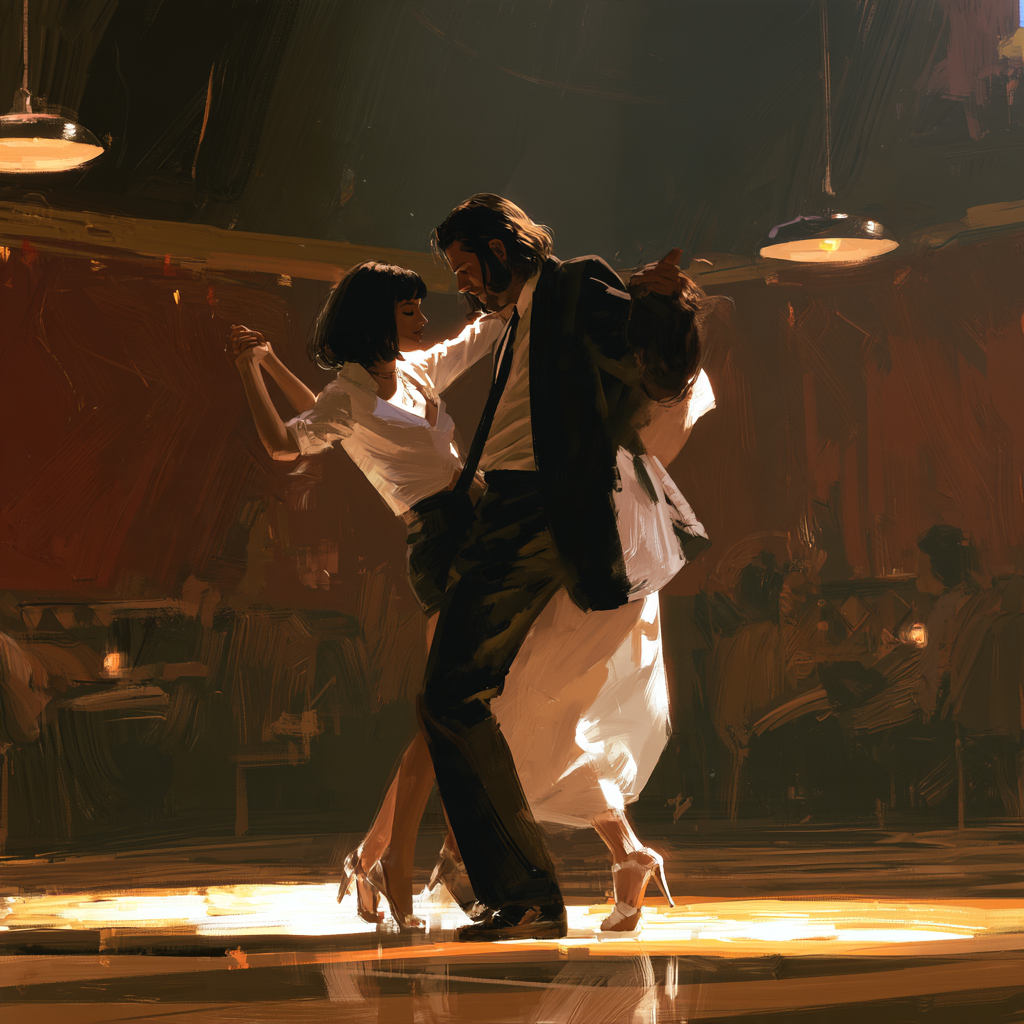
What Song Plays in the Pulp Fiction Dance Scene? Chuck Berry Explained
The song playing when John Travolta and Uma Thurman dance in Pulp Fiction is “You Never Can Tell” by Chuck Berry.
It’s also sometimes known as “C’est La Vie”.
Berry released the recording in 1964.
Thirty years later, Quentin Tarantino used it for one of the most famous dance scenes in cinema.
The sequence takes place at Jack Rabbit Slim’s.
Vincent Vega and Mia Wallace enter a twist competition.
The music begins.
And their unusual dance moves become one of the film’s defining moments.
But the song itself has a much older story.
Who originally sang “You Never Can Tell”?
Chuck Berry.
The American guitarist and songwriter became one of rock and roll’s defining figures.
His music combined blues, country and rhythm-and-blues influences.
Important recordings include “Johnny B. Goode”, “Roll Over Beethoven” and “Maybellene”.
“You Never Can Tell” belongs to a slightly different side of his catalogue.
The recording is playful and piano-driven.
It tells a complete story about a young couple.
That gives it an unusually narrative character.
When was the song released?
1964.
It appeared on Berry’s album St. Louis to Liverpool.
The recording became a commercial success.
It reached the American Top 20.
But its biggest later cultural association developed through Pulp Fiction.
Tarantino’s film introduced the song to a generation of viewers who hadn’t been alive during Berry’s original career.
That’s one of the director’s particular strengths.
He frequently uses older recordings to create distinctive cinematic moments.
What does “You Never Can Tell” mean?
Life can develop in unexpected ways.
The song tells the story of a young married couple.
They begin their life together.
Build a home.
Enjoy music.
And develop a relationship that seems surprisingly successful.
The central idea is that people cannot always predict how things will turn out.
That makes the title playful rather than threatening.
The recording is unusually optimistic.
Its cheerful rhythm supports the story.
Why is it also called “C’est La Vie”?
Because the French phrase appears prominently in the song.
It loosely means that’s life.
Listeners frequently remember that phrase more easily than the actual title.
That creates an identification problem.
Some people search for the Chuck Berry song from Pulp Fiction.
Others remember it as “C’est La Vie”.
Both searches refer to the same recording.
The official title is “You Never Can Tell”.
Where does the scene take place?
Jack Rabbit Slim’s.
The fictional restaurant is designed around 1950s and early-1960s American popular culture.
Its atmosphere includes music, dancing and nostalgic imagery.
The setting is deliberately exaggerated.
It’s not intended to be an ordinary contemporary restaurant.
Tarantino creates a stylised version of American entertainment history.
Chuck Berry’s recording fits naturally into that environment.
It sounds like music that belongs there.
Who are the characters dancing?
Vincent Vega, played by John Travolta.
And Mia Wallace, played by Uma Thurman.
The two characters have gone out together.
Their evening develops into an unusual mixture of conversation, humour and tension.
The dance competition becomes one of the few moments when they appear completely relaxed.
But the audience also recognises the potential danger surrounding their relationship.
That gives the cheerful scene another layer.
What dance are they doing?
The sequence is broadly associated with the twist.
But the performers incorporate various movements rather than following one precise conventional routine.
Travolta had already become internationally famous through dance films including Saturday Night Fever.
That history gives the scene additional cultural meaning.
The audience is watching an established dance-film star perform in an entirely different cinematic environment.
Uma Thurman’s restrained movements create an effective contrast.
The performance feels playful rather than technically elaborate.
Why is the scene so famous?
Because almost everything is immediately recognisable.
The music.
The costumes.
The characters.
The movement.
The restaurant.
The sequence also slows the film’s narrative.
Rather than presenting another dramatic confrontation, Tarantino allows the audience to enjoy a moment of unusual entertainment.
That makes the scene memorable independently of the surrounding story.
You don’t need to understand the complete plot of Pulp Fiction to recognise the dance.
Was Chuck Berry’s song written for the film?
No.
It existed thirty years earlier.
Tarantino selected it as an existing recording.
That makes it a soundtrack placement rather than an original film composition.
The song acquired another cultural identity through the scene.
For many modern listeners, it’s difficult to hear the recording without imagining Travolta and Thurman dancing.
That’s a powerful example of film changing how audiences experience older music.
What other songs are in Pulp Fiction?
The soundtrack includes numerous memorable recordings.
Among them:
- Dick Dale – Misirlou
- Dusty Springfield – Son of a Preacher Man
- Kool & the Gang – Jungle Boogie
- Urge Overkill – Girl, You’ll Be a Woman Soon
- The Revels – Comanche
- Chuck Berry – You Never Can Tell
The variety is important.
Tarantino doesn’t rely on one musical genre.
He uses different recordings to establish different emotional worlds.
What genre is “You Never Can Tell”?
Rock and roll.
Rhythm and blues.
Early pop rock.
The recording also has a distinctive piano-driven arrangement.
That separates it from Berry’s more guitar-focused hits.
Its rhythm is particularly effective for dancing.
The production is relatively simple.
But the melody and narrative provide enormous personality.
Songs like “You Never Can Tell”
Try:
- Chuck Berry – You Never Can Tell
- Chuck Berry – No Particular Place to Go
- Little Richard – Long Tall Sally
- Fats Domino – Blueberry Hill
- Ray Charles – What’d I Say
- Elvis Presley – A Little Less Conversation
- Jackie Wilson – Reet Petite
- The Isley Brothers – Shout
- The Beatles – Twist and Shout
- Sam Cooke – Twistin’ the Night Away
These recordings explore different parts of the rhythmic tradition that helped establish rock and roll.
What song plays during the Pulp Fiction dance?
“You Never Can Tell” by Chuck Berry.
Released in 1964.
Tarantino used it during the twist competition at Jack Rabbit Slim’s in 1994.
The song’s cheerful story and infectious rhythm helped create one of cinema’s most memorable musical sequences.
An older rock-and-roll recording became permanently associated with two characters dancing inside a fictional restaurant.
That’s the power of the right soundtrack choice.