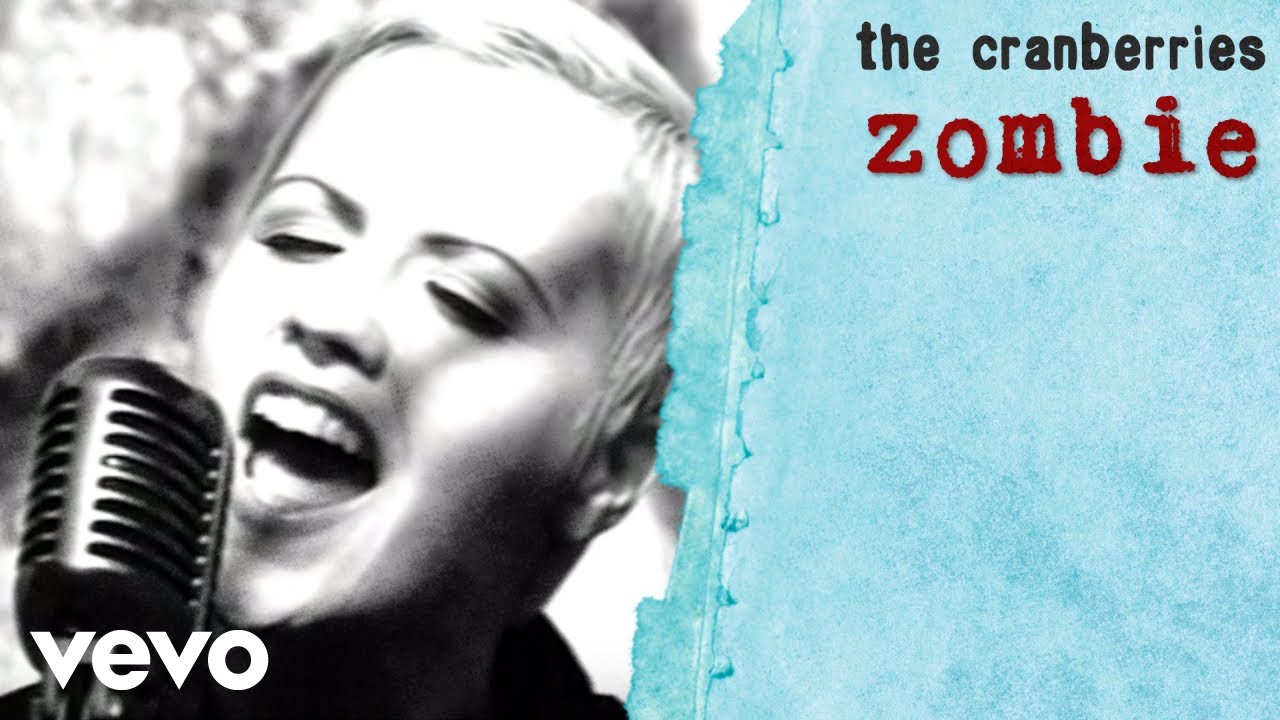
What Is The Cranberries’ “Zombie” Actually About?
“Zombie” was written after two children were killed in the 1993 Warrington bombing in England.
Three-year-old Johnathan Ball and 12-year-old Tim Parry died after bombs planted by the IRA exploded in Warrington town centre.
Dolores O’Riordan was horrified.
She turned that anger into one of the most famous anti-violence songs of the 1990s.
What happened in Warrington?
On March 20, 1993, bombs exploded in litter bins in Warrington.
Dozens of people were injured.
Two children died.
O’Riordan was particularly affected by television coverage showing the devastation experienced by their families.
She later recalled thinking about a mother who had carried a child for nine months only to lose him because somebody wanted to make a political point.
That anger sits underneath the entire recording.
Is “Zombie” about the IRA?
The Warrington bombing that inspired the song was an IRA attack.
So that context is essential.
But reducing the song to:
The Cranberries wrote an anti-IRA song
misses some of its wider meaning.
The target is the continuation of political violence itself.
Children are dying.
Families are being destroyed.
And generations are repeating conflicts inherited from the past.
The band’s Noel Hogan has described it less as a political manifesto and more as O’Riordan’s disgust at senseless violence.
What does “Zombie” mean?
The zombie can be interpreted as somebody continuing the same destructive behaviour without thinking.
Conflict becomes automatic.
One generation inherits hatred from another.
People stop seeing individual human beings.
They simply continue the fight.
The song repeatedly points toward history repeating itself.
That’s what makes the zombie metaphor so effective.
Why does “Zombie” sound so different from other Cranberries songs?
Listen to “Dreams”.
Then “Linger”.
Then “Zombie”.
The difference is enormous.
The Cranberries were known for atmospheric guitars and O’Riordan’s distinctive, delicate voice.
“Zombie” needed something heavier.
O’Riordan initially wrote it on acoustic guitar.
The band then layered distorted electric guitars until the music matched the anger in the words.
Why does Dolores O’Riordan sing with such a strong accent?
Because she wasn’t trying to hide it.
O’Riordan’s vocal identity drew partly from Irish traditional singing styles.
The breaks, yelps and shifts in her voice made her instantly recognisable.
On “Zombie”, those characteristics become almost weaponised.
She doesn’t sound polished.
She sounds furious.
That’s exactly what the song requires.
Was “Zombie” controversial?
Yes.
Any song touching the Troubles was inevitably politically sensitive.
The Cranberries were an Irish band addressing violence connected to Northern Ireland while becoming internationally famous.
But O’Riordan’s message was deliberately human rather than party-political.
Children shouldn’t die because adults are fighting over politics and history.
That’s difficult to argue with.
What did Tim Parry’s father think of the song?
Remarkably, Colin Parry said he didn’t realise until after O’Riordan’s death that “Zombie” had been connected to the Warrington attack that killed his son.
After learning the story, he described the words as powerful and very real.
That adds another emotional layer to the song’s history.
What genre is “Zombie”?
Alternative rock.
Grunge is also frequently mentioned because of the heavy distorted guitars.
But The Cranberries weren’t really a grunge band.
They simply borrowed some of the weight and distortion associated with 1990s alternative rock because this particular song demanded it.
Songs like “Zombie”
Try:
The Cranberries – Salvation
The Cranberries – Ridiculous Thoughts
Sinéad O’Connor – Black Boys on Mopeds
U2 – Sunday Bloody Sunday
The Smashing Pumpkins – Disarm
Pearl Jam – Jeremy
R.E.M. – Orange Crush
The Verve – The Drugs Don’t Work
Radiohead – Street Spirit
Manic Street Preachers – If You Tolerate This Your Children Will Be Next
What is “Zombie” really about?
The stupidity of inherited violence.
The song doesn’t offer a detailed political solution.
It asks a simpler question.
How can a political cause possibly justify killing children?
More than 30 years later, that question hasn’t become any less relevant.