What Is MIDI? A Simple Guide to MIDI in Music
If you make music, produce beats, use a keyboard, or work inside a digital audio workstation, you have probably seen the word MIDI. But what is MIDI, and why is it still so important in modern music production?
MIDI stands for Musical Instrument Digital Interface. It is a technology that allows electronic instruments, computers, controllers, and music software to communicate with each other.
The easiest way to understand MIDI is this:
MIDI does not contain sound.
Instead, MIDI contains instructions.
Those instructions tell a device or piece of software what notes to play, when to play them, how long to hold them, how loud they should be, and sometimes how they should be changed or controlled.
That is why MIDI is one of the most useful tools in music production. It lets musicians create, edit, control, and arrange music without recording audio directly.
What Does MIDI Mean?
MIDI means Musical Instrument Digital Interface.
It was created so different music devices could talk to each other. Before MIDI, connecting electronic instruments from different brands was much harder. MIDI gave keyboards, drum machines, synthesizers, computers, and sequencers a shared language.
Today, MIDI is used in almost every part of digital music creation. Even though it was first introduced decades ago, it remains a core part of modern music production.
Whether you are making pop, hip hop, electronic music, film scores, video game music, or simple piano demos, MIDI is often working in the background.
What Is MIDI Used For?
MIDI is used to control musical sounds and music software.
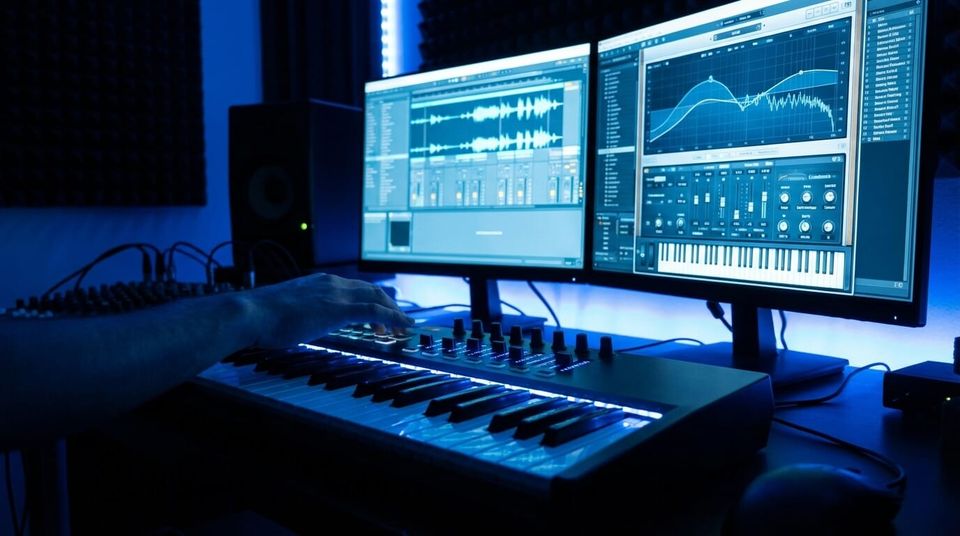
For example, you can play a MIDI keyboard connected to your computer. The keyboard sends MIDI information to your music software. The software then uses that information to play a piano, synth, drum kit, strings, bass, or any other virtual instrument.
MIDI is commonly used for:
- Playing virtual instruments
- Programming drums
- Recording keyboard parts
- Editing melodies and chords
- Controlling synthesizers
- Creating backing tracks
- Writing film and game music
- Automating music software
- Controlling live performance setups
- Connecting music hardware
MIDI is powerful because it gives you control after you record. You can change the notes, timing, sound, tempo, key, and instrument without having to re-record the performance.
How Does MIDI Work?
MIDI works by sending digital messages between devices.
When you press a key on a MIDI keyboard, the keyboard does not send an audio recording of that note. Instead, it sends information such as:
- Which note was played
- When the note started
- When the note ended
- How hard the key was pressed
- Which channel the note was sent on
- Whether any controls were moved
Your computer or instrument then uses those instructions to create sound.
For example, if you press middle C on a MIDI keyboard, MIDI tells the software that middle C has been played. The software then decides what sound to use. That sound could be a grand piano, a synth lead, a violin, a bass guitar, or a drum hit.
The MIDI data stays the same, but the sound can be changed.
That is what makes MIDI so flexible.
Is MIDI Audio?
No, MIDI is not audio.
This is one of the most important things to understand.
Audio is recorded sound. A vocal recording, guitar recording, drum loop, or exported song file is audio.
MIDI is performance data. It tells another device or piece of software what to play, but it does not make sound by itself.
A simple way to think about it:
Audio is the sound.
MIDI is the instruction sheet.
If you record a singer, you are recording audio. If you play notes into a virtual piano using a MIDI keyboard, you are recording MIDI.
What Is a MIDI File?
A MIDI file is a file that stores MIDI data.
It does not store actual instrument sounds. Instead, it stores musical instructions such as notes, timing, tempo, and performance information.
Because MIDI files do not contain audio, they are usually very small compared to audio files like WAV or MP3.
A MIDI file can be opened in music software and played back using different instruments. The same MIDI file could play as a piano piece, a synth melody, a string arrangement, or a chiptune-style track depending on the sounds you choose.
This makes MIDI files useful for songwriting, remixing, music education, game music, karaoke tracks, and production templates.
What Is a MIDI Keyboard?
A MIDI keyboard is a keyboard that sends MIDI information to another device.
Most MIDI keyboards do not produce sound on their own. Instead, they connect to a computer, tablet, synthesizer, or sound module. When you play the keys, the MIDI keyboard sends instructions to the connected device.
The connected device then creates the sound.
MIDI keyboards are popular because they make it easier to play virtual instruments naturally. Instead of drawing notes manually into music software, you can perform them in real time.
Many MIDI keyboards also include extra controls such as:
- Pads for drums
- Knobs for filters and effects
- Faders for volume
- Pitch bend wheels
- Modulation wheels
- Transport controls for recording and playback
These controls can make music production faster and more expressive.
What Is a MIDI Controller?
A MIDI controller is any device that sends MIDI messages.
A MIDI keyboard is one type of MIDI controller, but there are many others.
Common MIDI controllers include:
- Keyboard controllers
- Drum pad controllers
- DJ controllers
- Wind controllers
- Foot controllers
- Control surfaces
- Grid controllers
- Electronic drum kits
MIDI controllers are used to control sounds, effects, software instruments, mixing tools, lighting systems, and live performance setups.
The controller itself usually does not need to make sound. Its main job is to send instructions.
What Is MIDI in Music Production?
In music production, MIDI is used to write and control musical parts inside a DAW.
A DAW, or digital audio workstation, is music software such as Ableton Live, Logic Pro, FL Studio, Pro Tools, Cubase, GarageBand, Studio One, or Reaper.
Inside a DAW, MIDI lets you create and edit performances with a lot of control.
You can use MIDI to:
- Move notes
- Fix timing
- Change the key
- Change the tempo
- Adjust note length
- Change velocity
- Swap instruments
- Build drum patterns
- Layer sounds
- Create full arrangements
This is why MIDI is so important for producers. It gives you the freedom to experiment without committing to one final sound too early.
What Is MIDI Velocity?
MIDI velocity usually describes how hard or soft a note is played.
When you press a key gently, the MIDI velocity is lower. When you press it harder, the velocity is higher.
Velocity often affects volume, but it can also affect tone. For example, a soft piano note may sound gentle, while a hard piano note may sound brighter and more aggressive.
Velocity helps MIDI performances feel more human. Without velocity changes, every note can sound flat and robotic.
Good MIDI programming often involves adjusting velocity to create movement, groove, and expression.
What Are MIDI Channels?
MIDI channels allow different musical parts to be separated.
Traditional MIDI supports 16 channels. Each channel can send different information to different instruments or sounds.
For example:
- Channel 1 could control piano
- Channel 2 could control bass
- Channel 3 could control drums
- Channel 4 could control strings
This makes it possible to control multiple sounds from one MIDI connection.
In modern software, MIDI channels are still useful, although many DAWs make the process easier by handling much of it automatically.
What Is the Difference Between MIDI and USB?
MIDI and USB are not the same thing.
MIDI is the musical communication language.
USB is a connection type.
Many modern MIDI keyboards connect to computers using USB. In that case, the MIDI data travels through a USB cable.
Older MIDI equipment often uses 5-pin MIDI cables. Newer equipment may use USB, Bluetooth MIDI, or other connection methods.
So when someone says “USB MIDI,” they usually mean MIDI information being sent through a USB connection.
What Is MIDI 2.0?
MIDI 2.0 is an updated version of MIDI designed for modern music technology.
The original MIDI standard is still widely used, but MIDI 2.0 adds more detail, better control, improved expression, and two-way communication between devices.
This can make instruments and controllers more responsive and expressive.
For many beginners, the most important thing to know is that regular MIDI is still very common. You do not need to understand MIDI 2.0 to start making music. But over time, MIDI 2.0 may become more important in professional music production and performance setups.
Why Is MIDI Important?
MIDI is important because it gives musicians flexibility.
With audio, once something is recorded, changes can be more limited. With MIDI, you can keep editing the performance long after recording it.
You can take a MIDI piano part and turn it into strings. You can move one wrong note instead of recording the whole part again. You can speed up a song without changing the notes. You can build an entire track from a small idea.
MIDI is also important because it connects hardware and software. It allows instruments, controllers, computers, and production tools to work together.
That is why MIDI has lasted so long.
Is MIDI Still Used Today?
Yes, MIDI is still used everywhere in modern music.
It is used by bedroom producers, professional composers, DJs, live performers, sound designers, film scorers, game composers, and electronic musicians.
Even with all the advances in recording technology, MIDI remains essential because it solves a simple problem extremely well.
It lets musical tools communicate.
And that is still just as useful today as it was when MIDI first appeared.
Do You Need MIDI to Make Music?
You do not always need MIDI to make music, but it can make music production much easier.
If you only record vocals, guitar, or live instruments, you may work mostly with audio. But if you use virtual instruments, program drums, create beats, write electronic music, or compose inside a DAW, MIDI becomes extremely useful.
For beginners, a simple MIDI keyboard can make music creation feel more natural and creative.
You can start with no MIDI controller at all by drawing notes into your DAW. But most producers eventually find that MIDI controllers speed up the process.
What Is the Difference Between MIDI and a Synthesizer?
A synthesizer creates sound.
MIDI sends instructions.
Some synthesizers can send and receive MIDI, but MIDI itself is not a synthesizer.
For example, you could use a MIDI keyboard to control a software synthesizer on your computer. The keyboard sends the notes. The synth creates the sound.
This is another reason MIDI is so useful. One MIDI controller can control many different instruments.
Final Thoughts: What Is MIDI?
So, what is MIDI?
MIDI is a digital language that lets music devices and software communicate. It does not contain sound. Instead, it contains musical instructions, such as notes, timing, velocity, and control changes.
MIDI is used to play virtual instruments, program drums, control synthesizers, edit performances, and build songs inside music software.
It is one of the most important tools in modern music production because it gives musicians control, flexibility, and creative freedom.
Whether you are making your first beat or producing a full professional track, MIDI is something worth understanding.
Once you understand MIDI, digital music production becomes much easier.