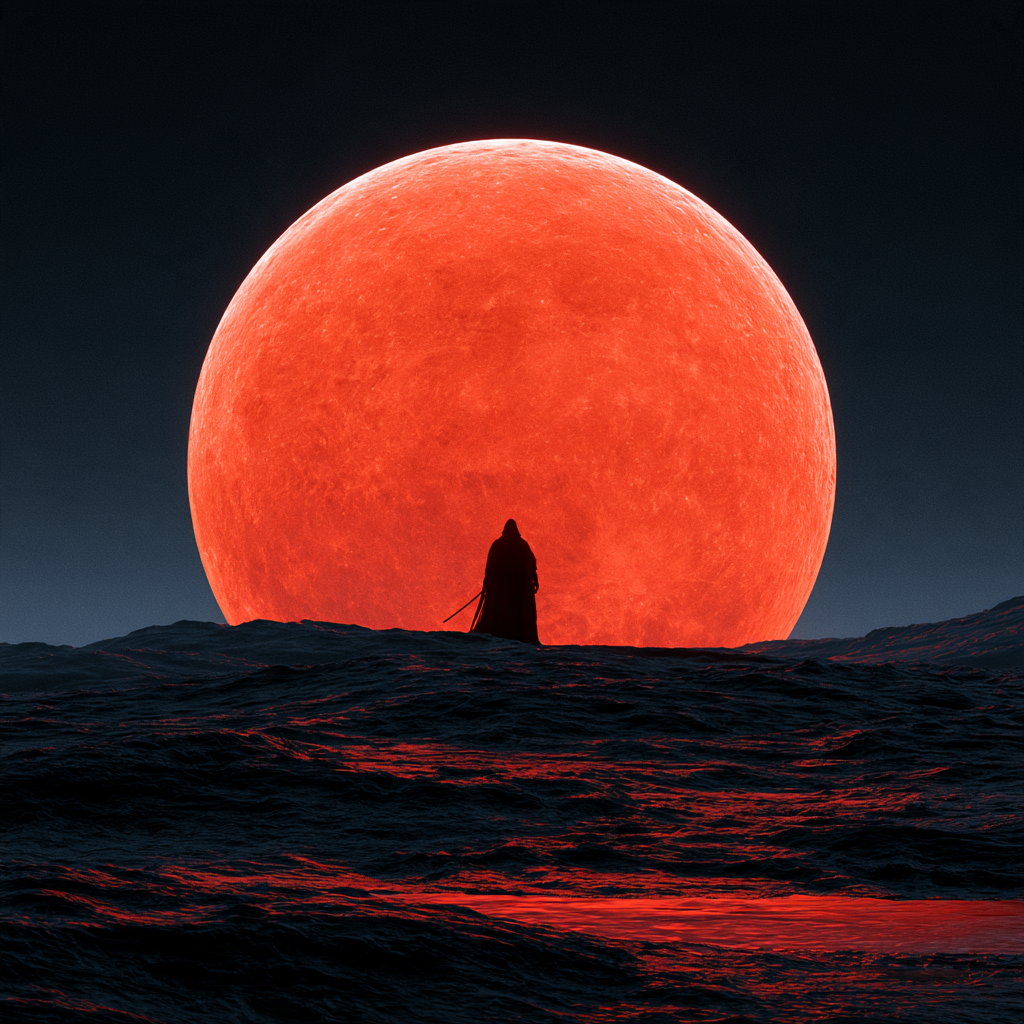
What Does “The Killing Moon” Mean?
“The Killing Moon” is about the conflict between fate and free will.
Ian McCulloch has described the song as dealing with:
birth
death
eternity
God
destiny
and the human struggle against forces we cannot control.
Very small topic.
The central idea appears in the phrase:
“fate up against your will”.
McCulloch has said those words came to him almost fully formed, and he later described the song as almost a psalm rather than ordinary pop writing.
What does “fate up against your will” mean?
You want something.
Life has another plan.
That tension exists across almost every human story.
Love somebody?
They leave.
Want to avoid something?
It happens.
Believe you control your future?
Perhaps you don’t.
“The Killing Moon” places romance inside that larger philosophical argument.
The person arriving in your life may feel like:
choice.
Destiny.
Both.
Why does the moon matter?
The moon naturally carries associations with:
cycles
night
romance
death
mystery
forces beyond human control.
You cannot negotiate with it.
It arrives.
Leaves.
Returns.
That makes the “killing moon” feel less like a literal object and more like the moment destiny catches up with you.
Did Ian McCulloch really think God wrote the song?
He has made comments close to that idea.
McCulloch has always spoken about “The Killing Moon” with unusually enormous confidence.
He has called it his greatest song and sometimes described its origin as though it arrived from somewhere outside him.
Modest?
No.
Entertaining?
Definitely.
But the song’s scale supports the attitude.
It sounds less like somebody writing:
verse.
chorus.
verse.
and more like somebody uncovering something.
What does David Bowie have to do with it?
“Space Oddity”.
McCulloch has said part of the chordal inspiration emerged from playing Bowie’s “Space Oddity” backwards and experimenting from there.
By the time Echo & the Bunnymen finished “The Killing Moon”, it sounded nothing like a reversed Bowie recording.
That’s the interesting part.
Influence rarely means:
copy song.
Sometimes it means:
do something strange to another song until your own idea appears.
Why does it sound so cinematic?
Strings.
Guitar.
Space.
McCulloch’s baritone.
The arrangement feels enormous without becoming bombastic.
Ocean Rain, the album containing the song, leaned heavily into orchestral texture.
Echo & the Bunnymen wanted something larger than straightforward post-punk.
“The Killing Moon” became the perfect demonstration.
Why is it in Donnie Darko?
Because it sounds like destiny approaching.
The original theatrical version of Donnie Darko uses “The Killing Moon” near the beginning while Donnie moves through the suburban environment.
That opening immediately tells you:
ordinary world.
Something wrong underneath.
The film deals with:
time
fate
death
alternate realities
sacrifice.
A song about destiny against human will almost feels written for it.
It wasn’t.
Why is the song different in the Donnie Darko director’s cut?
Music licensing and director Richard Kelly’s evolving intentions changed the soundtrack placement.
The director’s cut opens with INXS’ “Never Tear Us Apart” instead.
“The Killing Moon” appears later during the party sequence.
Some fans strongly prefer the original opening.
Even guitarist Will Sergeant joked bluntly about disliking the change.
Soundtracks can become so culturally fixed that changing one song feels like changing the film.
What genre is “The Killing Moon”?
Post-punk.
Neo-psychedelia.
Alternative rock.
Gothic-adjacent.
Echo & the Bunnymen emerged from Liverpool’s post-punk scene but regularly used:
psychedelic imagery
orchestration
dramatic vocals.
Calling them simply goth misses too much.
Calling this song bright indie pop would also be fairly ambitious.
Songs like “The Killing Moon”
The Church – Under the Milky Way
Joy Division – Atmosphere
The Cure – A Forest
The Psychedelic Furs – The Ghost in You
Siouxsie and the Banshees – Cities in Dust
New Order – Ceremony
Tears for Fears – Mad World
INXS – Never Tear Us Apart
Radar’s dedicated “Mad World” article is an especially natural internal link because both songs became fundamental parts of Donnie Darko’s musical identity.
Why does the song feel romantic and threatening at once?
Because surrender is both.
Falling in love often requires giving up some control.
So does accepting fate.
“The Killing Moon” makes those experiences overlap.
The person you want can feel destined.
Destiny can also destroy you.
That contradiction gives the song its emotional tension.
What does “The Killing Moon” really mean?
You make choices.
Something larger may still be moving around them.
Love.
Death.
Time.
God.
Chance.
Whatever you call it.
McCulloch calls it fate.
Donnie Darko made the interpretation even harder to escape.
Once you’ve watched Donnie cycle home under “The Killing Moon”, the song and the film seem as though they were always supposed to find each other.
Fate, perhaps.