What Does “Blue (Da Ba Dee)” Mean? Eiffel 65’s Song Explained
Eiffel 65’s “Blue (Da Ba Dee)” is about somebody who experiences the entire world through one colour.
Blue.
Everything surrounding the narrator appears connected with that colour.
His home.
His clothes.
His possessions.
Even his emotional life.
But is the song actually about depression?
Not necessarily.
Singer Jeffrey Jey has explained that the colour represents an individual’s personal perspective.
His idea was that everybody experiences life through their own unique filter.
The song turns that concept into a playful, surreal musical world.
And the famous nonsense chorus doesn’t contain a secret message.
It’s simply an unforgettable vocal hook.
What does “Blue” actually mean?
The colour represents the narrator’s way of experiencing life.
Jey has described believing that everybody possesses a personal colour.
That colour influences how they interpret the world.
Their preferences.
Their relationships.
Their surroundings.
Their identity.
The recording exaggerates that concept.
Instead of merely having a particular emotional perspective, the narrator literally experiences everything as blue.
It’s a surreal metaphor rather than an ordinary story.
Is the song about depression?
That’s one possible listener interpretation.
In English, feeling blue can mean feeling sad.
The song’s electronic atmosphere can also sound strangely melancholy.
But the writers have discussed the colour as a broader metaphor.
It wasn’t simply intended as a straightforward account of depression.
That’s an important distinction.
Listeners may find sadness within the recording.
The songwriter’s original concept was more expansive.
The colour represents an entire personal world.
What does “Da Ba Dee” mean?
Nothing specific.
The phrase was created because it sounded good.
The production team wanted a memorable vocal hook that listeners could recognise immediately.
The nonsense syllables became central to the recording.
That’s particularly effective in dance music.
A chorus doesn’t always require a complicated message.
Sometimes its main purpose is rhythm and melody.
“Da Ba Dee” demonstrates how powerful a simple vocal pattern can become.
Who are Eiffel 65?
An Italian electronic music group associated with the late-1990s Eurodance scene.
The important figures behind the original recording include:
Jeffrey Jey
Maurizio Lobina
Massimo Gabutti
and Gabry Ponte.
Their work developed around electronic production and catchy pop songwriting.
“Blue” became their enormous international breakthrough.
The group’s debut album Europop arrived in 1999.
It also included recordings such as “Too Much of Heaven”.
How was “Blue” created?
The central musical idea began with a piano hook.
Maurizio Lobina developed the melody.
The production team recognised that it could work inside an electronic dance recording.
They began building the rhythm and arrangement around it.
The song’s lyrical concept developed during the creative process.
The colour blue was selected without one elaborate symbolic plan already in place.
That spontaneity became part of the recording’s identity.
Why does the singer sound robotic?
Because of electronic vocal processing.
The production uses a harmoniser to alter the sound of Jeffrey Jey’s voice.
That creates the distinctive synthetic quality.
During the late 1990s, electronic dance music was increasingly experimenting with processed vocals.
Eiffel 65 embraced that approach completely.
The voice sounds almost like a character from a video game.
That fits the song’s imaginary blue world.
When was “Blue” released?
The original recording was released in Italy in 1998.
It became an enormous international hit during 1999.
In Britain, the song spent three weeks at No. 1.
It became one of the defining Eurodance recordings of the period.
Its commercial success was particularly impressive because the song was so unusual.
The lyrics were surreal.
The vocal was heavily processed.
The production sounded deliberately synthetic.
Yet the melody was irresistible.
What happens in the music video?
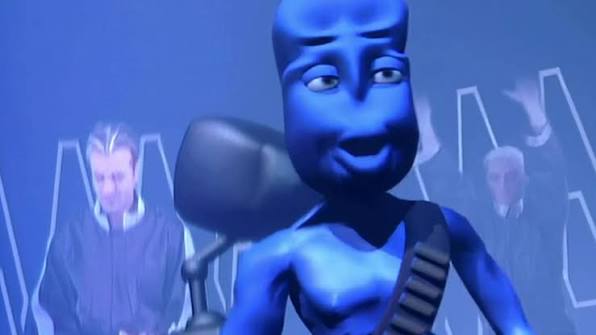
The animated video creates a fictional blue world.
The central character is a small blue alien-like figure.
He becomes involved in a strange adventure involving other colourful characters and futuristic environments.
The visual is deliberately cartoonish.
That makes the song feel almost like a children’s fantasy.
But the electronic production remains firmly connected with late-1990s dance music.
It’s an unusual combination.
Why did the song become popular again?
Because newer artists returned to its melody.
One of the most important examples is David Guetta and Bebe Rexha’s “I’m Good (Blue)”.
The collaboration was originally developed years before its official release.
Then the recording gained attention through TikTok.
It was released commercially in 2022.
The song became another enormous international hit.
That introduced Eiffel 65’s familiar musical idea to another generation.
Does “I’m Good (Blue)” sample Eiffel 65?
It uses identifiable musical material from “Blue (Da Ba Dee)”.
The original writers receive credit in connection with the newer composition.
The distinction between sampling and interpolation depends on whether a new recording uses original audio or recreates existing musical material.
For listeners, the important connection is obvious.
The melody comes from Eiffel 65.
Guetta and Rexha place it inside a different pop song.
Is “I’m Good (Blue)” about the same thing?
No.
The emotional message is different.
Eiffel 65 create a surreal world built around one colour.
Guetta and Rexha’s recording is primarily about enjoying a night out.
The original melody becomes part of a more conventional party anthem.
That’s an excellent example of how an older composition can acquire a completely different cultural purpose.
What genre is “Blue”?
Eurodance.
Electronic dance-pop.
It also contains elements associated with Europop.
The recording belongs to a period when European electronic music was becoming enormously successful internationally.
Artists such as:
Vengaboys
Alice Deejay
ATB
and Gigi D’Agostino
were also developing distinctive versions of the sound.
Songs like “Blue (Da Ba Dee)”
Try:
Alice Deejay – Better Off Alone
Gigi D’Agostino – L’Amour Toujours
Vengaboys – Boom, Boom, Boom, Boom!!
ATB – 9 PM (Till I Come)
Darude – Sandstorm
Haddaway – What Is Love
Ann Lee – 2 Times
David Guetta & Bebe Rexha – I’m Good (Blue).
These recordings provide a route through several styles of 1990s and early-2000s European dance music.
Why is “Blue” still so recognisable?
Because almost every part of the recording has a strong musical identity.
The melody.
The electronic vocal.
The rhythm.
The nonsense chorus.
The colour concept.
Even listeners who haven’t heard it for years can recognise it within seconds.
That makes it particularly useful for sampling, nostalgia and internet culture.
What does “Blue (Da Ba Dee)” really mean?
Everybody experiences the world through their own personal perspective.
Eiffel 65 turned that idea into a bizarre fictional world where everything is blue.
The chorus is nonsense.
The metaphor is more thoughtful than the recording initially suggests.
And more than twenty-five years after release, the melody remains one of electronic pop’s most recognisable sounds.