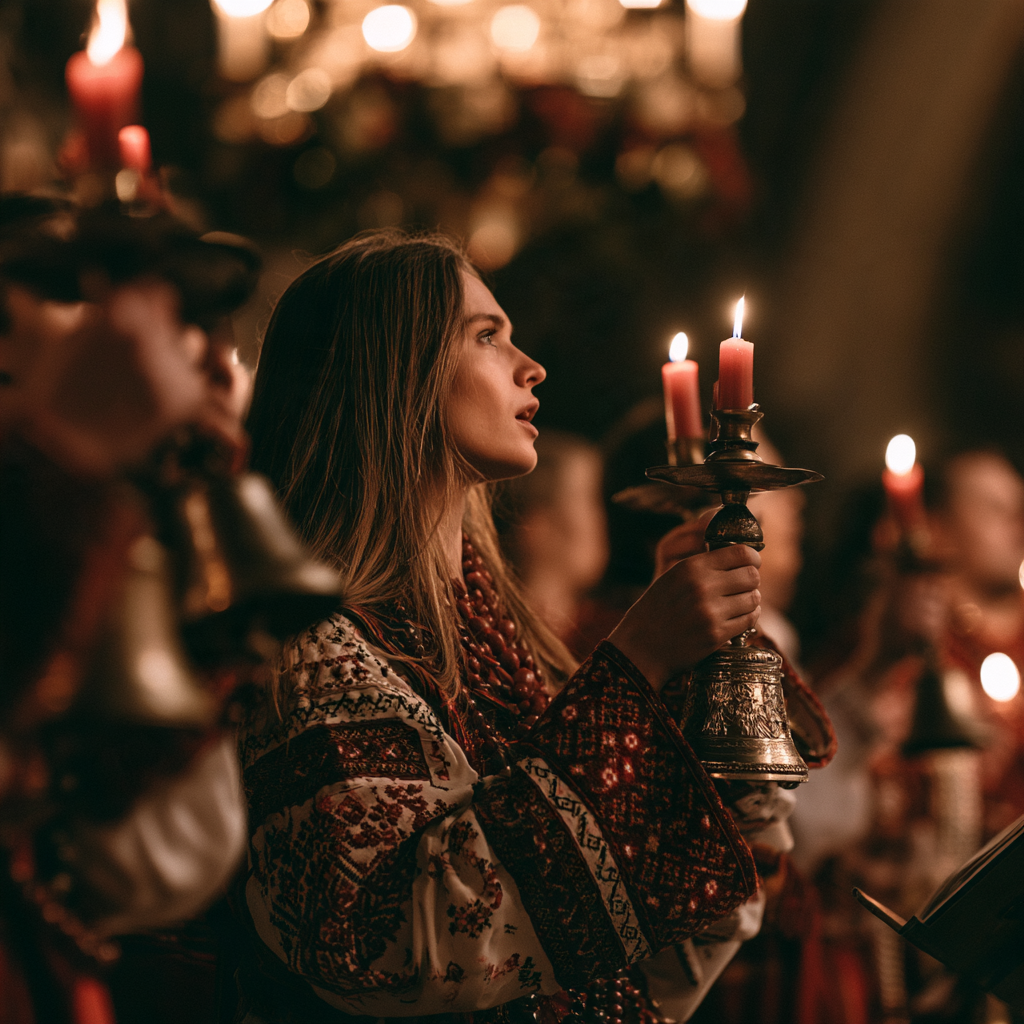
Was “Carol of the Bells” Originally Ukrainian? The Real Story
“Carol of the Bells” originated in Ukraine.
But it wasn’t originally a Christmas song about bells.
The famous melody comes from “Shchedryk”, a Ukrainian song associated with New Year traditions and hopes for prosperity.
Composer Mykola Leontovych created the choral arrangement that became internationally famous during the early twentieth century.
The recording eventually reached audiences in America.
Then, in 1936, Peter J. Wilhousky created new English-language lyrics that transformed the melody into a Christmas carol.
That means one of the world’s most recognisable Christmas songs originally had a very different subject.
And its history connects music with Ukrainian cultural identity.
What does “Shchedryk” mean?
The title is connected with generosity and abundance.
The original song belongs to the Ukrainian tradition of seasonal songs associated with the New Year.
Its words describe a swallow arriving at a household.
The bird brings news of future prosperity.
The imagery celebrates the hope of a successful year.
That’s quite different from the English-language Christmas song.
There are no central references to church bells in the original Ukrainian text.
Who composed the famous melody?
Mykola Leontovych arranged an existing Ukrainian folk melody.
He developed it into the recognisable choral work.
The composition uses a short repeating musical pattern.
That repetition creates much of its distinctive character.
The voices enter and develop around the central idea.
As the arrangement expands, the music becomes increasingly energetic.
It’s particularly effective because such a simple melodic foundation supports an elaborate choral performance.
When was “Shchedryk” first performed?
The famous choral version was performed in Kyiv in December 1916.
That means the arrangement has a history extending more than a century before the present Christmas season.
The work subsequently became associated with Ukrainian musical performances internationally.
Its development took place during a period of enormous political and cultural change in Eastern Europe.
That context is important to understanding why the song became significant beyond ordinary seasonal music.
How did the melody reach America?
Through performances by the Ukrainian National Chorus.
The ensemble toured internationally and introduced audiences to Ukrainian choral music.
A particularly significant American performance took place at Carnegie Hall in New York on 5 October 1922.
That introduced the composition to an important new audience.
The music’s distinctive repeating melody made it particularly memorable.
Its popularity continued expanding through later performances and recordings.
Who wrote the English Christmas lyrics?
Peter J. Wilhousky.
He was a Ukrainian-American composer, conductor and arranger.
In 1936, he created the English-language adaptation known as “Carol of the Bells”.
His lyrics were not a direct translation of the Ukrainian original.
Instead, he imagined the repeating musical pattern as the sound of ringing bells.
That created the familiar Christmas identity.
Why does the melody sound like bells?
Because of its repeating four-note idea.
The rhythm creates an effect similar to ringing handbells.
Different voices enter and overlap.
That reinforces the impression.
Wilhousky recognised how naturally the musical pattern could support a song about bells.
The original Ukrainian arrangement already contained the repeating musical structure.
The English adaptation changed the imagery surrounding it.
Is “Carol of the Bells” a traditional religious hymn?
The familiar English adaptation is a Christmas carol.
But its musical origins don’t come from a conventional Christian hymn.
The source belongs to Ukrainian New Year and folk traditions.
That makes its history unusual.
The melody moved from one seasonal celebration into another.
And the cultural meaning changed during the process.
Is the original still performed in Ukrainian?
Yes.
“Shchedryk” remains an important part of Ukrainian musical culture.
Choirs continue performing the original version.
Its international fame also provides an opportunity to introduce audiences to Ukrainian language and history.
For some performers, the song represents cultural continuity.
It isn’t simply another Christmas recording.
It’s a connection with a musical tradition that existed long before the familiar English words.
Why is the song particularly significant to Ukraine?
Because it became internationally recognisable at a time when Ukrainian cultural identity was politically important.
The Ukrainian National Chorus’ international performances helped demonstrate that Ukraine had its own artistic traditions.
That history remains relevant.
The song’s connection with Ukraine is sometimes overlooked because many international listeners know only the English version.
Discovering “Shchedryk” restores the earlier cultural context.
Why is “Carol of the Bells” used in films?
Because the music creates immediate dramatic intensity.
The repeating melody builds tension.
The arrangement can sound joyful or unsettling depending on the instruments.
That’s particularly useful in Christmas films.
A familiar seasonal melody can support comedy, excitement or suspense.
One of its most recognisable modern associations is with Home Alone.
The film helped introduce younger audiences to dramatic choral Christmas music.
Is the Home Alone version the original?
No.
The movie uses music connected with the familiar Christmas arrangement.
The underlying melody is much older.
That’s worth remembering when listening to different versions.
An orchestral film interpretation and a Ukrainian choral performance may sound very different.
But both trace back to Leontovych’s arrangement.
Why are there so many covers?
Because the melody adapts well to different instruments.
Choirs can perform it traditionally.
Pianists can create solo arrangements.
Orchestras can develop it into something enormous.
Rock musicians can add drums and distorted guitars.
Its simple repeating structure makes those transformations possible.
That flexibility has helped the composition survive across generations.
Other Christmas songs with surprising histories
“Have Yourself a Merry Little Christmas” originally had a considerably more melancholy character.
“White Christmas” became particularly associated with wartime longing.
And “Somewhere Only We Know” wasn’t a Christmas song before Lily Allen recorded it for a seasonal advertising campaign.
Radar’s explanation of Keane’s “Somewhere Only We Know” explores another song whose later placement created an important seasonal identity.
Which versions should you hear?
Start with a Ukrainian-language choral performance of “Shchedryk”.
Then find a traditional English choir singing “Carol of the Bells”.
Finally, explore orchestral or rock arrangements.
The comparison reveals how much the same melody can change through instrumentation and language.
Was “Carol of the Bells” originally Ukrainian?
Yes.
Its melody comes from Mykola Leontovych’s arrangement of the Ukrainian song “Shchedryk”.
The original was associated with New Year and prosperity rather than Christmas bells.
The familiar English lyrics were introduced by Peter J. Wilhousky in 1936.
One of Christmas music’s most recognisable melodies therefore has a history that begins with Ukrainian folk culture.