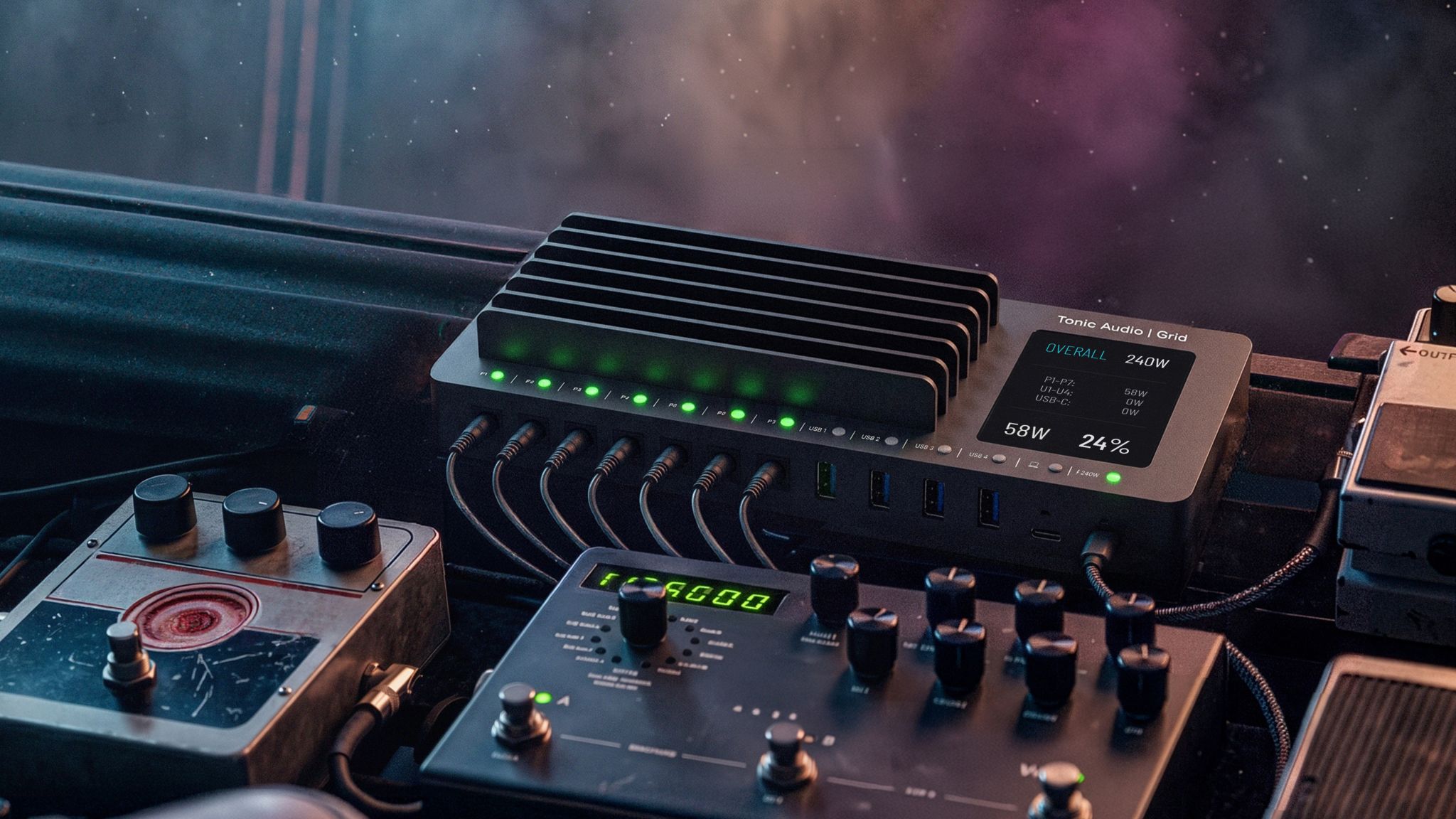
Tonic Audio Grid – One Power Supply for Your Entire Music Production Setup
Anyone who has built a home music studio or performed electronic music live will be familiar with the problem of cables, power adapters and extension leads.
Every synthesizer, drum machine, sampler and effects pedal seems to come with its own power supply. Add a laptop and a few MIDI controllers, and even a relatively small setup can quickly become a mess of cables.
Tonic Audio believes it has a solution.
The music technology company has introduced Grid, a programmable power supply designed to power an entire electronic music setup from a single device.
With seven individually configurable DC outputs, USB connectivity, laptop charging and a touchscreen interface, Grid aims to make powering music equipment considerably simpler.
But what exactly does it do, and could it become an essential piece of equipment for electronic music producers?
What Is Tonic Audio Grid?
Tonic Audio Grid is a multi-channel programmable power supply designed specifically for electronic musicians.
Rather than requiring a separate power adapter for every piece of equipment, Grid provides multiple configurable outputs capable of supplying different voltages and current limits.
This means musicians could potentially power their synthesizers, grooveboxes, drum machines, samplers, effects pedals and laptops from one central device.
The product was introduced on 26 October 2026 by Tonic Audio, a company specialising in technology for musicians and audio professionals.
Grid is designed for both studio production and live performances, with particular attention given to portability, flexibility and reliable connections.
The concept is straightforward: instead of carrying a bag full of power adapters, musicians can configure one device to meet the requirements of their equipment.
Tonic Audio Grid Features and Specifications
Despite its relatively compact design, Grid includes several features normally spread across multiple pieces of equipment.
Here are its main specifications.
| Feature | Specification |
|---|---|
| DC power outputs | 7 programmable channels |
| DC voltage range | 5V–19V |
| DC configuration | Adjustable voltage, current limit and polarity |
| Isolated outputs | 6 isolated channels and 1 high-power channel |
| USB-A connections | 4 USB-A 3.2 ports |
| USB-C connections | 2 |
| Maximum power input | Up to 240W USB-C PD EPR |
| Laptop charging | Up to 100W USB-C PD |
| Display | 2.4-inch AMOLED touchscreen |
| Power connections | Locking barrel connectors |
| Construction | Anodised aluminium housing |
One of Grid’s biggest advantages is that its outputs can be configured individually.
Traditional multi-output pedalboard power supplies commonly offer fixed voltage options, such as 9V, 12V or 18V.
Grid instead lets users configure each DC channel to suit compatible equipment.
This flexibility could make it particularly useful for musicians combining hardware from different manufacturers.
Seven Programmable Power Outputs
The most important feature of Grid is its seven individually programmable DC outputs.
Every channel can be configured with its own voltage, current limit and polarity.
For example, a producer might have a synthesizer requiring 12V, a drum machine requiring 9V and an effects pedal that uses a different power configuration.
With Grid, compatible devices could potentially be connected to the same power supply without requiring their original adapters.
The device supports output voltages from 5V to 19V.
However, users must still check the power requirements of every device before connecting it.
The voltage, polarity, connector type and available current must match the manufacturer’s requirements. Incorrect power settings can damage electronic music equipment.
The combined power requirements must also remain within Grid’s available power budget.
A Touchscreen That Shows Your Power Consumption
Another interesting feature is Grid’s integrated 2.4-inch AMOLED touchscreen.
Instead of simply indicating whether a device is receiving power, the display provides detailed information about individual channels.
Musicians can see:
- Configured and measured voltage.
- Current being delivered to connected equipment.
- Power consumption for each channel.
- Polarity settings.
- Remaining power capacity.
- Faults and potential power problems.
Users can also adjust channel settings directly through the touchscreen.
This could be particularly useful for artists who regularly change their equipment.
For example, a musician preparing for a live performance could check that each connected device is receiving the correct power before beginning their set.
Individual status LEDs also provide visual information about each channel.
If a short circuit occurs, Grid is designed to shut down the affected channel and display a warning without disrupting the other outputs.
Tonic Audio Grid Includes Presets for Popular Music Equipment
One of the challenges with programmable power supplies is knowing exactly which settings to use.
Different instruments require different voltages, current limits and connector polarities.
To simplify setup, Tonic Audio is developing a built-in database of power profiles for popular music equipment.
Instead of manually entering every setting, users will be able to select a compatible device profile and assign it to one of Grid’s outputs.
Tonic Audio has referenced equipment from manufacturers including Roland, Korg and Elektron.
The company also plans to allow musicians to create and save their own configurations.
For example, a producer could save one preset for their home studio and another for their live performance setup.
When switching between configurations, they could recall the appropriate power settings without manually reconfiguring every channel.
This could make Grid particularly useful for performers who regularly travel with different combinations of equipment.
Grid Can Also Charge Your Laptop
Grid isn’t limited to powering traditional electronic music hardware.
The device also includes a USB-C Power Delivery output capable of charging a compatible laptop or tablet at up to 100W.
For producers using Ableton Live, Logic Pro, FL Studio or another digital audio workstation, this could eliminate another separate power adapter.
The actual charging power available depends on the power source connected to Grid and the requirements of the connected equipment.
Grid also includes four USB-A 3.2 ports that function as a USB hub.
These can provide connectivity for compatible USB equipment such as MIDI controllers and other studio peripherals.
The combination of power distribution, laptop charging and USB connectivity could help reduce the number of separate accessories needed for a portable music production setup.
Designed for Live Electronic Music Performances
Although Grid could be useful in home recording studios, one of its strongest applications may be live electronic music.
Artists performing with hardware synthesizers, drum machines and samplers often travel with complicated equipment configurations.
Even relatively small live setups can require several power adapters, extension leads and USB hubs.
This creates additional equipment to transport, connect and troubleshoot before every performance.
Tonic Audio says the idea for Grid came from a problem experienced by its team during live performances.
In its announcement, the company described how loose power adapters caused equipment to stop working during a soundcheck.
Grid addresses this problem through a combination of programmable power outputs, locking power connections and integrated monitoring.
The company has also designed Grid to be positioned behind a synthesizer rack, underneath a studio desk or mounted on a pedalboard.
For performers regularly transporting equipment between venues, reducing the number of power accessories could make setup and breakdown more convenient.
Can Grid Replace a Traditional Pedalboard Power Supply?
Potentially, yes.
Traditional pedalboard power supplies are designed primarily for guitar pedals and other effects equipment.
Many provide isolated outputs with fixed voltages and limited current capacity.
Grid takes a broader approach by supporting multiple programmable power configurations.
This could make it suitable for musicians combining guitar pedals with synthesizers, grooveboxes and electronic percussion equipment.
However, Grid won’t necessarily replace every existing power supply.
Some instruments require voltages outside its supported range, alternative connectors or more power than Grid can provide.
Musicians should confirm compatibility with their specific equipment before making the switch.
Tonic Audio Grid Core vs Grid 240: What’s the Difference?
Tonic Audio has introduced two planned versions of the product: Grid Core and Grid 240.
Both versions use the same Grid hardware, including seven programmable DC outputs, USB connectivity and the touchscreen.
The main difference is the included power adapter.
Grid Core
Grid Core is designed for musicians who already own a suitable USB-C Power Delivery charger.
It includes:
- The Grid power distribution unit.
- A USB-C EPR cable.
- A set of locking DC cables.
Users will need to provide their own compatible charger rated at 100W or higher.
The total power available will depend on the charger being used.
Grid 240
Grid 240 includes the same hardware but adds a 240W USB-C PD EPR power adapter.
This provides access to the device’s higher supported input power budget, subject to its output limitations.
It could be the more convenient option for musicians who want a complete power solution without sourcing a separate compatible charger.
How Much Does Tonic Audio Grid Cost?
Tonic Audio has not yet announced confirmed retail pricing for Grid Core or Grid 240.
The company is currently accepting early interest registrations through its reservation website.
Users who sign up are being offered access to an exclusive early-bird discount when the product becomes available.
However, the company has not confirmed the final discount amount or the full retail price.
Musicians interested in the hardware can register through the official Tonic Audio Grid website.
When Is Tonic Audio Grid Being Released?
As of November 2026, Tonic Audio has not confirmed an official release date for Grid.
The company says the product is launching soon and is continuing development.
Tonic Audio is also sharing development updates through its YouTube channel, giving interested musicians a closer look at the product’s progress.
For now, Grid should be considered an upcoming product rather than widely available studio equipment.
Who Is Tonic Audio Grid Designed For?
Grid could appeal to several different types of musicians and producers.
Electronic Music Producers
Musicians using multiple hardware synthesizers, samplers and drum machines could benefit from combining their power supplies into one central unit.
This could be especially useful in smaller home studios where desk space and cable management are important.
Live Electronic Performers
Artists performing with hardware-based setups may find Grid’s configurable outputs and locking connectors particularly useful.
Reducing the number of separate power supplies could make transporting and assembling live equipment easier.
Synthesizer Enthusiasts
Musicians who regularly experiment with different synthesizers and grooveboxes could benefit from saving power configurations for different combinations of equipment.
Guitarists Using Digital and Electronic Equipment
Guitarists combining traditional effects pedals with modern digital processors, synthesizers or MIDI equipment may also find Grid useful, provided their hardware is electrically compatible.
Is Tonic Audio Grid Worth Buying?
Grid addresses a genuine problem experienced by musicians who own multiple pieces of electronic equipment.
Although power supplies aren’t particularly exciting compared with new synthesizers or music production software, they are essential to creating a reliable setup.
For musicians who own only one or two instruments, the cost of a programmable power supply may be difficult to justify.
However, artists using several hardware instruments could potentially benefit from a simplified setup.
Its programmable outputs, touchscreen monitoring and integrated USB connectivity offer functionality beyond many conventional fixed-voltage power supplies.
There are still several important questions to consider before purchasing.
These include the final price, compatibility with specific instruments, long-term reliability and how the product performs during extended live sessions.
As Grid has not yet reached a general retail launch, independent testing and real-world reviews will be important.
Frequently Asked Questions About Tonic Audio Grid
What Is Tonic Audio Grid?
Tonic Audio Grid is a programmable power supply for electronic musical instruments. It is designed to power multiple compatible synthesizers, drum machines, samplers, effects pedals and USB devices from a central unit.
How Many Devices Can Tonic Audio Grid Power?
Grid includes seven programmable DC outputs, four USB-A ports and a USB-C laptop charging output. The number of devices that can be powered simultaneously depends on their electrical requirements and the available power budget.
Does Grid Work With All Synthesizers?
No. Grid supports DC voltages from 5V to 19V. Instruments requiring other voltages, incompatible connectors or unsupported power configurations may need their original power supplies.
Can Tonic Audio Grid Charge a MacBook?
Grid provides USB-C Power Delivery charging at up to 100W, potentially allowing it to charge compatible MacBook models. Users should check their laptop’s requirements and the power available from Grid’s input adapter.
Does Tonic Audio Grid Work With Guitar Pedals?
Grid is designed to support compatible guitar effects pedals alongside synthesizers and other electronic music equipment. Users must configure the correct voltage, polarity and current limits for each device.
How Much Is Tonic Audio Grid?
Official retail pricing has not yet been announced. Tonic Audio is accepting registrations for an early-bird discount ahead of launch.
Is Tonic Audio Grid Available in the UK?
The company has not confirmed UK-specific retail availability or shipping arrangements. Interested customers can register for launch information through its official website.
When Will Tonic Audio Grid Launch?
Tonic Audio has not announced a confirmed release date as of November 2026.
A More Convenient Future for Electronic Music Hardware?
Tonic Audio Grid takes an interesting approach to a problem that has existed for decades.
Although music production equipment continues to become more advanced, many musicians still rely on collections of individual power adapters to operate their hardware.
By combining programmable power distribution, USB connectivity, laptop charging and touchscreen monitoring into one device, Grid could help simplify both studio production and live performances.
Its flexibility may be particularly appealing to electronic musicians who regularly combine instruments from different manufacturers.
The remaining questions are how much it will cost and how reliably it performs once the finished hardware reaches musicians.
For those currently building their first setup, check out RouteNote’s complete guide to home recording studio equipment for advice on choosing the right gear.
And once you’ve finished producing your next track, you can distribute your music worldwide for free with RouteNote, reaching major streaming services including Spotify, Apple Music, Amazon Music and YouTube Music.