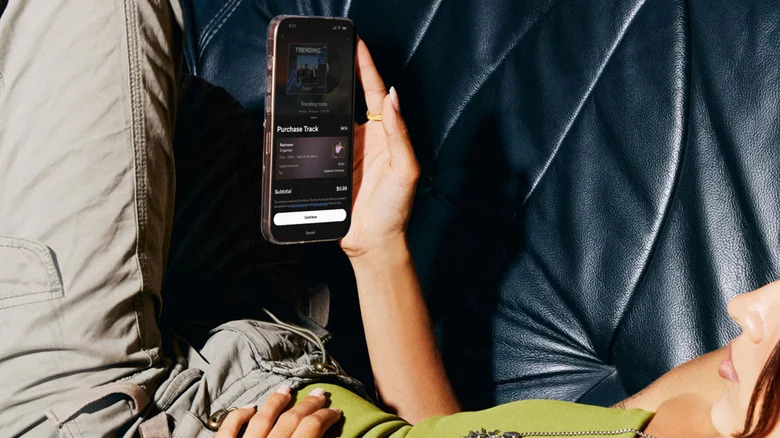
SoundCloud Will Let Fans Buy Music Directly From Artists — But Isn’t This Just Bandcamp?
SoundCloud is introducing a new way for fans to buy music directly from artists.
And if your immediate reaction is, “Isn’t that basically Bandcamp?” — you’re not alone.
The new SoundCloud feature will allow artists to sell downloadable music directly from their SoundCloud profiles, rather than sending listeners elsewhere to platforms such as Bandcamp or Beatport.
SoundCloud will initially test direct music sales with 200 US-based Artist Pro subscribers before expanding the feature to more artists later this autumn.
For fans, it means discovering a song on SoundCloud, listening to it and then buying a copy directly from the artist without leaving the platform.
That sounds remarkably familiar.
Bandcamp has essentially spent almost two decades building its business around exactly that relationship.
But there are some important differences — and SoundCloud could potentially turn a fairly unoriginal idea into something much bigger.
How will buying music on SoundCloud work?
Artists participating in the SoundCloud beta will be able to make individual tracks available for purchase directly from their profile pages.
Artists can choose which digital formats they want to provide, including formats such as MP3 and WAV, while sales information will be available through SoundCloud’s Artist Studio and Fan Support tools.
The most interesting part is SoundCloud’s fee.
There isn’t one.
SoundCloud says it won’t take a commission from music sold through the new feature.
Artists will still need to pay payment processing fees and any applicable taxes, but SoundCloud itself will not take a percentage of the sale.
That’s a very aggressive proposition.
Particularly when you compare it with Bandcamp.
So… isn’t SoundCloud basically building Bandcamp?
At a basic level: yes.
Bandcamp allows an artist to upload music, build an artist profile, let fans listen to that music and then sell digital downloads directly to those fans.
SoundCloud is now allowing an artist to upload music, build an artist profile, let fans listen to that music and then sell digital downloads directly to those fans.
There’s clearly a lot of overlap.
Bandcamp describes itself as a direct-to-fan marketplace where artists can sell digital tracks, albums, vinyl, CDs, cassettes, merchandise and other products.
Artists can determine their own prices, set minimum prices and even allow fans to voluntarily pay more than the asking price.
That direct relationship between artist and fan has effectively been Bandcamp’s core product since its launch in 2008.
SoundCloud isn’t inventing a new music business model here.
It’s bringing a proven one into SoundCloud.
And that distinction could matter enormously.
SoundCloud’s 0% commission makes things interesting
Bandcamp currently takes a 15% revenue share on digital music sales and 10% on merchandise, with payment processing fees charged separately.
Bandcamp says artists and labels receive around 82% of the money from an average purchase after its revenue share and payment processing costs.
SoundCloud says it will take 0%.
That’s potentially a strong reason for artists already using SoundCloud to sell their music there instead.
Imagine an independent artist generating $10,000 in digital download sales.
Before payment processing costs, a 15% platform commission represents $1,500.
A 0% platform commission represents nothing.
Of course, SoundCloud isn’t providing the service entirely for free. The initial feature is being offered to Artist Pro subscribers, meaning SoundCloud can monetise artists through subscriptions rather than taking a percentage of every transaction.
It’s a different business model.
And arguably one that aligns very well with SoundCloud’s broader strategy.
But Bandcamp is much more than a checkout button
This is where saying “SoundCloud has copied Bandcamp” becomes a little too simplistic.
Bandcamp isn’t simply payment processing attached to an artist profile.
It has developed an entire culture around owning music and supporting artists.
Fans maintain collections.
Artists sell albums.
Labels operate stores.
Listeners browse genres and tags.
There is a large market for vinyl, CDs, cassettes and merchandise.
Bandcamp says fans have now paid artists and labels around $1.8 billion through the platform. In the past year alone, its users have purchased millions of digital albums, individual tracks, vinyl records and CDs.
That ecosystem isn’t something SoundCloud recreates simply by adding a Buy button.
At least not yet.
Where SoundCloud could have an enormous advantage
SoundCloud’s advantage is discovery.
Bandcamp is somewhere people frequently go because they already want to buy or discover independent music.
SoundCloud is somewhere millions of listeners are already consuming music.
That sounds like a subtle difference, but commercially it could be huge.
Suppose someone hears an underground electronic track on SoundCloud.
Today, they might:
discover the track on SoundCloud,
follow the artist,
search for them elsewhere,
find their Bandcamp page,
and then perhaps purchase the track.
Every additional step reduces the likelihood of a purchase.
SoundCloud wants to reduce that journey to:
hear song → like song → buy song.
That is much more powerful.
The best direct-to-fan businesses don’t necessarily need to convince people to visit another store.
They put commerce directly where the fan relationship is already happening.
SoundCloud is slowly becoming an artist commerce platform
Direct music sales also make more sense when viewed alongside everything else SoundCloud has been adding.
SoundCloud already allows artists to promote and monetise their music through streaming.
It has added ticket integrations through Ticketmaster and Universe, allowing Artist Pro musicians to display shows and sell tickets through their SoundCloud presence.
It has worked with elasticStage to offer on-demand vinyl.
It has introduced more fan-focused features including follower-exclusive releases.
And in July 2026, SoundCloud acquired independent music platform Nina Protocol as part of its continued push into independent music culture.
Direct downloads now add another layer.
Suddenly the SoundCloud artist profile starts looking less like a streaming profile and more like a storefront.
An artist could eventually use the same ecosystem to:
- Release music
- Stream music
- Build followers
- Identify fans
- Sell downloads
- Sell concert tickets
- Sell vinyl
- Promote merchandise
- Distribute music
- Monetise streams
That’s a considerably bigger idea than simply competing with Spotify for streams.
The streaming industry is rediscovering direct-to-fan
There’s also a broader shift happening across music.
For years the industry concentrated almost entirely on streaming.
Get the music onto Spotify.
Generate streams.
Collect royalties.
Repeat.
But streaming has one fundamental limitation for artists: the individual fan doesn’t spend money directly with the artist.
Someone might listen to an artist 500 times without the artist knowing who that person is or having any direct commercial relationship with them.
Direct-to-fan models change that.
A fan might spend $10 on an album.
$30 on a vinyl record.
$40 on a T-shirt.
$50 on a concert ticket.
Potentially all from the same artist.
For independent musicians with relatively small but highly engaged audiences, those relationships can be considerably more valuable than trying to generate millions of streams.
SoundCloud appears increasingly interested in owning that relationship.
Could SoundCloud actually become a serious Bandcamp competitor?
Potentially.
But it’s far too early to say SoundCloud has built a Bandcamp replacement.
The initial rollout is tiny: just 200 US-based Artist Pro subscribers.
It is also initially focused on digital music rather than the enormous range of physical products, merchandise and community features available through Bandcamp.
But SoundCloud doesn’t necessarily need to recreate Bandcamp feature-for-feature.
It has something Bandcamp would probably love to have at SoundCloud’s scale:
listening behaviour.
SoundCloud knows which tracks people play.
Which artists they follow.
Which tracks they replay.
Which songs they like.
Which artists are starting to break.
And potentially which listeners are becoming genuine fans.
Add commerce to that data and things become much more interesting.
SoundCloud could eventually show a purchase option exactly when a listener is most engaged.
Played this track 20 times?
Buy the lossless version.
Followed this artist for three years?
Buy their new album.
Listening to the new EP?
Order the vinyl.
That would make SoundCloud’s version of Bandcamp significantly more deeply integrated into actual music consumption.
Maybe the future isn’t streaming versus ownership
For years, digital downloads looked like a dying format.
Streaming had won.
Why buy an MP3 when Spotify, Apple Music, YouTube Music and SoundCloud can give you access to almost everything?
But buying music increasingly isn’t just about obtaining the audio file.
It’s about supporting the artist.
That’s the idea Bandcamp understood very early.
Fans often buy albums on Bandcamp even though those same albums are already available on streaming services.
The transaction itself becomes part of fandom.
SoundCloud now appears to be recognising the same thing.
SoundCloud isn’t inventing Bandcamp — it’s putting Bandcamp where people already listen
So yes, SoundCloud’s new music purchasing feature looks a lot like Bandcamp.
That’s not necessarily a criticism.
Bandcamp has already demonstrated that fans are willing to directly purchase music from independent artists.
SoundCloud doesn’t need to prove the business model.
It needs to make the model work with SoundCloud’s much broader discovery and listening ecosystem.
And the 0% platform commission is an aggressive place to start.
If SoundCloud eventually combines streaming, discovery, artist profiles, downloads, merchandise, vinyl, tickets and fan relationships inside a single platform, it could become something considerably more significant than another place to stream music.
It could effectively become Bandcamp with a major streaming and discovery engine attached.
And that might be the more interesting story.