Did the Girl Who Sang “I Want a Hippopotamus for Christmas” Really Get One?
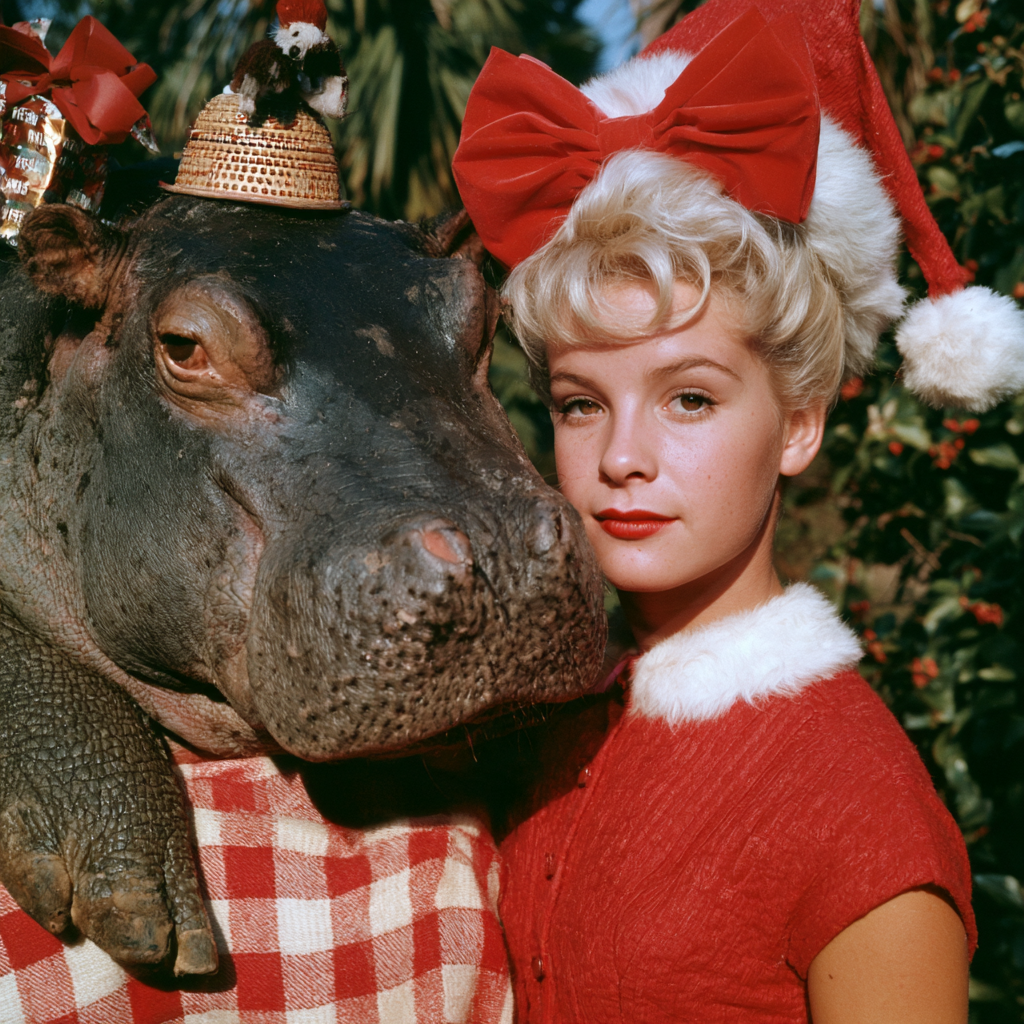
Yes. Gayla Peevey, the original singer of “I Want a Hippopotamus for Christmas”, really did receive a hippopotamus following the song’s success in 1953.
The animal was named Mathilda.
However, the ten-year-old singer didn’t take the enormous animal home. Instead, Mathilda became a resident of the Oklahoma City Zoo.
The extraordinary story began when the novelty recording became popular during the Christmas season and local supporters decided to turn its fictional request into reality.
More than seventy years later, it remains one of the strangest true stories behind a familiar Christmas song.
Who originally sang “I Want a Hippopotamus for Christmas”?
Gayla Peevey.
She was just ten years old when the original recording appeared in November 1953.
Peevey was already performing professionally, appearing on local television and developing a reputation for singing humorous novelty songs.
Her distinctive voice made the hippopotamus recording particularly effective.
She sounds completely committed to the unusual request, which is precisely what makes the song entertaining.
Who wrote the hippopotamus song?
American songwriter John Rox.
The composition was written as a novelty Christmas song.
Its central joke involves a child rejecting conventional Christmas presents in favour of an enormous animal that would be extremely impractical to keep at home.
The humour works because the narrator treats the request as perfectly reasonable.
Peevey’s performance reinforces that confidence.
Instead of sounding uncertain, she presents the hippopotamus as the obvious choice.
When was the song originally released?
11 November 1953.
It appeared through Columbia Records and subsequently reached No. 24 on Billboard’s pop chart.
Peevey also performed the composition on The Ed Sullivan Show, introducing the recording to a national television audience.
The song arrived during a period when humorous children’s recordings and novelty songs could achieve significant commercial success.
However, very few created consequences as unusual as this one.
Did Gayla Peevey actually want a hippopotamus?
The famous recording was a performance rather than a literal instruction to buy a dangerous wild animal.
Peevey subsequently recalled that the idea of receiving a hippopotamus developed into a much larger public event.
Oklahoma City Zoo was interested in acquiring a hippo, and the song provided an extraordinary opportunity to attract attention to the idea.
Local supporters began raising money.
Children contributed small amounts, helping turn the fictional Christmas request into a community project.
How did the hippopotamus arrive?
A fundraising campaign helped finance the purchase and transport of a young hippopotamus named Mathilda.
She arrived on Christmas Eve in 1953.
The event attracted considerable media attention, particularly because of its connection with the enormously recognisable novelty song.
Although Mathilda was presented in connection with Peevey’s Christmas wish, the intention was for the animal to live at the zoo.
The singer subsequently described donating the hippo to the institution.
What happened to Mathilda?
Mathilda remained associated with Oklahoma City Zoo for approximately 45 years.
She became a familiar animal to generations of visitors.
That means the song’s unusual real-world consequence lasted considerably longer than the original Christmas chart campaign.
A child performer had recorded a humorous composition, and the resulting public interest helped establish an animal’s long-term home.
Why does the song sound so funny?
Because it combines an unusual lyrical idea with a surprisingly straightforward musical performance.
The arrangement resembles cheerful mid-century popular music.
Peevey’s voice communicates the enthusiasm of a child who has decided exactly what she wants.
The contrast creates the humour.
There’s nothing particularly mysterious about the musical arrangement itself. The entertainment comes from the enormous difference between the request and the everyday Christmas environment surrounding it.
Was Gayla Peevey still a singer afterwards?
Yes.
She continued recording during her younger years and later released music under the name Jamie Horton.
However, her family eventually moved away from the public attention surrounding her childhood career.
Peevey subsequently discussed the difficulty of being recognised so frequently at a young age.
Her later life was considerably more private than the enormous publicity surrounding the Christmas recording.
Why did the song become popular again?
Older Christmas recordings frequently find new audiences through radio, compilations and seasonal playlists.
The hippopotamus song also benefits from being particularly distinctive.
There are thousands of recordings about Christmas romance, snow and family gatherings.
There are considerably fewer about requesting an enormous African mammal as a present.
That unusual subject makes the recording easy to recognise and remember.
Is it the same singer as Brenda Lee?
No.
Brenda Lee recorded “Rockin’ Around the Christmas Tree” at thirteen in 1958.
Gayla Peevey recorded “I Want a Hippopotamus for Christmas” at ten in 1953.
Both became associated with surprisingly confident childhood vocal performances, but they were different singers with separate musical careers.
Their histories demonstrate how several exceptionally young performers helped create the Christmas soundtrack that listeners still recognise today.
Other funny Christmas songs worth discovering
Try:
- The Chipmunks – The Chipmunk Song (Christmas Don’t Be Late)
- Spike Jones – All I Want for Christmas Is My Two Front Teeth
- Stan Freberg – Green Chri$tma$
- Elmo & Patsy – Grandma Got Run Over by a Reindeer
- Lou Monte – Dominick the Donkey
- The Waitresses – Christmas Wrapping
- The Kinks – Father Christmas
These recordings approach Christmas through humour, unusual storytelling and deliberately exaggerated musical personalities.
Did the hippopotamus Christmas wish really come true?
Yes.
Gayla Peevey’s recording inspired a fundraising campaign that helped bring Mathilda to Oklahoma City Zoo on Christmas Eve 1953.
The ten-year-old singer didn’t need to make room for a hippopotamus in her house.
But her famous fictional Christmas request became an extraordinary real-life event.
It’s difficult to imagine another novelty song producing quite the same result.