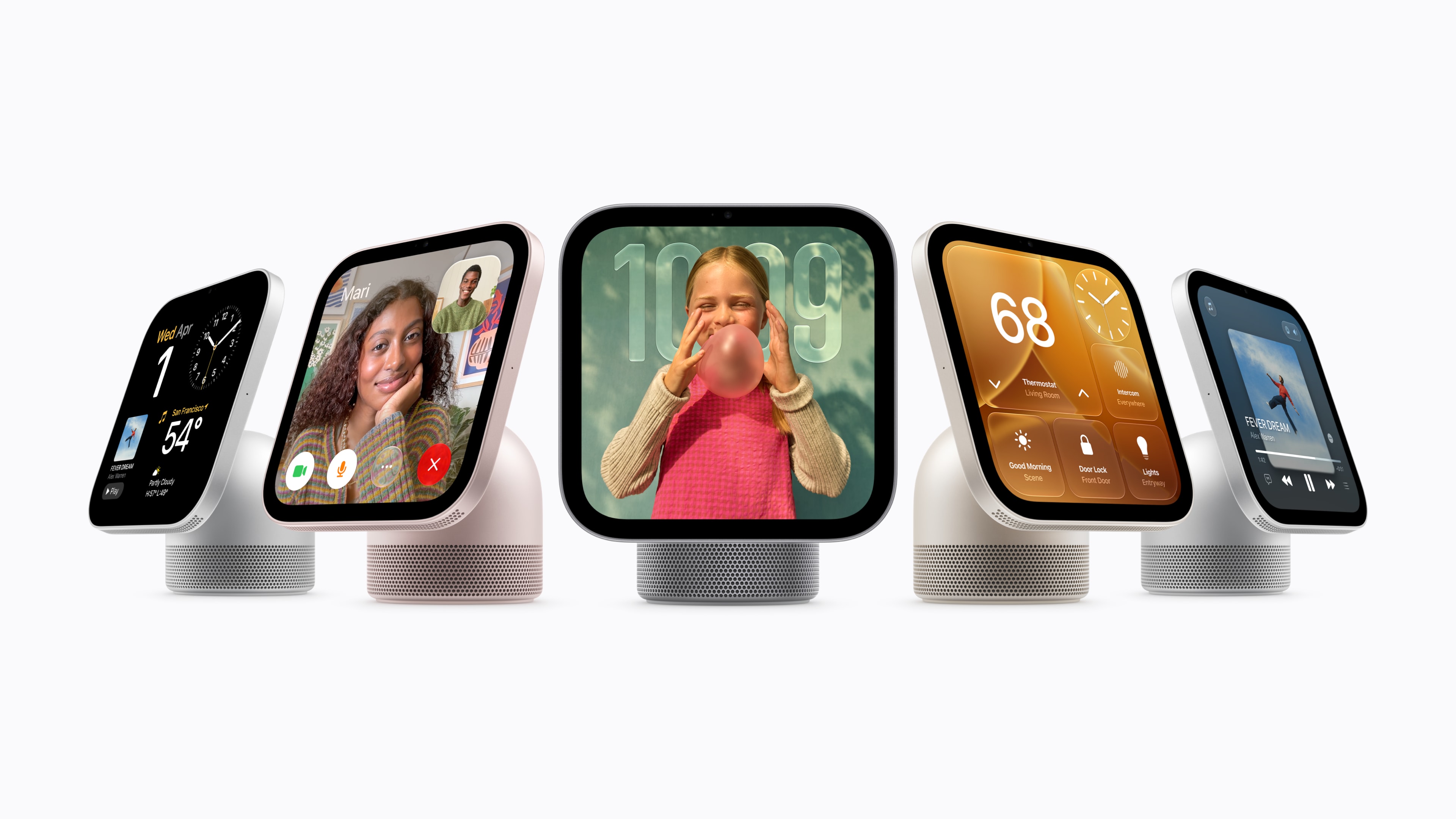
Apple HomeView Tabletop vs Wall-Mounted: Which Sounds Better?
Apple is selling two versions of HomeView, and at first glance the decision might seem to be entirely about where you put the screen. One sits on a desk or kitchen counter. The other hangs on a wall. Both cost £299 in the UK.
But music listeners should pay attention to something less obvious: the two models do not have the same speaker hardware.
On paper, the tabletop HomeView has the stronger bass-focused design. It includes a dedicated woofer and two passive radiators that Apple doesn’t list for the wall-mounted version. That makes it the more promising choice if sound is a top priority, although listening tests are still needed to establish the difference in practice.
What speakers are inside each HomeView?
Apple’s official technical specifications spell out the difference clearly.
The tabletop HomeView has two custom full-range drivers, a custom down-firing woofer and dual force-cancelling passive radiators. The full-range drivers sit in the display, while the larger bass components are housed in its domed base.
The wall-mounted HomeView has two custom full-range drivers, with computational audio tuned specifically for its position on a wall. Apple doesn’t list a separate woofer or passive radiators for this version.
Both models support Spatial Audio with Dolby Atmos for compatible material. Both also use computational audio to adjust playback in real time.
In other words, you aren’t choosing between a music-capable model and a silent smart-home controller. Both can play music. The important difference is how each is designed to produce low frequencies.
Why does a separate woofer matter for music?
A woofer is a speaker driver designed to reproduce lower frequencies. Those are the sounds that give a kick drum its weight, make a bass guitar feel substantial and add body to electronic music.
Passive radiators can help a compact enclosure produce more bass without using a conventional open port. In the tabletop HomeView, Apple has used two force-cancelling passive radiators alongside the down-firing woofer.
That doesn’t guarantee the tabletop model will shake a room, but it gives the speaker system a physical advantage for reproducing bass. Small speakers without dedicated bass hardware often have to work harder to create the impression of low frequencies.
For listeners who enjoy hip-hop, dance, pop or bass-heavy soundtracks, that difference could be noticeable. Whether it remains noticeable at quiet volumes or in a noisy kitchen will depend on Apple’s tuning and the room itself.
Does wall mounting make music sound worse?
Not necessarily. Wall placement changes how speakers interact with a room, and a well-tuned wall speaker can sound good. Apple says it has tuned the wall-mounted HomeView specifically for on-wall use.
There are also reasons someone might prefer the wall version. It saves counter space, places controls in a consistent location and may be easier to see in a hallway or shared living area. If your main listening system is elsewhere, its built-in speakers might be perfectly adequate for casual background music.
However, there is a trade-off in design. The wall-mounted model is just 0.98cm thick, compared with a tabletop model built around a considerably larger speaker base. There’s simply less enclosure space for dedicated bass hardware.
That is why comparing the two only by their identical screen size and advertised Spatial Audio support misses the most useful music-related detail.
Can both models play Dolby Atmos music?
Yes. Apple lists Spatial Audio with Dolby Atmos among the audio technologies supported by HomeView. It doesn’t limit that listing to the tabletop model.
However, the existence of a Dolby Atmos label should not be confused with identical physical sound. A compact wall-mounted speaker can process spatial audio while still producing a different balance of bass and volume from a larger enclosure.
If you’re curious about Atmos music, Apple Music is the most clearly documented source for enjoying it through HomeView’s built-in Music app. Spatial mixes may sound more open and immersive, but the result varies between recordings and speakers.
Which model is better for a kitchen?
For music-first use in a kitchen, the tabletop version is my initial pick based on its design. Its integrated speaker base gives it a better chance of producing satisfying bass while you cook, wash up or have friends around.
The adjustable display is another practical advantage. Apple has included a hinge that lets you tilt the screen to suit different countertop heights. You can move the device without reinstalling anything, provided there’s an available power socket.
Choose the wall-mounted model if counter space is scarce or the screen will mostly be used for lights, timers, recipes and household information. A permanent wall position can make a lot of sense in a busy room, even if audio is not as ambitious on paper.
Is the wall-mounted version really the same price?
The two HomeView units start at £299, but the installed cost is not necessarily the same.
Apple includes a USB-C cable and 30W power adapter with the tabletop version. The wall-mounted version requires a compatible mount plus a USB-C cable and power adapter, which are sold separately. Apple’s Schneider Home wall-mount options start at £54.95 in the UK, with more expensive alternatives for other installation methods.
That means a wall-mounted HomeView can cost noticeably more once it’s ready to use. If you need professional installation, factor that in too. The higher final cost doesn’t buy the tabletop version’s extra woofer.
Which HomeView should music lovers buy?
Based on the confirmed specifications, choose the tabletop HomeView if you want to listen directly through the device’s built-in speakers. Its woofer and passive radiators make it the more promising audio choice.
Choose the wall-mounted model if permanent positioning and access to smart-home controls matter more than bass. It still supports music, Spatial Audio and AirPlay, and you could also listen through other compatible speakers in your home.
Both arrive on 13 November 2026. Until someone compares them side by side, it’s too early to say exactly how large the sound difference is. What is already certain is that the £299 price tags conceal two genuinely different speaker systems.