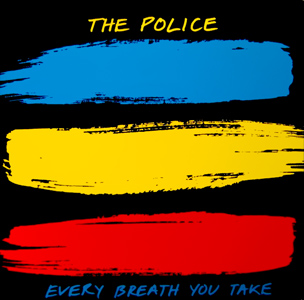
The Police’s “Every Breath You Take” Meaning: Why It Isn’t a Love Song
“Every Breath You Take” is not the romantic declaration many people believe it is.
Sting wrote it about obsession, jealousy and the desire to control another person.
The narrator isn’t simply admiring somebody he loves.
He’s watching them.
Monitoring their movements.
And behaving as though the end of a relationship doesn’t remove his right to know what they’re doing.
Sting has repeatedly described the song as deeply sinister.
That hasn’t stopped people choosing it for weddings.
Which is a fairly remarkable misunderstanding.
What is “Every Breath You Take” actually about?
Possessiveness.
The narrator appears unable to accept that a relationship has changed or ended.
He continues observing the other person as though they still belong to him.
The central idea is not:
I love you so much.
It’s closer to:
I cannot accept losing control of you.
That distinction completely changes the emotional meaning.
A romantic song celebrates mutual affection.
This one describes somebody who cannot let go.
Did Sting really write it about his own relationship?
The song emerged during an extremely complicated period in Sting’s personal life.
His first marriage to Frances Tomelty was ending.
His relationship with Trudie Styler was becoming public.
The situation attracted considerable attention.
Sting retreated to Jamaica, where he worked on music away from the immediate pressure.
The emotional atmosphere surrounding those events influenced the song.
That doesn’t mean every word is a literal description of his behaviour.
But the jealousy and possessiveness were connected with real emotional circumstances.
Where did Sting write it?
At the Goldeneye estate in Jamaica.
The property had previously belonged to Ian Fleming, creator of James Bond.
Sting has recalled writing the song there.
That provides one of music history’s stranger connections.
A song about obsessive observation was written in a location associated with the novelist who created the world’s most famous fictional spy.
Probably not intentional.
Still appropriate.
Why do people think it’s romantic?
Because the arrangement is beautiful.
The guitar is delicate.
The rhythm is restrained.
Sting’s vocal is controlled.
Nothing sounds aggressively threatening.
That makes the recording easy to misunderstand.
Listeners hear the idea of paying constant attention to somebody and interpret it as devotion.
But context changes everything.
Attention can be romantic when it’s welcomed.
It becomes disturbing when somebody refuses to respect another person’s independence.
What has Sting said about the misunderstanding?
He has repeatedly expressed surprise that listeners interpret the recording as a conventional love song.
In interviews, Sting has described the writing as sinister and uncomfortable.
He’s also acknowledged that listeners bring their own experiences to music.
Some hear devotion.
Others hear control.
The tension between those interpretations may actually be part of the recording’s enduring power.
Why does the guitar sound so distinctive?
Andy Summers.
His repeating guitar figure is one of the most recognisable parts of the recording.
The arrangement is remarkably restrained.
Rather than filling the song with complicated guitar solos, Summers creates a pattern that repeats throughout.
That repetition mirrors the emotional subject.
The narrator keeps returning to the same obsession.
The musical pattern behaves similarly.
What album is “Every Breath You Take” on?
Synchronicity.
Released in 1983.
It became one of The Police’s most successful albums.
The recording also marked the final phase of the band’s original career.
Internal relationships were increasingly difficult.
The group eventually separated.
That creates another uncomfortable layer around the song.
A recording about possessiveness and emotional tension emerged while the band itself was experiencing enormous interpersonal conflict.
How successful was the song?
Enormously.
It reached No. 1 in both the United States and United Kingdom.
In America, it spent eight weeks at the top of the Billboard Hot 100.
It also won major Grammy Awards.
Its commercial success helped establish it as one of the defining pop-rock recordings of the 1980s.
The song’s longevity has been extraordinary.
It continues attracting new listeners decades after release.
What does the music video mean?
The video uses a restrained black-and-white visual style.
The band perform in a dark, almost theatrical environment.
Lighting and shadows create tension.
The presentation avoids elaborate romantic storytelling.
That decision fits the recording.
It’s more concerned with atmosphere than showing a conventional love story.
The visual world feels slightly cold.
Which is appropriate once you understand the lyrics.
Is “Every Breath You Take” about stalking?
That’s a reasonable modern interpretation.
The narrator displays behaviour associated with unwanted surveillance and obsessive attention.
Sting has acknowledged that the song contains a disturbing level of possessiveness.
But it’s worth remembering that the recording is a fictional artistic perspective rather than a set of instructions.
The song explores an unhealthy emotional state.
It doesn’t celebrate it.
What song samples “Every Breath You Take”?
“I’ll Be Missing You” by Puff Daddy and Faith Evans, featuring 112.
Released in 1997, the recording was created as a tribute to The Notorious B.I.G.
It uses the recognisable guitar-based musical idea from The Police’s song.
That creates an extraordinary transformation.
The original is about obsession and control.
The later recording is about grief and remembrance.
The same musical foundation supports two very different emotions.
Why does the sample work so well?
Because the guitar figure is immediately recognisable.
The original melody carries a sense of longing.
That can be interpreted in different ways.
In The Police’s recording, the longing is possessive.
In “I’ll Be Missing You”, it becomes grief.
The arrangement changes the emotional message.
It’s one of the clearest examples of how sampling can transform musical meaning.
Songs like “Every Breath You Take”
The Police – Wrapped Around Your Finger
Sting – Fragile
Phil Collins – Against All Odds
Dire Straits – Brothers in Arms
Tears for Fears – Everybody Wants to Rule the World
Bryan Ferry – Slave to Love
Sade – Smooth Operator
Depeche Mode – Enjoy the Silence
These recordings share different elements of restrained production, emotional complexity and sophisticated 1980s songwriting.
Why does the song remain popular?
Because it operates on two levels.
Casual listeners hear a beautiful melody.
More attentive listeners discover the darker narrative.
That allows the recording to remain interesting.
It also makes the song a useful example of why listeners shouldn’t always assume that the emotional tone of the music matches the subject of the words.
What does “Every Breath You Take” really mean?
The difference between love and control.
The narrator confuses constant observation with devotion.
He appears unable to accept the other person’s independence.
Sting turned that unhealthy emotional perspective into one of the most beautiful-sounding recordings of the decade.
The result became a wedding favourite.
Sometimes a melody is so good that nobody pays attention to the warning.