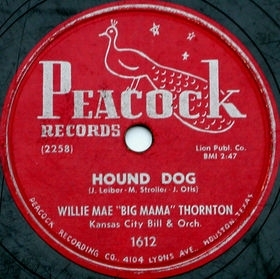
Who Originally Sang “Hound Dog”? Big Mama Thornton Before Elvis
Big Mama Thornton.
Not Elvis Presley.
Thornton recorded the original “Hound Dog” in August 1952.
The song became a major R&B hit in 1953.
Elvis Presley recorded his famous version in 1956.
But there’s another important detail.
Elvis didn’t simply reproduce Thornton’s recording.
He based much of his interpretation on a later version performed by Freddie Bell and the Bellboys.
That means one of rock and roll’s most famous songs travelled through several performers before reaching the version most listeners recognise today.
Who was Big Mama Thornton?
Willie Mae Thornton was an American blues singer born in Alabama.
She became known for her extraordinary vocal power and commanding stage presence.
Her musical background was rooted in blues, gospel and rhythm and blues.
She developed a professional career during the 1940s and became associated with the Johnny Otis musical revue.
Thornton’s performances were powerful and direct.
She didn’t sing like the polished pop performers who dominated much mainstream radio.
Her voice sounded raw.
Physical.
Uncompromising.
That made her an ideal performer for “Hound Dog”.
Who wrote “Hound Dog”?
Jerry Leiber and Mike Stoller.
The pair were young songwriters working in Los Angeles.
They were asked to create material suitable for Thornton.
The result was a blues song about a woman rejecting a man who had treated her badly.
That original meaning is important.
“Hound Dog” wasn’t initially a novelty song about an actual dog.
It was a relationship song.
A particularly dismissive one.
When did Big Mama Thornton record it?
August 13, 1952.
The recording was released commercially in 1953.
It became an enormous success on the American R&B chart.
Thornton’s version spent seven weeks at No. 1.
That was a major achievement.
The song had already become famous within rhythm and blues years before Elvis recorded his interpretation.
What does the original “Hound Dog” mean?
The narrator is dismissing an unreliable romantic partner.
The man has behaved badly.
The woman has had enough.
The title uses an animal comparison to insult somebody she no longer respects.
Thornton’s performance makes the emotional message unmistakable.
This is not a vulnerable person asking somebody to return.
It’s a confident singer telling somebody they are no longer welcome.
That gives the original recording a very different personality from Elvis’s version.
How did Elvis Presley discover the song?
Through Freddie Bell and the Bellboys.
Bell’s group performed a rewritten version of “Hound Dog” during the 1950s.
The arrangement was more closely connected with the emerging rock-and-roll style.
The lyrics also changed.
Elvis heard the group perform during a Las Vegas engagement.
He liked their interpretation.
Then added the song to his own performances.
That became the foundation of his recording.
Did Elvis steal the song from Big Mama Thornton?
That’s too simplistic.
“Hound Dog” was an existing copyrighted composition written by Leiber and Stoller.
Elvis recorded a cover.
He didn’t claim to have written it.
And his arrangement drew significantly from Freddie Bell’s intermediate version.
But the wider history does raise important questions about recognition.
Thornton’s original success is often overlooked.
Elvis’s recording became vastly more commercially successful.
That imbalance reflects the racial divisions affecting American music during the 1950s.
Why are the Elvis lyrics different?
Because the composition had already been altered by other performers.
Freddie Bell’s version made the song more comedic.
The familiar imagery involving a dog and a rabbit belongs to that later lyrical tradition.
Thornton’s original recording was much more direct about the narrator’s relationship with an unreliable man.
The change affects the song’s meaning.
The original is an angry blues performance.
Elvis’s version becomes a high-energy rock-and-roll record.
Why did Elvis’s version become so enormous?
Timing.
Performance.
Television.
Elvis was becoming one of the most important entertainers in America.
His physical stage presence attracted enormous attention.
The recording had a relentless rhythm and memorable vocal delivery.
It also worked perfectly within the developing rock-and-roll market.
The song became one of Presley’s defining hits.
But the original musical idea had already existed for years.
Did Big Mama Thornton receive royalties?
Thornton has spoken about receiving very little financial benefit from the enormous popularity of her recording.
The wider history of her career reflects the difficult conditions faced by many Black musicians during the period.
Recording contracts were frequently disadvantageous.
Artists didn’t always control their work.
And later performers could achieve much larger commercial success through reinterpretations.
Thornton’s contribution to early rock and roll deserves recognition independent of the financial outcome.
Did Big Mama Thornton influence other famous singers?
Yes.
Janis Joplin is one of the clearest examples.
Joplin famously recorded Thornton’s “Ball and Chain”.
She admired Thornton’s vocal power and emotional directness.
That creates another musical connection.
Thornton helped influence the vocal style associated with later blues-rock singers.
Her importance extends far beyond “Hound Dog”.
What genre is the original “Hound Dog”?
Rhythm and blues.
Electric blues.
Early rock-and-roll influence.
Thornton’s version belongs to the musical environment from which rock and roll developed.
Elvis’s recording is much more clearly associated with mainstream rock and roll.
Listening to both reveals how closely the genres were connected.
Songs to hear after “Hound Dog”
Big Mama Thornton – Hound Dog
Big Mama Thornton – Ball and Chain
Elvis Presley – Hound Dog
Big Joe Turner – Shake, Rattle and Roll
Ruth Brown – Mama, He Treats Your Daughter Mean
Wynonie Harris – Good Rockin’ Tonight
Little Richard – Tutti Frutti
Chuck Berry – Maybellene
These recordings provide a useful introduction to the musical world surrounding early rock and roll.
Why is the original recording worth hearing?
Because it changes the story.
If you only know Elvis, “Hound Dog” sounds like a classic rock-and-roll performance.
Hear Thornton and the composition becomes something else.
A blues singer confronting an unreliable man.
A powerful rhythm-and-blues arrangement.
A very different vocal personality.
The later versions make more sense once you understand the original.
Who originally sang “Hound Dog”?
Big Mama Thornton.
She recorded it in 1952.
It became a major R&B hit in 1953.
Freddie Bell and the Bellboys later reworked the song.
Elvis Presley made another enormously successful version in 1956.
That history is worth remembering.
Rock and roll didn’t appear from nowhere when Elvis entered a recording studio.
It developed from musical traditions and performers who had already laid much of the foundation.
Big Mama Thornton was one of them.