Hindustani vs Carnatic Music – What’s the Difference?
Indian classical music isn’t one single musical system.
It has two major traditions.
Hindustani classical music developed primarily across northern India, while Carnatic classical music became the dominant classical tradition of southern India.
Both share ancient roots.
Both use concepts such as raga and tala.
And both can sound completely unfamiliar to listeners raised primarily on Western pop or classical music.
So what is the difference between Hindustani and Carnatic music?
What is Hindustani music?
Hindustani classical music is the classical tradition most strongly associated with northern and parts of western India.
It developed over centuries while absorbing influences from different cultures that passed through northern India.
Improvisation plays an extremely important role.
A musician may spend significant time exploring the notes and emotional character of a particular raga before gradually increasing the rhythmic and technical complexity of the performance.
What is Carnatic music?
Carnatic music is the classical tradition most closely associated with southern India.
It is particularly important across states including Tamil Nadu, Karnataka, Andhra Pradesh, Telangana and Kerala.
Carnatic music also contains extensive improvisation, but compositions generally play a particularly important structural role.
India’s Ministry of Culture recognises Hindustani and Carnatic music as the two principal classical musical traditions of the country.
What is a raga?
You will encounter the word raga constantly when exploring Indian classical music.
A raga isn’t simply a scale.
It is closer to a musical framework.
A raga determines things such as:
- which notes are important
- how notes can be approached
- characteristic melodic phrases
- movement between notes
- the mood or emotional atmosphere
Two musicians can perform the same raga and produce very different performances.
That space for interpretation is one of the defining characteristics of Indian classical music.
What is tala?
Tala refers to rhythmic structure.
Instead of thinking only in terms of a simple beat, Indian classical musicians organise rhythm into repeating cycles.
Different talas contain different numbers and arrangements of beats.
Performers can create extremely complex rhythmic patterns while still resolving phrases back into the underlying cycle.
Hindustani and Carnatic music use different instruments
There is overlap, but listeners will often encounter different instruments within each tradition.
Common Hindustani instruments include:
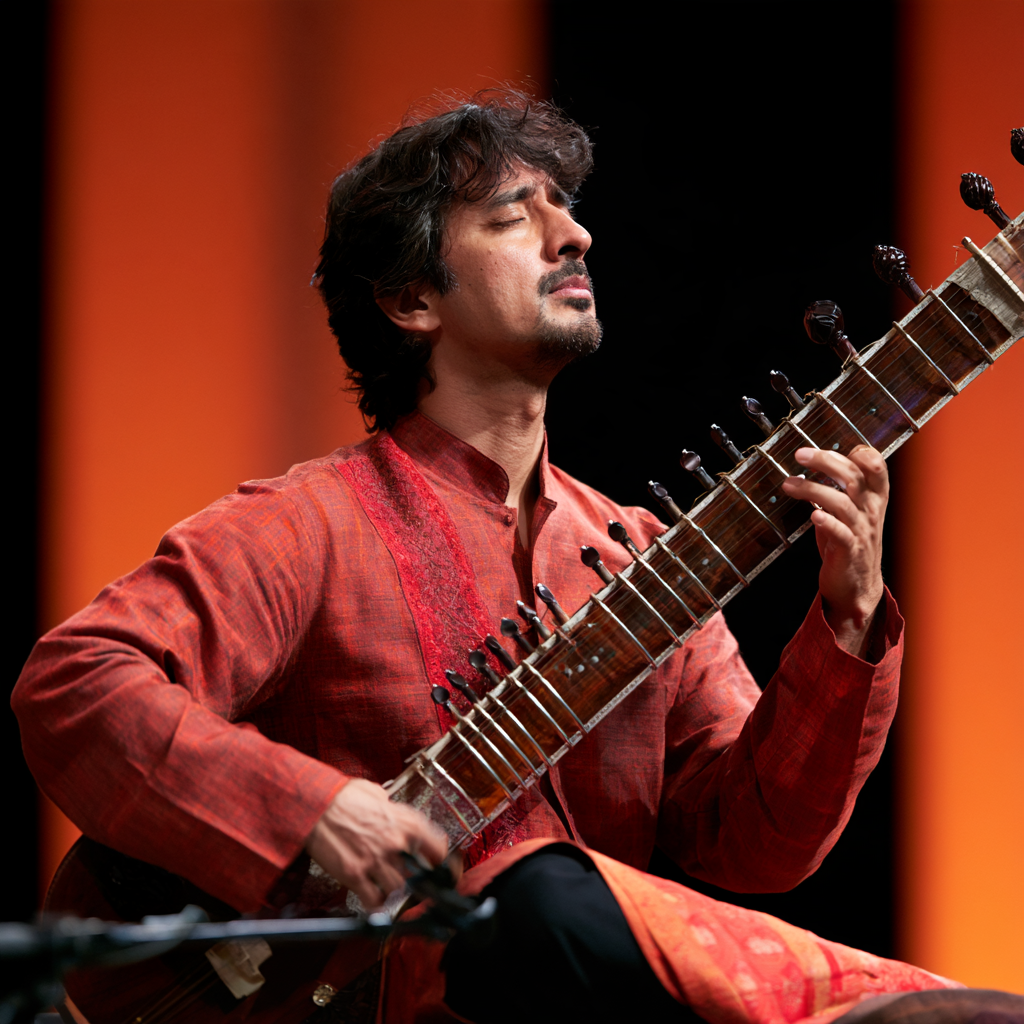
- sitar
- sarod
- tabla
- bansuri
- shehnai
- sarangi
- tanpura
Carnatic performances may feature:
- veena
- mridangam
- violin
- venu flute
- ghatam
- kanjira
- nadaswaram
- tanpura
Indian government cultural information also highlights different instrument traditions associated with Hindustani and Carnatic performance.
Vocals sound different too
Vocal music plays an enormous role in both systems.
Hindustani vocal styles include forms such as:
- khayal
- dhrupad
- thumri
- tarana
Carnatic music has its own compositional and vocal traditions, including forms such as:
- kriti
- varnam
- tillana
Even to an inexperienced listener, the phrasing, ornamentation and rhythmic movement can sound noticeably different.
Is one older than the other?
Both traditions ultimately share ancient Indian musical roots.
They became increasingly distinct over time as northern and southern musical cultures developed differently.
That makes it misleading to think of one simply appearing first and the other copying it.
They are better understood as related traditions that gradually developed their own musical languages.
Is Hindustani music more improvised?
This is sometimes used as a simple distinction, but it is slightly misleading.
Both Hindustani and Carnatic music involve sophisticated improvisation.
The difference is often how that improvisation interacts with the structure of the performance.
Hindustani performances can feature very extended exploration of a raga.
Carnatic performances often revolve more visibly around established compositions while still containing substantial improvised sections.
How can beginners hear the difference?
One of the easiest ways is to listen to representative performances back-to-back.
For Hindustani music, try searching for:
- Ravi Shankar
- Ali Akbar Khan
- Hariprasad Chaurasia
- Zakir Hussain
- Bhimsen Joshi
For Carnatic music, try:
- M. S. Subbulakshmi
- Lalgudi Jayaraman
- T. N. Krishnan
- L. Subramaniam
- T. M. Krishna
Don’t worry about understanding every technical concept initially.
Listen first.
You will gradually start noticing differences in vocal style, instrumentation, rhythm and the way musicians develop melodies.
Is Bollywood music based on Indian classical music?
Sometimes.
Indian film music has borrowed heavily from classical traditions, folk music, Western pop, electronic music and almost everything in between.
Some famous Bollywood songs are closely based on particular ragas.
Others contain very little classical influence.
Bollywood is therefore better understood as an enormous popular-music ecosystem rather than an extension of Hindustani classical music.
Which should you listen to first?
There is no correct order.
If you enjoy slowly developing improvisation, long instrumental performances and instruments such as sitar or sarod, start with Hindustani music.
If you enjoy intricate rhythm, virtuosic vocals, violin and composition-driven performances, try Carnatic music.
Then switch.
The similarities become more interesting once you can hear the differences.
Indian classical music isn’t really one tradition split into two neat halves.
It is two huge musical worlds.
And either one could keep a curious listener busy for a lifetime.