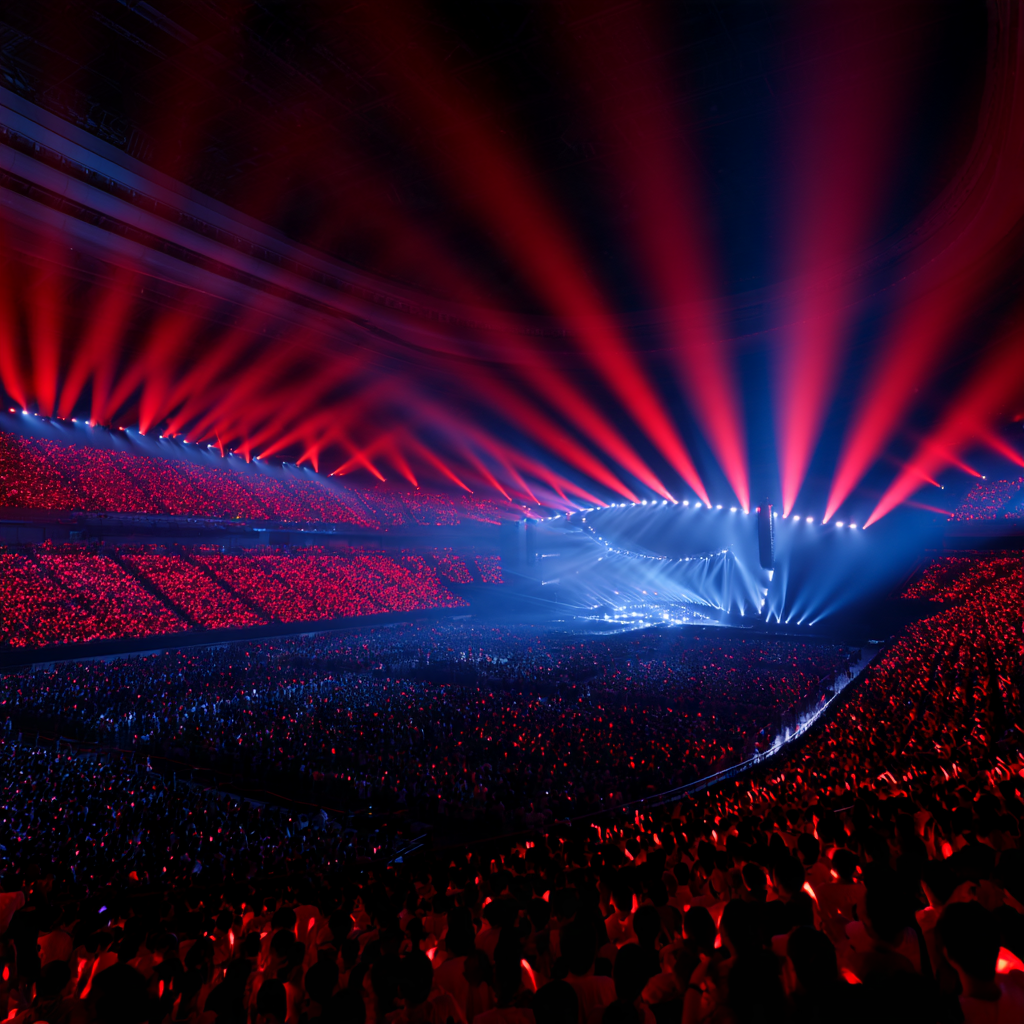
Live Music Has Gone Global – Now the World Is Running Out of Arenas
For years, the music industry had a distribution problem.
Artists outside the US and UK struggled to reach audiences around the world. Record labels controlled access to international markets, radio was overwhelmingly local, and getting physical music into another country required an entire distribution network.
Streaming effectively destroyed that barrier.
TikTok, YouTube and Instagram then did something similar to music discovery.
Now the industry appears to have a completely different problem.
There are plenty of fans.
There are plenty of global artists.
There simply aren’t enough venues to put them in.
New figures from Live Nation provide perhaps one of the clearest indications yet of how dramatically the global music business is changing.
Before the pandemic, only around 8% of Live Nation’s top 50 tours were performed by non-English-speaking artists.
Today, that figure is around 30%.
And Live Nation thinks it could eventually exceed 50%.
That would represent an extraordinary transformation of an industry historically dominated by artists from the United States and United Kingdom.
But the most interesting number might actually be another one.
According to Live Nation, 47 of the top 75 international markets outside the United States don’t currently have enough modern arena infrastructure to satisfy demand.
In other words, global music demand may now be expanding faster than the buildings required to accommodate it.
The world’s biggest artists no longer need to sing in English
There was once an assumption within the Western music industry that international artists eventually needed to “cross over”.
Usually that meant singing in English.
That idea increasingly looks outdated.
Bad Bunny became one of the world’s biggest touring artists while continuing to perform overwhelmingly in Spanish.
K-pop artists routinely sell out stadiums thousands of kilometres from South Korea.
Latin music has become a major global genre.
African artists are building international audiences without necessarily changing their music to suit American radio.
Live Nation CFO Joe Berchtold pointed to Bad Bunny as arguably the biggest touring artist of the post-COVID era while highlighting K-pop and Latin music as examples of genres that have expanded dramatically beyond their original markets.
The implication is important.
English is no longer a prerequisite for becoming a global music star.
The internet has made language much less important than community.
Streaming didn’t just change recorded music
We normally talk about Spotify, Apple Music and YouTube in terms of recorded music.
But streaming may ultimately have an equally large effect on concerts.
Before streaming, breaking an artist internationally required enormous infrastructure.
Labels needed local marketing teams.
Music needed radio support.
Physical albums had to be distributed.
Press campaigns had to be organised market by market.
Today, a song uploaded in Seoul, Lagos, São Paulo or Mexico City can immediately be heard virtually anywhere.
Social media then allows communities to form around those artists without needing traditional media.
Live Nation believes this is one of the fundamental reasons touring has become so global.
An artist doesn’t necessarily need millions of fans in one city.
They just need enough concentrated fans to fill a venue.
Berchtold used Los Angeles as an example: even an artist operating within a relatively niche genre may only need a tiny fraction of the city’s population to create a viable live audience. Social platforms make finding that small community dramatically easier than it was previously.
That changes the economics of touring.
The long tail of music is becoming the long tail of concerts
This might be the bigger structural change.
Streaming created the long tail of recorded music.
Instead of consumers choosing between whatever albums happened to be stocked in a record store, they suddenly had access to almost everything.
Live music is beginning to experience something similar.
A Turkish rapper doesn’t need to become a mainstream American celebrity to sell thousands of tickets in New York.
A Korean artist doesn’t need to dominate British radio before developing an audience in London.
A Brazilian artist may already have communities scattered across Portugal, Japan, France and the United States.
Streaming creates the audience.
Social media identifies and connects the audience.
Touring monetises it.
That combination could produce thousands more internationally viable touring artists than the traditional music industry ever supported.
And that is where the infrastructure problem begins.
47 major markets don’t have enough modern arenas
Live Nation says 47 of the top 75 markets outside the US lack sufficient modern arena infrastructure.
These aren’t tiny emerging markets either.
The company specifically highlighted cities including Rome, Istanbul, Frankfurt, Seoul, Tokyo, Manila, São Paulo, Rio de Janeiro and Lima.
Many of these are enormous cities.
The problem isn’t necessarily that they have no venues.
It’s that the supply of modern music-focused arenas, with the capacity, production facilities, hospitality, premium areas and commercial infrastructure expected by major international tours, doesn’t match demand.
That creates a fascinating situation.
The digital part of the music industry has globalised incredibly quickly.
The physical part can’t.
You can make Spotify available in another country almost instantly.
You cannot download a 20,000-seat arena.
Live Nation is effectively making a $5.2 billion bet on this trend
Live Nation isn’t simply talking about the opportunity.
It is putting billions behind it.
At its 2025 Investor Day, the company outlined a pipeline of 48 large venues requiring around $5.2 billion of capital investment.
Twenty-eight of those venues are outside the United States.
Live Nation has also been acquiring arenas.
During 2026 it completed arena acquisitions in Santiago, Bangkok, Milan and Buenos Aires and agreed to acquire a majority interest in three Prague venues, including the city’s 20,000-capacity O2 arena.
New facilities are planned too.
A 21,000-capacity arena is being developed in São Paulo, while plans have been submitted for an 18,500-capacity arena in Lima.
This isn’t just property development.
It is infrastructure for the globalisation of music.
Live Nation wants 225 million concertgoers
The scale of the company’s ambitions provides another indication of where live music could be heading.
A record 159 million people attended Live Nation-promoted concerts during 2025, across roughly 55,000 shows.
For the first time, more of those attendees were outside the United States than inside it.
That is a significant milestone.
Live Nation has already sold more than 155 million tickets during 2026 and expects approximately 175 million fans to attend its concerts this year.
Its longer-term target is around 225 million.
The company believes international markets will provide much of that growth.
Consider the disparity Live Nation sees today.
Latin America’s activity with the company has increased roughly 15-fold over the past decade, yet Live Nation says it remains at only around one-tenth of US activity levels.
Japan operates at roughly 40% of US activity on a per-capita basis.
Even Western Europe could potentially grow another 25%, according to the company.
There is still a huge amount of unused capacity in the global live music economy.
Music may be entering its truly global era
The recorded music industry often calls itself global.
In reality, its biggest commercial markets have historically been remarkably concentrated.
The United States, UK and Western Europe have produced a disproportionate number of internationally successful artists.
The internet is beginning to dismantle that advantage.
There is an important distinction here.
American and British music isn’t necessarily becoming less popular.
The total market is becoming much larger.
A listener can follow Taylor Swift, Bad Bunny, BTS, Burna Boy and a local artist from their own country simultaneously.
Music is no longer a winner-takes-all competition between geographical markets.
More artists can become globally relevant at the same time.
The next huge music markets may already exist
There is another way to interpret Live Nation’s figures.
The next great music markets might not need to be created.
The demand may already exist.
The infrastructure hasn’t caught up with it.
A city with millions of young consumers, widespread smartphone usage and access to Spotify, YouTube and TikTok can develop enormous music communities remarkably quickly.
But converting those digital fans into a live music economy requires considerably more.
You need venues.
Promoters.
Ticketing.
Transport.
Security.
Production infrastructure.
Hotels.
Local partners.
Sponsorship markets.
All of that develops far more slowly than an audience on TikTok.
That gap could become one of the largest investment opportunities in entertainment over the coming decade.
Arenas could become one of music’s most valuable assets
It also explains why Live Nation is so interested in owning and operating venues.
An arena isn’t simply somewhere to hold a concert.
It sits at the centre of several businesses.
The promoter earns from the show.
Ticketing generates fees.
Food and drink generate revenue.
VIP and hospitality generate revenue.
Brands buy sponsorship.
Premium seating generates revenue.
The venue itself becomes an asset.
Live Nation’s existing venues generated around $2 billion in venue revenue at the time of its 2025 Investor Day, with approximately $1 billion coming from food and beverage alone. The company said it targets returns above 20% across its venue investment portfolio.
That means building music infrastructure can potentially capture value from almost every part of a fan’s night out.
This is also very good news for independent artists
There is another important takeaway from all of this.
Artists don’t necessarily need to become globally famous anymore.
They need globally distributed pockets of passionate fans.
An independent artist might have:
20,000 fans in London
8,000 in Berlin
12,000 in Mexico City
5,000 in Sydney
15,000 in Los Angeles
10,000 in São Paulo
Historically those fragmented audiences would have been incredibly difficult to identify and reach.
Today they are measurable.
Spotify streaming data can show where listeners are.
Social platforms reveal where followers live.
Digital advertising can target those people.
Ticketing platforms can measure actual demand.
Touring decisions can therefore increasingly be driven by data rather than simply assuming where an artist might be popular.
For independent musicians, that is potentially revolutionary.
The biggest music industry story might be geography
AI currently dominates almost every conversation about the future of music.
But something arguably just as significant is happening much more quietly.
Music is becoming geographically decentralised.
The numbers are starting to show it.
Non-English-speaking artists have gone from around 8% to 30% of Live Nation’s biggest tours.
International fans have overtaken US fans across Live Nation’s concert business.
And the world’s largest concert promoter thinks international markets will eventually drive so much growth that describing them separately as “international” will stop making much sense.
That may ultimately be the most important point.
For most of music history, an artist’s home country placed enormous limits on how large their career could become.
Streaming removed much of that barrier.
Social media removed another.
Now live music infrastructure has to catch up.
And if Live Nation is right, the next decade of music growth may not come primarily from getting Americans and Europeans to attend more concerts.
It may come from hundreds of millions of fans around the world finally getting the venues needed to see the artists they already love.