Spotify Launches Free AI Audiobook Creator in 21 New Markets, Allowing Authors to Create Five Audiobooks for Free
Spotify is making it easier than ever for independent authors to turn their books into audiobooks, expanding its free AI audiobook creation tools to 21 additional markets, including the UK, Australia, Canada and Spain.
The new tools allow eligible self-published authors to transform written manuscripts into professionally styled, digitally narrated audiobooks without paying traditional narration and production costs.
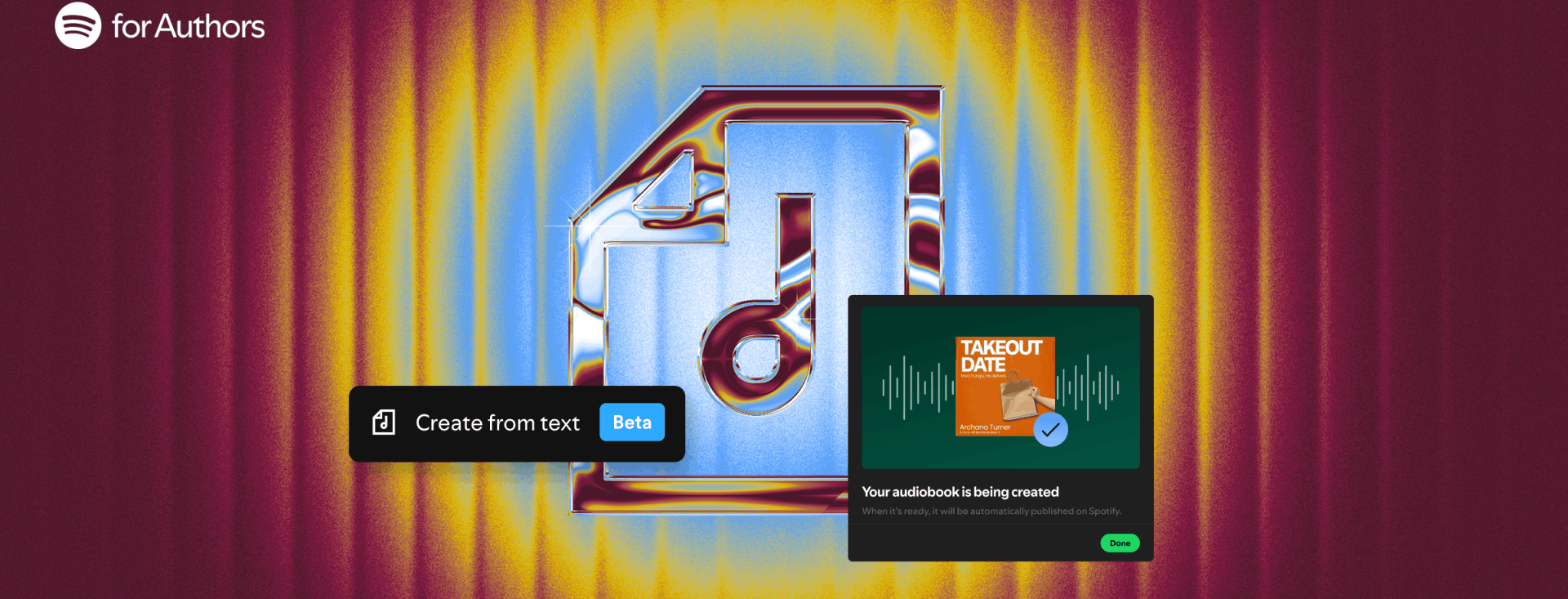
Powered by AI voices from ElevenLabs, Spotify’s Audiobook Creation Tools allow authors to produce up to five audiobooks completely free of charge.
The expansion also introduces Spanish-language support, opening up new opportunities for authors across Spain and Latin America.
For Spotify, the move represents another significant step towards becoming a major platform for all forms of audio, rather than focusing exclusively on music and podcasts.
Spotify expands free audiobook creation to 22 countries
Spotify originally launched its Audiobook Creation Tools in the United States in September 2026.
Following encouraging early adoption, the company announced on 18 November that it was expanding the service to 21 additional markets.
The tools are now available to eligible self-published authors in:
- United States
- United Kingdom
- Canada
- Australia
- Ireland
- New Zealand
- Spain
- Mexico
- Colombia
- Chile
- Peru
- Ecuador
- Guatemala
- Bolivia
- Dominican Republic
- Honduras
- Paraguay
- El Salvador
- Nicaragua
- Costa Rica
- Panama
- Uruguay
This brings the total number of supported countries to 22.
Authors in these markets can create audiobooks in English or Spanish, with Spotify introducing additional Spanish-language AI voices to support different accents and regional variations.
The expansion comes as Spotify continues rolling out audiobook listening to more than 180 markets worldwide.
Read more about Spotify’s global audiobook expansion on RouteNote Radar.
How does Spotify’s free AI audiobook creator work?
Spotify has integrated its audiobook creation technology directly into Spotify for Authors.
The platform allows writers to convert a completed manuscript into an audiobook using digital narration, without requiring recording equipment, professional voice actors or specialist audio production software.
The process is designed to be straightforward.
Step 1: Upload your manuscript
Authors begin by uploading their finished manuscript to Spotify for Authors.
The platform currently accepts EPUB files, a common format used for ebooks.
Step 2: Choose an AI narrator
Once the manuscript has been uploaded, authors can select a digital voice from a curated library powered by ElevenLabs.
The library includes English and Spanish voices, with regional Spanish options such as Castilian, Mexican and Latin American varieties.
Step 3: Customise pronunciations
Authors can review how names, locations and unusual words are pronounced.
This is particularly useful for fictional books, technical writing and manuscripts containing unfamiliar terminology.
Step 4: Preview individual chapters
Before publishing, authors can listen to chapter previews to check the narration.
They can make adjustments to pronunciation and other supported settings until they are satisfied with the result.
Step 5: Publish directly to Spotify
Once the author approves the final audiobook, it can be submitted for publication directly through Spotify for Authors.
Spotify says most audiobooks are published within 72 hours after processing has finished.
This dramatically simplifies a production process that would traditionally require recording sessions, editing, mastering and distribution arrangements.
Authors can create five audiobooks completely free
One of the biggest advantages of Spotify’s new service is its pricing.
Eligible authors can produce up to five audiobooks at no cost.
There are no upfront narration fees for these projects, although authors must create a Spotify for Authors account and complete a validated payment profile before accessing the tools.
Spotify also applies certain usage and audiobook generation limits.
For independent writers, this could remove one of the biggest financial barriers to entering the audiobook market.
Professional audiobook production can be expensive, particularly for longer manuscripts requiring many hours of narration and editing.
AI narration offers an alternative for authors who might otherwise be unable to justify those costs.
The five-audiobook allowance could also be particularly useful for writers with existing ebooks that have never been released in an audio format.
Authors wanting to create more than five audiobooks can contact Spotify for Authors support.
Spotify introduces Spanish AI narration with ElevenLabs
The addition of Spanish-language support is another important part of the announcement.
Spotify has expanded its partnership with AI voice technology company ElevenLabs to introduce new Spanish voices.
These include regional variations designed to give authors more control over how their stories sound.
For example, an author targeting listeners in Spain may prefer a Castilian Spanish narrator, while a writer targeting audiences in Mexico may choose a Mexican Spanish voice.
This flexibility could make AI narration more useful for independent authors producing content for international audiences.
It also reflects Spotify’s wider ambitions to expand beyond predominantly English-language audiobook catalogues.
Earlier in 2025, Spotify announced that it would begin accepting AI-narrated audiobooks through its partnership with ElevenLabs.
Read about Spotify’s original ElevenLabs audiobook partnership.
The latest expansion takes that partnership further by integrating AI narration directly into Spotify’s own author publishing platform.
Spotify says author sign-ups have more than doubled
Spotify has also shared some early performance figures following the introduction of its audiobook creation tools in the United States.
According to the company:
- Spotify for Authors sign-ups have more than doubled since the September launch.
- Nearly two in three new authors have tried the Audiobook Creation Tools.
- More than 60% of uploaded manuscripts have progressed to publication.
- Listeners are returning to AI-narrated titles at approximately the same rate as other self-published audiobooks on Spotify.
These figures suggest there is substantial demand for more accessible audiobook production.
The listener retention statistic is particularly interesting.
One potential concern surrounding AI narration is whether audiences will engage with synthetic voices in the same way they engage with human narrators.
Spotify’s early results suggest that, at least among the titles included in its analysis, return listening behaviour has been comparable.
However, Spotify has not published detailed breakdowns of listening duration, sales or author earnings for these titles.
It remains too early to determine how AI-narrated audiobooks will perform across the wider publishing industry.
Why is Spotify investing so heavily in AI audiobooks?
Spotify believes there is a substantial gap between the number of books available worldwide and those that have been converted into audio.
According to estimates cited by Spotify, approximately 100 million books exist globally, but only around one million are available as audiobooks.
If accurate, that would mean only around 1% of the world’s books have an audiobook version.
Traditional audiobook production requires time, money and specialist resources.
For many independent authors, particularly those publishing shorter books or working with limited budgets, producing an audiobook may simply not be financially viable.
AI narration changes that calculation.
By dramatically reducing the cost and complexity of creating audiobooks, Spotify could encourage a much larger proportion of published books to become available in audio format.
That would help Spotify grow its audiobook catalogue while giving listeners access to titles that might never have received a traditional audiobook release.
It is also an opportunity for Spotify to expand the amount of content available to its existing audience without having to produce the books itself.
Can authors distribute their audiobooks outside Spotify?
Yes.
Spotify says audiobooks created through Spotify for Authors are non-exclusive.
That means authors are not required to keep their audiobooks exclusively on Spotify and can distribute them through other services, subject to the relevant platform’s requirements.
Spotify also offers wider distribution through its integration with Voices by INaudio.
This provides authors with another potential way to reach listeners beyond Spotify’s own platform.
However, it is worth checking the policies of individual audiobook retailers before distributing AI-narrated content, as not every platform necessarily accepts digitally narrated audiobooks under the same conditions.
For independent authors, retaining control over distribution can be particularly important.
Rather than relying on a single platform, writers can explore multiple ways to reach listeners and build their audience.
Will listeners know if an audiobook uses an AI voice?
Spotify says all audiobooks created through its Audiobook Creation Tools are clearly labelled as digitally narrated.
This means listeners can distinguish AI-narrated audiobooks from recordings produced by human narrators.
The company has also confirmed that it does not use manuscripts or audiobooks uploaded through these tools to train generative AI models.
These policies are important as the wider creative industry continues debating the appropriate use of artificial intelligence.
Professional narration remains a valuable creative skill, and human narrators offer performance, emotional interpretation and storytelling abilities that are difficult to reproduce consistently through automation.
Spotify has acknowledged the importance of human narration while positioning AI as another option for authors who might otherwise struggle to release their work in audio format.
What does Spotify’s audiobook expansion mean for independent creators?
Although the announcement is primarily aimed at authors, the underlying strategy is relevant to musicians, podcasters and other independent creators.
Spotify is increasingly moving beyond its original role as a music distribution and listening platform.
The company now operates across music, podcasts, audiobooks and other spoken-word content.
More importantly, it is beginning to offer tools that help creators produce the content itself.
This represents an interesting change in Spotify’s relationship with creators.
Traditionally, artists and publishers were responsible for producing recordings before uploading them to streaming platforms.
With Audiobook Creation Tools, Spotify is becoming involved earlier in the creative process.
The platform is providing production technology, publishing infrastructure, audience discovery and distribution within a single ecosystem.
This model could help Spotify attract more content creators while making its platform increasingly useful to publishers and independent writers.
It also raises interesting questions about how AI-powered production tools could influence other creative industries over time.
Spotify has not announced an equivalent free AI music production service as part of this expansion, so the current tools should be viewed specifically as an audiobook initiative.
Spotify wants to become the home of all audio
Spotify’s broader audiobook ambitions are becoming increasingly clear.
In October 2026, the company announced plans to expand audiobook access to more than 180 markets before the end of the year.
The expansion is expected to make audiobooks available to more than 750 million potential listeners worldwide.
Spotify is also introducing additional ways for customers to access audiobooks, including dedicated audiobook subscription add-ons and individual purchases.
At the same time, the company is continuing to experiment with new forms of spoken-word content.
Earlier this year, Spotify introduced narrated magazine articles, bringing professionally produced journalism into the same app as music, podcasts and books.
Read more about Spotify’s narrated articles and its expansion into spoken-word content.
The combination of audiobook creation technology, global distribution and an established listening audience creates an interesting opportunity for Spotify.
Instead of competing solely for music streaming subscribers, the company can increasingly attract people interested in several different forms of audio entertainment.
Is AI the future of audiobook production?
The expansion of Spotify’s Audiobook Creation Tools could mark an important development in the publishing industry.
For emerging authors, free AI narration provides an opportunity to reach audiobook listeners without committing substantial amounts of money to production.
For established writers, it offers a way to convert older titles into audio and potentially generate additional revenue from existing intellectual property.
And for Spotify, the technology could significantly increase the number of audiobooks available on its platform.
There will still be demand for professional voice actors and high-quality human narration, particularly for titles where performance is an important part of the listening experience.
However, AI narration may allow a much wider range of books to become available in audio format.
With tools now available across 22 countries and Spotify expanding audiobook access globally, the opportunity for independent authors is growing.
The bigger question may no longer be whether an author can afford to create an audiobook.
It may be whether they can afford to ignore the audio market altogether.
Authors interested in trying the tools can visit Spotify for Authors to learn more and check their eligibility.