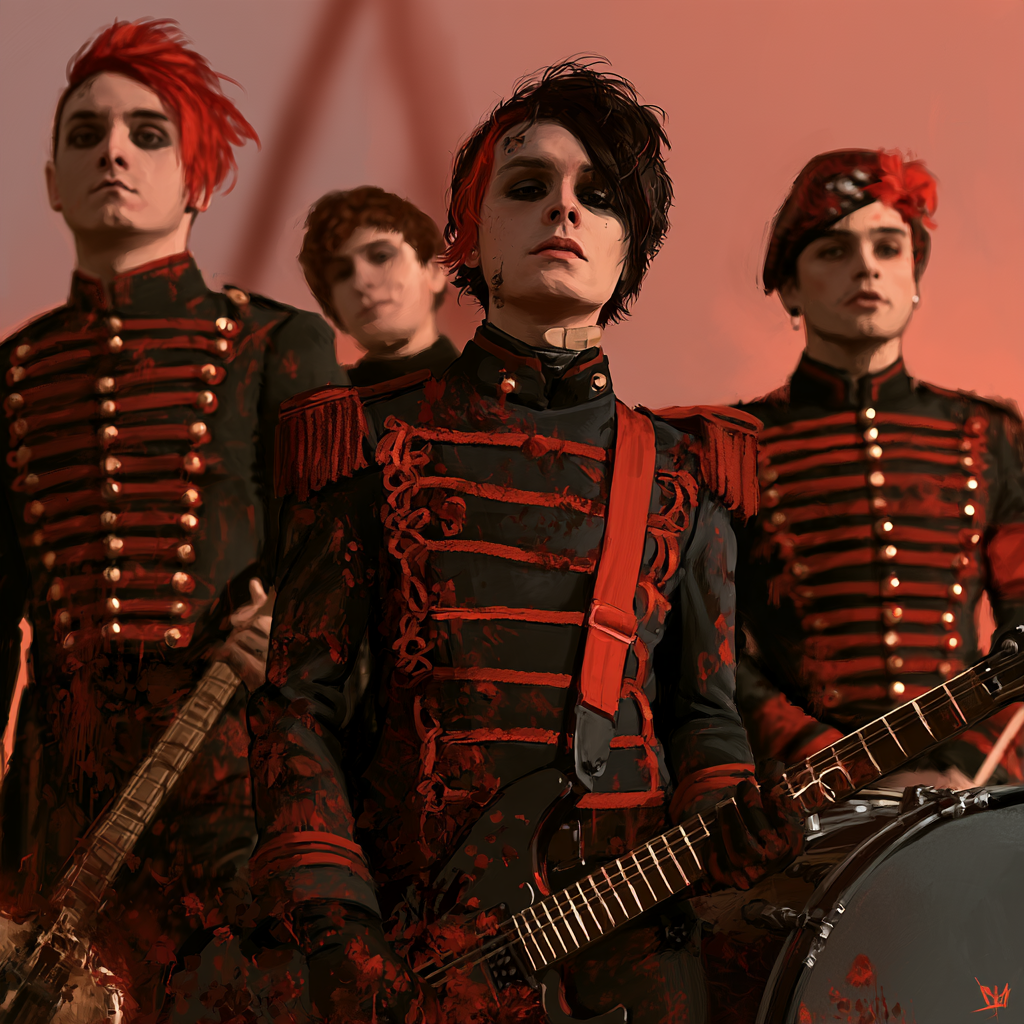
What Is My Chemical Romance’s The Black Parade About? The Full Story Explained
My Chemical Romance’s The Black Parade tells the story of a dying cancer patient confronting death, remembering his life and ultimately finding a reason to keep going.
The central character is known as The Patient.
As he approaches death, he experiences an extraordinary vision.
Death appears to him as a marching parade because one of his strongest childhood memories involves his father taking him to see a parade.
That becomes the foundation of the album’s fictional world.
The songs explore mortality, regret, love, fear and the possibility of redemption.
Released on 23 October 2006, The Black Parade has become one of the most recognisable rock albums of the twenty-first century.
And its story is attracting another generation.
Following its 20th-anniversary reissue in October 2026, the album has reached No. 1 in both Britain and America for the first time.
Is The Black Parade a concept album?
Yes.
A concept album is a collection of songs connected through a central story, character or theme.
Rather than functioning only as separate recordings, the songs contribute to a larger musical experience.
The Black Parade is frequently described as a rock opera.
It has a central character.
A fictional environment.
Recurring emotional themes.
And a dramatic progression.
However, not every song needs to represent one literal event in chronological order.
Some explore The Patient’s experiences directly.
Others develop the album’s broader ideas about mortality, identity and society.
Who is The Patient?
A fictional character dying of cancer.
Gerard Way has explained that The Patient provides a central perspective for the album.
The audience experiences his journey through different musical and emotional scenes.
But The Patient isn’t intended to represent one particular real person.
His experiences create a framework through which listeners can explore universal fears.
What happens when life ends?
What do people regret?
What remains important?
And can somebody find hope while confronting death?
Those questions form the emotional centre of the album.
Why does death appear as a parade?
Because of a childhood memory.
Way imagined that death might approach a person through an image they remember powerfully from childhood.
For The Patient, that image is a marching band.
His father once took him to see a parade.
That memory becomes transformed into something much stranger.
A ceremonial procession associated with death.
The idea is simultaneously beautiful and frightening.
A parade usually suggests celebration.
Here, it accompanies the possibility of dying.
That contrast gives the album much of its visual identity.
What happens at the beginning?
The opening tracks establish The Patient’s situation.
“The End.” creates an atmosphere of theatrical introduction.
The listener enters the fictional world almost as though attending a performance.
“Dead!” develops the confrontation with mortality through energetic rock music.
The contrast is deliberately uncomfortable.
The subject is death.
But the music can sound almost celebratory.
That approach continues throughout the album.
My Chemical Romance frequently uses enormous melodies to communicate extremely difficult emotions.
What does “Welcome to the Black Parade” mean?
Remembering the people who shaped your life and finding strength to continue.
The title track introduces the parade most directly.
The Patient remembers his father and experiences death through that childhood image.
But the song expands beyond one fictional character.
It explores legacy, identity and perseverance.
The arrangement begins with a relatively restrained piano introduction.
Then it grows into an enormous rock anthem.
That musical progression helps explain why the recording became so culturally important.
The listener moves from vulnerability towards collective strength.
What is the meaning of “Cancer”?
It’s one of the album’s most direct songs.
Gerard Way deliberately avoided making every part of the recording metaphorical.
The song confronts the physical and emotional consequences of serious illness.
The Patient recognises what his condition means for himself and the people around him.
The arrangement is comparatively restrained.
That makes the words particularly affecting.
Way has explained that he wanted the recording to feel emotionally brutal rather than disguising the experience behind elaborate imagery.
It provides an important contrast with the album’s larger theatrical moments.
What happens in “Mama”?
The song introduces themes of guilt, family conflict and war.
Its musical presentation is almost cabaret-like.
The arrangement is theatrical and deliberately chaotic.
Liza Minnelli contributes guest vocals.
That was an unusual collaboration for a rock band associated with emo and alternative music.
The recording helps establish The Black Parade as something broader than conventional guitar rock.
It incorporates characters and musical traditions associated with theatrical storytelling.
Is “Teenagers” part of The Patient’s story?
Not as directly as most of the album.
“Teenagers” explores society’s fear of young people.
Its musical identity is also different.
The recording has a relatively straightforward glam-rock rhythm.
It is more playful than many of the surrounding songs.
The track demonstrates how the album’s broader themes can exist alongside the central fictional narrative.
The Patient provides the framework.
But My Chemical Romance also uses the album to explore anxiety, social expectations and growing up.
What happens at the end of The Black Parade?
The album’s emotional resolution arrives through “Famous Last Words”.
The song becomes an expression of determination.
Rather than simply surrendering to fear, the narrator finds a reason to continue.
Gerard Way has described the broader story as involving The Patient ultimately choosing life.
But the precise literal interpretation of every moment remains open.
That distinction is important.
The ending is not necessarily a medical documentary establishing exactly what happens to his illness.
It’s an emotional and symbolic resolution.
Does The Patient survive?
The ending can be interpreted in different ways.
Some listeners understand it literally as The Patient choosing to fight for survival.
Others hear a metaphorical decision to confront death without surrendering emotionally.
Way’s explanation strongly supports the importance of choosing life.
However, the album leaves enough ambiguity for listeners to develop their own interpretations.
That flexibility contributes to its longevity.
The fictional story provides structure.
The emotional message reaches beyond it.
What genre is The Black Parade?
Emo.
Alternative rock.
Pop punk.
Hard rock.
Glam rock.
The album also draws from classic rock and theatrical rock-opera traditions.
Queen and Pink Floyd are frequently mentioned as influences.
That mixture gave the recording an unusually ambitious musical identity.
It doesn’t sound like thirteen variations on one punk-rock idea.
Some tracks are enormous anthems.
Others are intimate ballads.
Several are deliberately theatrical.
Why is The Black Parade popular again in 2026?
The album celebrated its twentieth anniversary on 23 October 2026.
A new anniversary edition brought renewed attention to its songs and artwork.
The reissue also included additional recordings.
On 30 October, it reached No. 1 on the UK Albums Chart for the first time.
It subsequently topped the Billboard 200 chart dated 7 November, with the achievement reported on 1–3 November.
The US chart result is particularly remarkable.
The original album peaked at No. 2 in 2006.
It took twenty years to reach the top.
What should new listeners hear first?
Begin with the album in its original running order.
Then return to these songs individually:
- Welcome to the Black Parade
- Famous Last Words
- Cancer
- I Don’t Love You
- Mama
- Disenchanted
Afterwards, explore My Chemical Romance’s earlier Three Cheers for Sweet Revenge and later Danger Days.
Those albums reveal different aspects of the band’s musical identity.
What is The Black Parade really about?
Facing mortality and deciding what makes life worth living.
The fictional story follows The Patient as he confronts death through the image of a childhood parade.
But the emotional themes are much broader.
Fear.
Love.
Regret.
Memory.
And resilience.
Twenty years after its release, The Black Parade is finally reaching No. 1 on album charts.
Its cultural success isn’t simply nostalgia.
The questions at the centre of the record remain relevant to every generation.