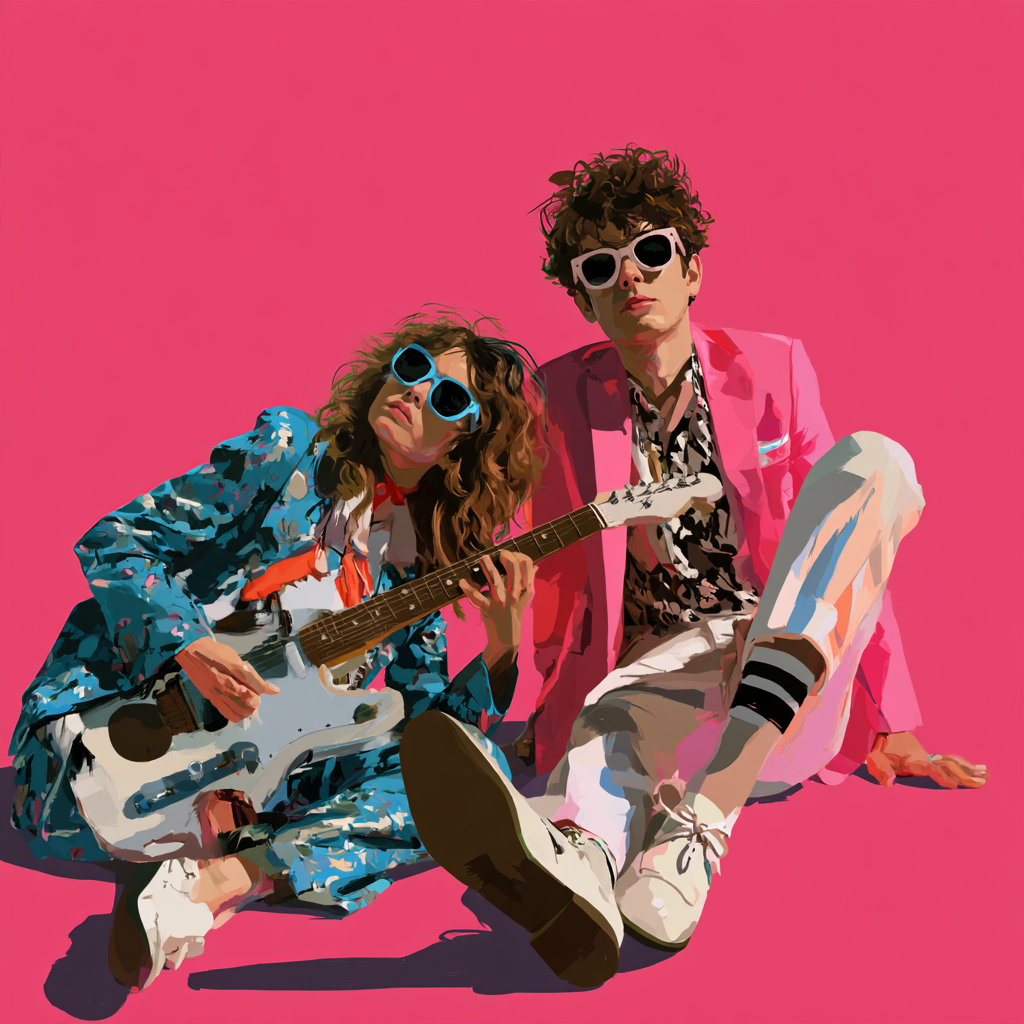
What Does MGMT’s “Kids” Mean? The Childhood and Monster Video Explained
MGMT’s “Kids” is widely interpreted as a song about childhood innocence and the uncertainty of growing up.
The lyrics suggest the experience of moving from a relatively protected world towards adult responsibility.
But the recording’s creation was surprisingly playful.
Andrew VanWyngarden and Ben Goldwasser developed it while they were college students.
Goldwasser originally created the music partly as a joke.
VanWyngarden added the lyrics.
Then the recording gradually became one of the defining alternative-pop hits of the late 2000s.
Its famous music video introduced another strange element.
A frightened toddler surrounded by monsters.
Who are MGMT?
An American musical duo consisting of Andrew VanWyngarden and Ben Goldwasser.
The pair met while studying at Wesleyan University.
Their early music combined psychedelic influences with electronic pop.
They became internationally famous through songs including:
“Time to Pretend”
“Electric Feel”
and “Kids”.
Their debut album Oracular Spectacular helped define the sound of late-2000s alternative electronic music.
When did “Kids” come out?
The song existed in earlier forms before its major commercial release.
It became widely recognised through Oracular Spectacular, released in 2007.
The single subsequently became successful during 2008 and 2009.
The recording reached a much larger audience through radio, festivals and online discovery.
Its electronic hook became immediately recognisable.
For many listeners, it remains the defining MGMT song.
What does “Kids” actually mean?
The loss of childhood innocence.
The narrator appears to address somebody experiencing the world through a young person’s perspective.
The song suggests that childhood involves both wonder and vulnerability.
But growing older introduces responsibilities and difficult choices.
That creates an emotional tension.
The music sounds bright and playful.
The subject is more reflective.
Listeners frequently interpret the recording as a warning about losing the freedom associated with youth.
Is the song really about parents?
Parenthood is one possible interpretation.
The lyrics can be heard as advice given to a child.
But the song doesn’t provide one completely literal narrative.
Its wider emotional territory includes childhood, control and growing independence.
That ambiguity is important.
The recording works because listeners can recognise several different experiences inside it.
A parent may hear one message.
A teenager may hear another.
An adult looking back on childhood may hear something else entirely.
How did MGMT write the song?
The early musical idea began as an experiment.
VanWyngarden recalled that Goldwasser created the instrumental after returning from a college party.
He wanted to write an extremely simple pop progression.
The idea was deliberately playful.
VanWyngarden added the lyrics relatively quickly.
The pair then developed the song through live performances.
At one early show, they even incorporated unusual sound effects and improvised activity involving hockey equipment.
That’s a very different origin from the polished recording listeners now recognise.
Was “Kids” originally intended to be funny?
Partly.
The duo’s early performances frequently involved humour and absurdity.
They were interested in experimenting rather than behaving like conventional pop stars.
But that doesn’t mean the final recording is meaningless.
A playful musical idea can develop into something emotionally effective.
“Kids” combines an almost cartoonish synthesizer melody with lyrics that encourage reflection.
That contradiction is central to its appeal.
What happens in the music video?
A young child encounters terrifying monsters.
The creatures appear in ordinary environments.
The child’s mother seems unaware of what is happening.
The boy becomes increasingly frightened.
The video then moves into more surreal imagery.
Its visual style combines live-action horror effects with animation.
The result is disturbing and deliberately strange.
It’s not a conventional pop video about musicians performing.
Who directed the music video?
Ray Tintori.
He also directed other MGMT videos.
The official “Kids” video appeared in June 2009.
It became particularly discussed because of its unusual treatment of the child character.
The scenes made some viewers uncomfortable.
The production later released behind-the-scenes material showing how parts of the performance were created.
That didn’t remove every concern.
But it helped provide context.
Who plays the mother?
Joanna Newsom.
The American singer-songwriter appears as the child’s mother.
Her character seems largely unaware of the frightening creatures.
That creates an unusual emotional contrast.
The child is experiencing terror.
The adult continues behaving as though everything is normal.
The video can therefore be interpreted as a representation of how differently children and adults experience the world.
What do the monsters represent?
The film doesn’t establish one definitive literal meaning.
But several interpretations are possible.
Childhood fears.
The overwhelming nature of adult society.
Or the experience of facing dangers other people don’t recognise.
The most important visual idea is that the child and parent perceive the environment differently.
That creates an unsettling atmosphere.
The viewer is invited to understand the child’s fear.
Even when the adults inside the video don’t.
Is the opening quote really from Mark Twain?
No.
The famous quotation appearing at the beginning of the video is often misattributed to Mark Twain.
It comes from philosopher Friedrich Nietzsche’s Beyond Good and Evil.
The words concern the danger of becoming what one struggles against.
That idea connects with the video’s monster imagery.
It’s another example of a popular cultural reference developing an incorrect attribution.
Why does the song sound so happy?
Because the synthesizer melody is extremely catchy.
The rhythm is direct.
The production is bright.
And the chorus encourages participation.
That creates a contrast with the more complicated lyrical themes.
The song can work as a festival anthem.
But it also invites listeners to think about childhood and growing up.
That dual identity helped establish its lasting popularity.
What genre is “Kids”?
Synth-pop.
Psychedelic pop.
Indietronica.
Alternative dance.
MGMT emerged during a period when alternative musicians were increasingly combining guitar-band culture with electronic production.
Their music became an important part of that development.
“Kids” is one of the clearest examples.
It’s accessible enough for mainstream pop audiences.
But unusual enough to retain a distinctive alternative identity.
Songs like MGMT’s “Kids”
Try:
- MGMT – Electric Feel
- Passion Pit – Sleepyhead
- Empire of the Sun – Walking on a Dream
- Foster the People – Houdini
- Phoenix – Lisztomania
- M83 – Midnight City
- The Naked and Famous – Young Blood
- CHVRCHES – The Mother We Share
- Cut Copy – Lights & Music
- Two Door Cinema Club – What You Know
These recordings explore different aspects of electronic indie pop and nostalgic late-2000s alternative music.
Why does “Kids” remain popular?
Because the musical hook is extraordinarily memorable.
The recording also belongs to a period of music that younger listeners continue discovering through online culture.
It can sound nostalgic even to somebody who wasn’t old enough to hear it during its original release.
That is a particularly interesting quality.
The song concerns childhood.
Its sound also becomes associated with memories of youth.
The subject and cultural identity reinforce one another.
What does MGMT’s “Kids” really mean?
The transition from childhood innocence towards adult responsibility is its most widely recognised interpretation.
The song began as a playful college experiment.
It became an international alternative-pop hit.
Then its disturbing music video introduced another layer of meaning.
The recording is cheerful, nostalgic and slightly unsettling.
Which is perhaps an appropriate description of growing up.