YouTube Music Adds AI Labels to Songs: Here’s What They Mean
YouTube Music is introducing new AI labels that tell listeners when a song has been created using generative artificial intelligence. The change aims to make it easier to distinguish between music created by human artists and tracks produced with AI tools.
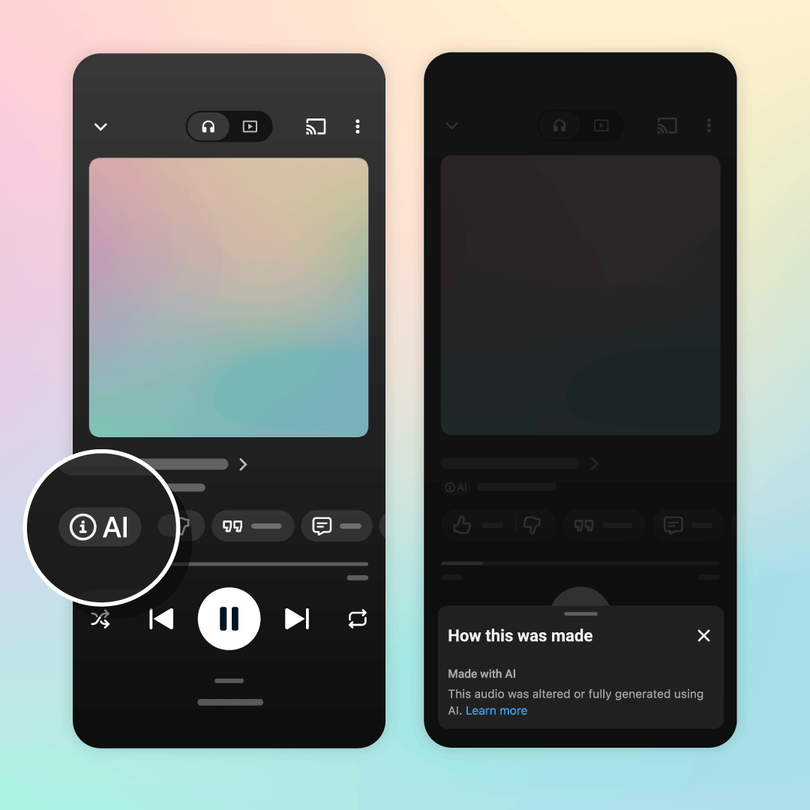
Announced on 14 October 2026, the feature places a visible AI label directly on the Now Playing screen whenever generative AI has played a significant role in creating a track.
The update comes as streaming services face a growing volume of AI-generated music, raising questions about transparency, artist identity and how listeners discover new songs.
With Spotify and Deezer already introducing their own AI transparency measures, YouTube Music is the latest major streaming platform to address how AI-created music should be identified.
How do YouTube Music’s new AI labels work?
The new feature is designed to make identifying AI-generated music straightforward.
When listening to an eligible track, users will see a small AI label beneath the song title, alongside the artist or channel information on the Now Playing screen.
Tapping the label opens a panel titled “How this was made”, explaining that the audio was altered or generated using artificial intelligence.
Rather than requiring listeners to investigate an artist’s background or search for information about a song, YouTube Music is bringing AI disclosures directly into the listening experience.
According to YouTube’s official announcement, the labels are being introduced for music created primarily using generative AI. This includes tracks where artificial intelligence generates both the musical composition and the vocals.
The feature began rolling out on 14 October 2026, with YouTube confirming that the same labels will eventually become available within the main YouTube app.
What counts as AI-generated music on YouTube Music?
Not every song that uses artificial intelligence will necessarily receive the same classification.
AI has become increasingly common in music production, appearing in everything from automated mastering tools to software capable of generating complete songs from text prompts.
YouTube has introduced three classifications that music partners can use when declaring how a track was created:
- Fully Gen AI: The entire piece of content was created using generative AI. This could include a song where the composition, instruments and vocals were all produced using an AI music generator.
- Partly Gen AI: Generative AI contributed to part of the creative process. For example, an artist might use AI to generate a bassline or melody before recording their own vocals and instruments.
- No Gen AI: The content was not created using generative AI. Traditional recording and production techniques, including standard pitch correction and automated mastering, can fall into this category.
Importantly, these classifications are used for content declarations. They do not necessarily mean listeners will see three different badges within YouTube Music.
YouTube’s public-facing announcement focuses on identifying songs where generative AI played a significant role.
This distinction matters because there is a considerable difference between a completely AI-generated song and an otherwise human-created recording that uses a small amount of AI technology.
How does YouTube Music detect AI-generated songs?
YouTube Music isn’t relying entirely on artists to identify their own AI-generated content.
Instead, the company is combining information supplied by music partners with its own AI detection technology.
Music distributors, labels and other partners can declare whether generative AI was used when delivering recordings and associated metadata.
YouTube supports these disclosures through established industry delivery systems, including DDEX metadata and CSV templates. Eligible creators uploading through YouTube Studio can also provide relevant information.
However, YouTube can also use its own detection signals to identify potentially AI-generated recordings.
If a music partner does not provide an AI declaration, YouTube may independently classify the content as fully or partly AI-generated.
This gives the platform a way to identify certain AI-created tracks even when the uploader has not voluntarily disclosed their origins.
There are still limitations. AI detection technology is not infallible, and accurately distinguishing between human creativity and AI assistance becomes more complicated as music production tools evolve.
For artists, providing accurate information about how their music was created could become increasingly important.
Why is YouTube Music introducing AI labels now?
The amount of AI-generated music entering streaming platforms has increased dramatically.
AI music generators can produce complete recordings within minutes, allowing users to create songs without traditional recording equipment, instruments or studio sessions.
This has contributed to a substantial increase in the volume of music being delivered to streaming services.
In July 2026, Deezer reported that it was receiving approximately 90,000 fully AI-generated tracks every day. During peak periods in June, AI-generated music represented more than half of all new tracks uploaded to the platform.
Those figures apply specifically to Deezer, but they illustrate the scale of AI music production.
Interestingly, Deezer also reported that fully AI-generated music accounted for only around 1–3% of total listening activity on its platform.
While AI music represents a growing share of new uploads, that does not necessarily mean listeners are choosing to play it at the same rate.
For streaming services, the challenge is increasingly about managing the volume of new recordings while maintaining listener trust and protecting legitimate artists.
YouTube Music’s AI labels are one approach to that problem.
How do YouTube Music’s AI labels compare with Spotify and Deezer?
Streaming platforms are taking different approaches to AI-generated music.
Spotify has introduced AI Credits, allowing listeners to see information about how artificial intelligence contributed to a recording. It has also introduced AI Persona badges to identify artist profiles representing AI-generated identities rather than real people.
These measures are intended to distinguish genuine artist identities from synthetic performers and provide greater transparency about music creation.
Deezer has taken a more restrictive approach.
Alongside labelling fully AI-generated tracks, Deezer excludes detected AI-generated music from editorial playlists and algorithmic recommendations. It also takes action against fraudulent streaming activity involving AI-generated recordings.
YouTube Music’s new system currently focuses primarily on disclosure.
The platform has not announced a blanket ban on AI-generated songs as part of this update. Instead, the aim is to give listeners clearer information about the music they encounter.
These differences highlight a growing question for the music industry: should AI-generated music simply be identified, or should streaming platforms also change how it is recommended and monetised?
There is not yet a universal approach.
What do YouTube Music’s AI labels mean for artists?
For musicians and producers, the introduction of AI labels is another indication that transparency around music creation is becoming an important part of digital distribution.
Artists experimenting with generative AI should understand the difference between using AI as a creative tool and generating an entire recording artificially.
For example, using conventional vocal pitch correction or automated mastering does not automatically mean a track should be classified as generative AI.
However, generating vocals, melodies, instrumentals or other creative elements using generative models may require disclosure.
Artists should also remember that declaring AI involvement does not resolve questions about copyright ownership, licensing or permission to imitate another performer’s voice.
These remain separate considerations when distributing music commercially.
As more streaming platforms introduce AI metadata requirements, accurate disclosure is likely to become an increasingly important part of preparing music for release.
Can you turn off AI-generated music on YouTube Music?
The new YouTube Music feature is a transparency tool rather than an AI music filter.
As of the October 2026 announcement, YouTube has not introduced a dedicated setting allowing listeners to remove all AI-generated tracks from their recommendations or search results.
Instead, users can identify labelled tracks and decide whether they want to continue listening.
This differs from services such as Deezer, which already restrict the recommendation of detected AI-generated music.
YouTube could potentially introduce additional listener controls in the future, although it has not confirmed plans to do so.
For now, the main change is that listeners will have more information about how certain songs were made.
Does the absence of an AI label mean a song was made by a human?
Not necessarily.
YouTube Music’s labelling system is being rolled out gradually, and identifying AI-generated music depends on both disclosure information and the platform’s detection capabilities.
A track without an AI label should not automatically be considered entirely human-created.
Some recordings may not have been classified yet, while others may contain forms of AI assistance that do not meet YouTube’s threshold for displaying a label.
As the system develops, its effectiveness will depend on accurate information from music partners and the reliability of AI detection technology.
What happens next for AI-generated music?
AI-generated music is becoming a permanent part of the wider streaming landscape.
The technology is increasingly accessible, and the distinction between traditional music production and AI-assisted creation is becoming harder to define.
For streaming platforms, simply identifying entirely synthetic recordings may be the easiest starting point.
The more difficult challenge is determining how to categorise music that combines human creativity with generative AI.
A song featuring an AI-generated instrumental but original human vocals is fundamentally different from a recording produced entirely from a text prompt. Treating both identically could overlook meaningful differences in how music is created.
YouTube Music’s new labelling system represents another step towards making those distinctions visible.
It also reflects a broader shift across the music industry, where artists, distributors and streaming platforms are increasingly expected to explain how AI has contributed to the creative process.
For listeners, the biggest benefit is straightforward: greater transparency about the music they choose to hear.
As AI-generated tracks become more common, knowing whether a song was made by a human artist, an AI model or a combination of both could become an increasingly important part of the listening experience.
And YouTube Music’s new AI labels suggest that this information is beginning to become a standard feature of music streaming.