What Is a Ghazal? A Beginner’s Guide to Ghazal Music
If you’ve ever heard a slow Indian song built around poetry, longing, love and an expressive singer, there is a chance you were listening to a ghazal.
Ghazal music has been part of South Asian culture for centuries and remains one of the region’s most distinctive musical traditions.
But what exactly is a ghazal?
What does ghazal mean?
A ghazal is fundamentally a form of poetry.
Rather than originating as a specific musical genre, the ghazal developed as a poetic structure that could later be sung.
It has deep roots in Persian and Arabic literary traditions and became enormously influential across South Asia, particularly in Urdu poetry.
Musicians eventually developed styles of singing that allowed the words to become the centre of the performance.
That is what most listeners today mean when they refer to ghazal music.
What is ghazal music about?
Love is probably the subject most closely associated with ghazals.
But it is rarely simple romantic love.
Ghazals frequently explore:
- unrequited love
- separation
- desire
- heartbreak
- longing
- beauty
- loss
- spirituality
- mortality
The lyrics often leave room for several interpretations.
A verse that sounds like it describes longing for another person might simultaneously describe spiritual longing or a wider sense of loss.
That ambiguity is one reason ghazal poetry has remained powerful for so long.
What does a ghazal sound like?
There isn’t one fixed sound.
However, ghazal music is generally far more focused on vocals and poetry than heavy production.
You may hear instruments including:
- harmonium
- tabla
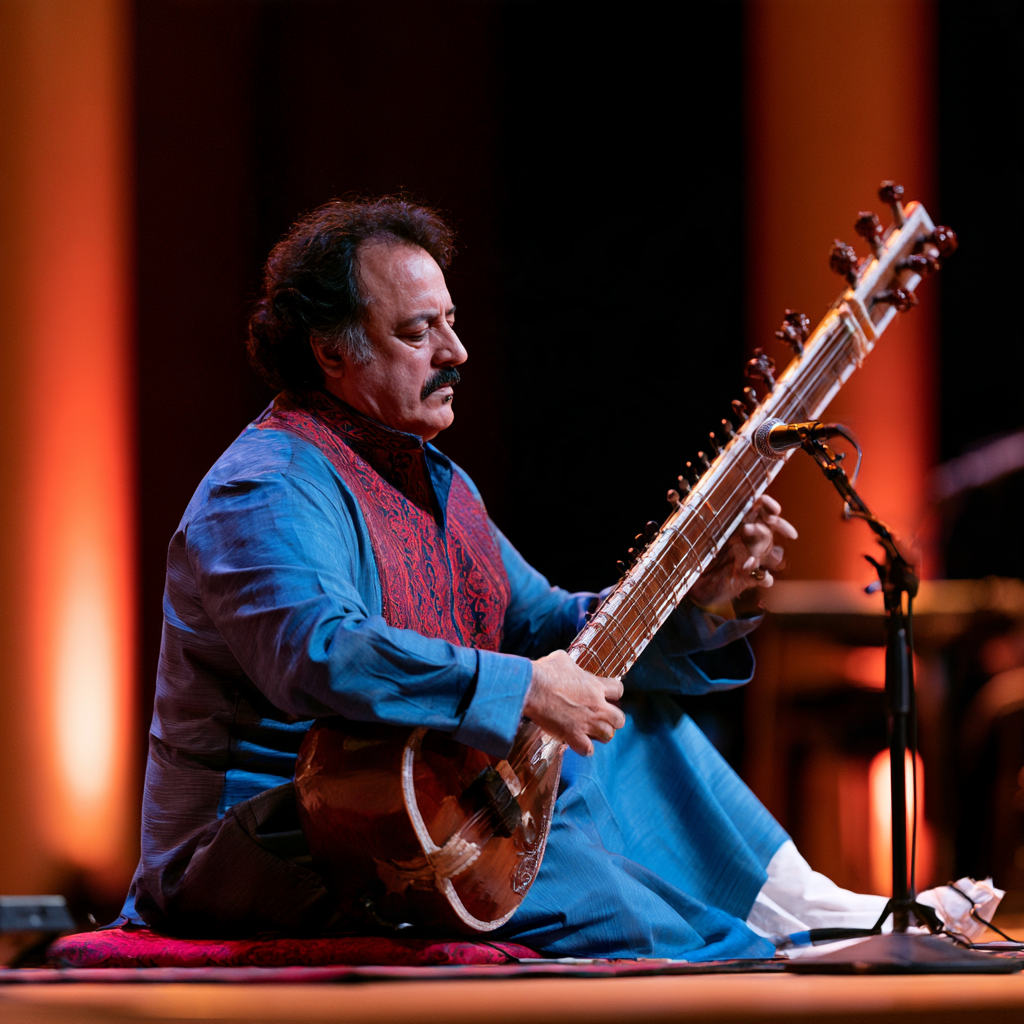
- sitar
- sarangi
- flute
- violin
Modern ghazal recordings sometimes add keyboards, guitars, orchestral arrangements and contemporary studio production.
The music generally leaves plenty of space around the singer.
That matters because the words are the main event.
Why do ghazal singers stretch words and phrases?
Expression is central to ghazal performance.
A singer may slow down a phrase, repeat part of a line or decorate individual notes.
The purpose isn’t simply to demonstrate vocal ability.
It gives listeners time to absorb the poetry.
A powerful ghazal singer can make the same line feel different when it is repeated because the emotional emphasis changes.
That relationship between poetry and improvisation is a major part of the appeal.
Is ghazal Indian classical music?
Not exactly.
India has two major classical traditions: Hindustani music, associated mainly with northern India, and Carnatic music, associated primarily with southern India. India’s Ministry of Culture recognises these as the country’s two principal classical systems.
Ghazal music is normally described as semi-classical rather than purely classical.
Performers may use techniques influenced by Hindustani classical music, but ghazals tend to prioritise the poetry and emotional interpretation rather than the longer exploration of a raga associated with classical performance.
Who are some famous ghazal singers?
For listeners discovering ghazals for the first time, several names appear again and again.
Jagjit Singh
Jagjit Singh became one of the most widely recognised ghazal singers in modern Indian music.
His relatively accessible arrangements helped bring ghazals to a much larger audience.
Chitra Singh
Chitra Singh frequently performed and recorded alongside Jagjit Singh and became an important ghazal vocalist in her own right.
Mehdi Hassan
Pakistani singer Mehdi Hassan is widely associated with the development and popularity of modern ghazal singing across South Asia.
His influence extends far beyond Pakistan.
Ghulam Ali
Another hugely influential Pakistani ghazal singer, Ghulam Ali became popular throughout India and internationally.
Pankaj Udhas
Pankaj Udhas helped bring ghazal music into Indian popular culture through recordings, concerts and appearances connected with cinema.
Are ghazals always in Urdu?
No.
Urdu is strongly associated with the ghazal tradition, but ghazals have been written and performed in multiple languages.
The poetic form travelled across cultures and languages over centuries.
That adaptability is one reason it has survived.
What’s the difference between a ghazal and a Bollywood song?
They can overlap.
Bollywood films have included songs influenced heavily by ghazal music, and famous ghazal singers have recorded music for films.
But a Bollywood song is defined primarily by being connected to a Hindi-language film.
A ghazal is defined by its poetic form and musical tradition.
A ghazal therefore doesn’t need any connection to cinema.
Why are ghazals worth listening to today?
Modern music often competes for attention immediately.
Ghazals do almost the opposite.
They reward concentration.
A song may not reveal everything during the first thirty seconds.
Instead, the meaning becomes clearer as you listen to the words, vocal expression and relationship between poetry and melody.
That makes ghazals particularly suited to quiet listening.
Headphones help.
Translations can help even more if you don’t understand the language.
Once you understand what is being said, tiny changes in a singer’s delivery can become incredibly powerful.
Where should a beginner start?
Search for playlists built around Jagjit Singh, Mehdi Hassan, Ghulam Ali and Pankaj Udhas.
Listen to several singers rather than just one.
You will quickly hear how differently performers approach the same general tradition.
Then find translations of the lyrics.
Ghazal music isn’t really background music.
The words are the reason the music exists.
And once you start listening to both together, it becomes much easier to understand why the ghazal has survived for centuries.