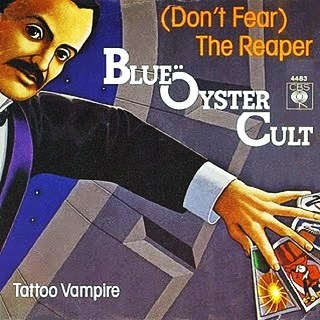
What Does “(Don’t Fear) The Reaper” Actually Mean – and What’s With the Cowbell?
Yes.
“(Don’t Fear) The Reaper” is about death.
But it isn’t telling people to die.
Songwriter Donald “Buck Dharma” Roeser wrote the song while thinking about mortality and the possibility that love could continue beyond death.
Then, decades later, Saturday Night Live turned the recording into the most famous cowbell joke in music history.
Those are two extremely different legacies for one song.
Is “Don’t Fear the Reaper” a suicide song?
No.
That interpretation has followed the recording because death sits at the centre of it.
But Buck Dharma has repeatedly explained that the idea was acceptance of mortality rather than encouraging anybody to accelerate it.
Death comes for everyone.
Being terrified of that fact doesn’t prevent it.
The song imagines love existing beyond that boundary.
Why does it mention Romeo and Juliet?
Because they represent lovers connected through death.
That doesn’t mean the song endorses their actions.
The reference is romantic symbolism.
Love becomes larger than an individual lifetime.
Very 1970s.
Very dramatic.
Perfect for a rock song.
Why does it sound creepy?
That guitar.
The repeating riff feels hypnotic rather than aggressive.
Then the vocals arrive almost calmly.
The recording doesn’t sound frightened of death.
It sounds strangely comfortable around it.
That makes it considerably creepier than a singer screaming about the Grim Reaper.
And now the important question: why the cowbell?
There really is cowbell in the recording.
But it wasn’t considered particularly remarkable until 2000.
Then Saturday Night Live happened.
Will Ferrell and Christopher Walken appeared in a sketch parodying the recording session.
Ferrell played fictional cowbell player Gene Frenkle.
Walken played producer Bruce Dickinson.
The producer demands increasingly excessive cowbell.
The result became one of SNL’s most famous sketches.
Was Gene Frenkle a real member of Blue Öyster Cult?
No.
Completely fictional.
This is important because the sketch became so culturally powerful that people started assuming Gene Frenkle must have existed.
He didn’t.
There wasn’t a legendary forgotten cowbell player desperately demanding recognition.
Comedy created him.
Did Blue Öyster Cult like the sketch?
Generally, yes.
Buck Dharma has said he found it funny.
Although he also noted that the sketch temporarily damaged the song’s creepy atmosphere because audiences started waiting for the cowbell.
Imagine writing a serious meditation on mortality.
Then 24 years later Will Ferrell arrives.
Now everybody shouts “more cowbell”.
Popular culture doesn’t ask permission.
What genre is “Don’t Fear the Reaper”?
Hard rock.
Classic rock.
Psychedelic rock elements.
Blue Öyster Cult could be considerably stranger than conventional arena rock, and “Reaper” captures that beautifully.
It is catchy enough for radio.
Odd enough to feel unsettling.
Where have I heard it?
Everywhere.
Films.
TV.
Horror.
Games.
The song’s title makes it extremely attractive to directors whenever death appears.
It has also become permanently attached to the SNL sketch.
Stephen King even cited the song as an inspiration connected with The Stand.
Songs like “Don’t Fear the Reaper”
Try:
Blue Öyster Cult – Burnin’ for You
Fleetwood Mac – Rhiannon
Eagles – Witchy Woman
Black Sabbath – Planet Caravan
The Doors – Riders on the Storm
Donovan – Season of the Witch
Electric Light Orchestra – Evil Woman
Steely Dan – Do It Again
Jefferson Airplane – White Rabbit
Cliff Richard – Devil Woman
What does “Don’t Fear the Reaper” really mean?
Death is unavoidable.
Love makes mortality less frightening.
That’s the serious answer.
The internet’s answer is:
cowbell.
Both are now correct.