Suno Studio 2.0 Launches With MIDI Support, AI Chat and Advanced Stem Separation
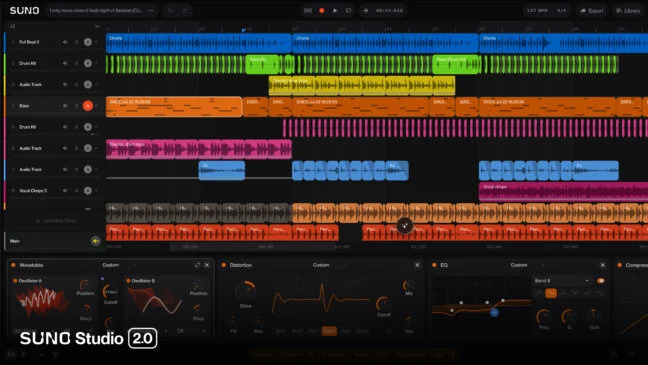
Suno has launched Studio 2.0, a major update to its browser-based AI music production platform, adding MIDI support, an AI-powered chat assistant, advanced stem separation, new audio effects and automation tools.
The update represents another significant step in Suno’s push beyond simple AI song generation and towards becoming a more complete music production platform.
Suno Studio was originally launched as a browser-based digital audio workstation (DAW), allowing users to generate, arrange and edit music within the Suno ecosystem. With Studio 2.0, the platform is moving closer to the workflows traditionally associated with professional DAWs such as Ableton Live, Logic Pro and FL Studio.
Suno Studio 2.0 Adds Full MIDI Support
One of the biggest additions to Studio 2.0 is MIDI support.
Users can now import, record and edit MIDI directly within the Studio timeline. MIDI parts can be created using an external MIDI controller or even a standard computer keyboard through Suno’s new Musical Typing feature.
Studio 2.0 also includes a built-in wavetable synthesizer for creating basses, leads, pads, chords and other sounds.
More interestingly, MIDI can also interact directly with Suno’s generative AI technology. MIDI clips can be used to guide new audio generations, effectively allowing musicians to create a melody or musical idea themselves before asking Suno to generate audio around it.
This potentially gives artists and producers much more control over AI-generated music than relying entirely on text prompts.
Suno Introduces an AI Chat Assistant for Music Production
Studio 2.0 also introduces a new AI chat bar, currently in beta.
Instead of controlling the platform entirely through traditional menus, users can ask the assistant to perform music production tasks conversationally.
Suno says the assistant can generate instruments and vocals, help with music production tasks and even create custom plugins and synthesizer presets.
For example, a producer can describe the type of audio effect they want and Studio can generate a working plugin that can then be used within the project.
Those custom plugins can subsequently be adjusted through further conversations with the AI assistant.
This could become one of the more interesting parts of Suno Studio.
Rather than AI simply generating the finished song, Suno appears to be positioning AI as an active production assistant sitting alongside the musician.
Advanced Stem Separation Arrives in Suno Studio
Suno has also upgraded its stem separation technology.
Users can bring audio into Studio and separate a finished recording into individual components, allowing elements of a track to be rearranged, edited or used as part of a new production.
Studio 2.0 includes both standard and advanced stem separation options within the editing interface.
Stem separation has become an increasingly important feature across modern music production platforms as AI makes it easier to isolate vocals, drums, bass and other elements from existing recordings.
New Audio Effects and Automation Tools
Studio 2.0 also introduces a much broader range of traditional music production tools.
Users can now apply effects including:
- Compression
- Convolution
- Delay
- Distortion
- EQ
- Gate
- Reverb
Automation has also been added, allowing producers to change volume, panning and plugin parameters over time.
Studio also supports MIDI Learn, meaning compatible hardware controllers can be mapped to parameters within the software.
One notable limitation is that Suno Studio does not currently support VST or Audio Units plugins, meaning producers cannot yet bring their normal third-party plugin collections directly into the platform.
Suno Studio Exports Will Have No Download Limit
The Studio update arrives just as Suno prepares to introduce new limits on how many songs users can download from its main AI music generation service.
Those restrictions are due to begin on September 3, 2026, with different limits applying across Suno’s Free, Pro and Premier plans.
However, Suno says exports from Studio will remain unlimited for Premier subscribers.
Studio users can export high-quality 32-bit/48kHz multitracks and stems without download limits, allowing producers to move their work into other production environments if required.
Studio 2.0 is currently available to Suno Premier subscribers.
Suno Is Becoming More Than an AI Music Generator
Perhaps the most important aspect of Studio 2.0 isn’t any individual feature.
It is the direction Suno is taking.
AI music platforms initially focused heavily on generating complete songs from relatively simple text prompts. Suno Studio increasingly shifts the product towards a hybrid workflow where musicians can play, record, edit, arrange and mix music while using generative AI when they want it.
Adding MIDI, synthesizers, automation, effects, stem separation and AI-powered production tools makes Studio look considerably more like a genuine music production environment.
The bigger question is whether producers eventually begin using AI-native environments like Suno Studio alongside — or potentially instead of — traditional DAWs.
If Suno continues developing Studio at this pace, the battle in AI music may increasingly move beyond who can generate the best song.
It could become a battle over who owns the music production workflow itself.