Quantcast

Archive for: major labels

Major Labels are Abandoning Traditional A&R

There was a very interesting article on DigitalMusicNews that I just had to let everyone read.

The following is a guest post by Ritch Esra of the Music Business Registry, who attempts to answer the question: whatever happened to traditional A&R?

“My take is that the traditional A&R process as we knew it is dying for a few reasons;

(1) The major labels are hiring fewer and fewer A&R executives because the volume of acts - and more importantly the types of acts – that they sign has dramatically decreased.

(2) The A&R process used to be about the discovery, signing & nurturing (ie, making the album) of the act.  Today, A&R executives are not looking for talent per se.  They are looking for an ongoing business.

(3) An artist that has developed some kind of traction and awareness on their own is what I’m talking about.  Today, acts need to be “developed” or at least developing in a business sense for any label to have even the slightest amount of interest.  The idea that today’s A&R executives will discover an unknown act / artist and develop that artist is an illusion. They have neither the desire, time or money for that matter in 2011.

And by the way, this last point is about to become profoundly illustrated in the next 60-90 days – as dramatic and sweeping changes happen at Universal and Sony.

(3) This is why from an A&R perspective, only the most generic, ubiquitous type of acts get any attention from labels today.  There is only a certain type of act these days that major labels are willing to sign.

So if you happen to have those specific skills these days – great!  Otherwise, our stats show it all: not one of the 40 A&R people let go last year has found another A&R job.  Not one!”

  • A&R executives hired by labels, 2010: 25

(of those, 40 exited without subsequent rehire)

  • A&R executives hired by labels, 2009: 58 (w/ 51 exiting)
  • A&R executives hired by labels, 2008: 80 (w/ 64 exiting)
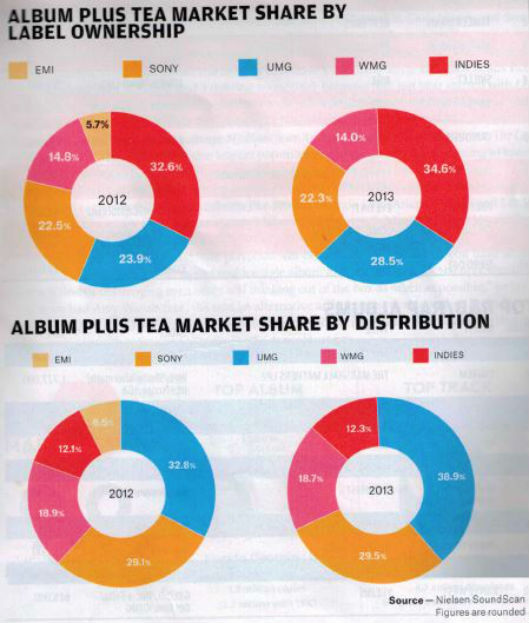
  • 2010 Quarter 1 Marketshare for Major Music Labels

    Record industry trade Hits Daily Double has gone through the numbers for Q1 of 2010 to see how the major label marketshare is shaping up. Sony has been gaining some great marketshare from Universal, Im guessing that is mainly because of the huge success of Simon Cowell’s record label. Hits has more analysis.  Free registration is required.

    2010 major label marketshare

    Death of the CD?

    Flogging a dead horse?Paul Resnikoff of  Digital Music News today posted this article on his blog, making the radical suggestion that the majors should seriously consider ditching CD’s as a major sales format, and concentrating on digital, thereby divesting themselves of the whole distribution network necessary to sell them. If they just stopped pressing CD’s all the shops, warehouses, trucks, box packers and smiling counter staff would suddenly become obsolete, bad for the truck drivers, and bad for the record companies in the short term, as they’d lose that income stream – but would such a ruthless move be good for the majors in the long run?

    Looking at the storage formats that have waxed and waned over the history of recorded music, the eventual demise of compact discs seems inevitable; from wax cylinders to minidiscs, everything is replaced by a more convenient alternative. Even though this shift from physical to digital is a big one for the human mind to wrap itself around “But where is my actual music? My computer looks just the same as before” This will hold true of the CD just as it did of the horse-drawn carriage; people will stand around scratching their heads for a while and bemoaning the loss of work for farriers and the fall in the price of oats, but eventually we’ll all get used to having our music stored in a cufflink, or beamed into our brains from our mobile phone or whatever else is in store for us, and the CD will become what vinyl is now – a charming reminder of a less convenient, more physical age. Those companies that accept the decline of physical media and look towards maximising the advantages of digital music distribution (minescule distribution costs, instant worldwide availability, no cumbersome physical infrastructure etc. etc.) will be the ones that dominate the new era, and those that keep clinging to the old technology, will lose out in the future, no matter how strongly entrenched the current hardware seems.

    YouTube Baulks at PRS Rates

    youtube_logo

    VS

    prsformusiclogo1

    In what may prove a revolutionary move, YouTube is refusing to pay the increased licensing fee that the MCPS/PRS alliance has demanded for the right to stream music videos for signed artists in the UK.

    Music licensing can be a knotty problem; while most of the copyrights necessary to permit streaming for tracks belong to the record labels that have direct agreements with YouTube, there are other authorship rights that artists and songwriters can retain, or assign to be protected by the MCPS/PRS, which will attempt to collect revenues on their behalf whenever a song is played.

    The previous licence that YouTube had negotiated with the PRS has expired, and the asking price for a new one is larger by many multiples. On top of this, the PRS has declined to specify what rights and what songs are actually covered by the agreement they’re offering to sell YT. In effect the PRS is demanding to be paid for a mystery box, which may or may not contain anything that YouTube actually needs.

    The PRS have a different take on this, of course. They claim to be outraged on behalf of both artists and consumers that Google/YouTube have taken the drastic step of shutting down official access to music videos in the UK.  Personally I find this quite unbelievable, since all they would need to do to permit the consumers to see these videos is set out exactly what rights they’re selling, and agree a reasonable price, rather than pulling a number out of the air, for an undisclosed package of rights and expecting it to be paid without question.

    As we ponder all this, let’s think back to Jan 2008, when the MCPS/PRS forced Pandora, an online radio site that is nothing to do with Microsoft, to shut down UK operation. Pandora said they couldn’t operate sustainably if they had to pay the fees demanded of them. Do these sound like instances of the PRS looking after the rights of consumers and the artists they represent, or is it more like the stifling of new technologies and ways of consuming music, and why can’t the PRS specify what they’re actually bringing to the table in a deal this important?

    What is sure is that while the content that’s being wrangled over is unavailable through more legitimate channels, the consumers will be looking elsewhere for their entertainment, to sites like the Pirate Bay to direct them to torrents that generate zero revenue for the artists concerned.

    A lot of people are losing revenue and losing their jobs as the whole geography of the music industry, and the entertainment industry at large is gripped in the seismic change the internet is facilitating, and you can’t blame groups like the PRS and the big labels for trying to retain control. This said, perhaps stifling new channels like YouTube and Pandora is cutting off their nose to spite their face, and they would be better off supporting innovation, and creating new ways to generate revenue and help people enjoy the great music that their artists are creating.youtubelogo